Key Takeaway
Heavy-duty truck transmissions come in three types: manual, fully automatic, and automated manual (AMT). An AMT is a manual-style gearbox with a real dry clutch controlled electronically, not a torque converter like a true automatic. Most new Class 8 linehaul trucks are now AMTs, with manufacturer take-rates at 75 to 80 percent or higher, driven by fuel savings and two-pedal ease.
A heavy duty truck runs one of three transmission types. A manual transmission uses a driver-operated clutch pedal and a shift lever, and the driver picks every gear. A fully automatic shifts on its own using a fluid torque converter instead of a dry clutch. An automated manual transmission (AMT) is a manual-style gearbox where the clutch engagement and gear changes are handled by electronic control, sensors, and often the air system. Here’s the part that trips people up: an AMT is not the same thing as an automatic transmission. They look similar from the driver’s seat, but they’re built differently, they fail differently, and they get diagnosed differently.
This is written for owner-operators, fleet managers, and drivers who are either speccing a truck or trying to understand a shifting problem before they call a shop. Keep one idea in mind as you read: the label on the transmission doesn’t fix the truck. The duty cycle and the diagnosis do.
Why Transmission Type Matters in Heavy Duty Trucks
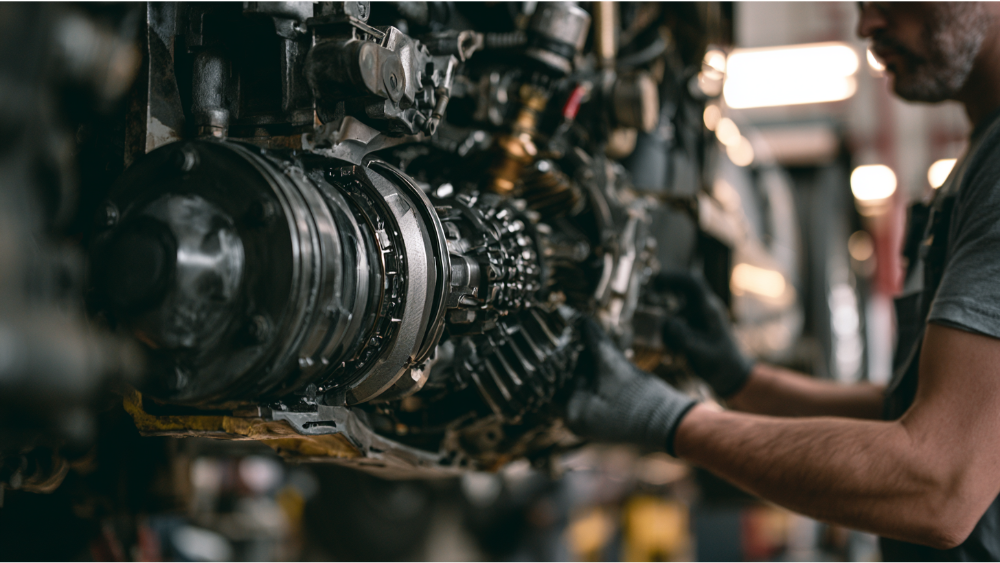
Transmission type isn’t a spec-sheet detail you check once and forget. It drives downtime risk, fuel control, and how the truck gets diagnosed when it starts acting up. It also decides who can legally drive the unit.
Drivers who can run a manual gearbox are harder to find every year. Driver shortages across the trucking industry make this worse, because a large share of new drivers train and test on two-pedal trucks, so a fleet that runs a traditional manual transmission is fishing in a smaller pool. That’s a hiring and coverage problem, not just a driving one.
Fuel efficiency, maintenance planning, and diagnostic accuracy all shift with the transmission type too. An AMT that won’t engage might have nothing wrong with its gears. A manual that grinds might be a clutch, linkage, or a driver-habit issue. When the truck is down, every wrong guess costs money. Knowing what you’re working with is the first step to getting it back on the road.
What Is a Manual Heavy Duty Truck Transmission?
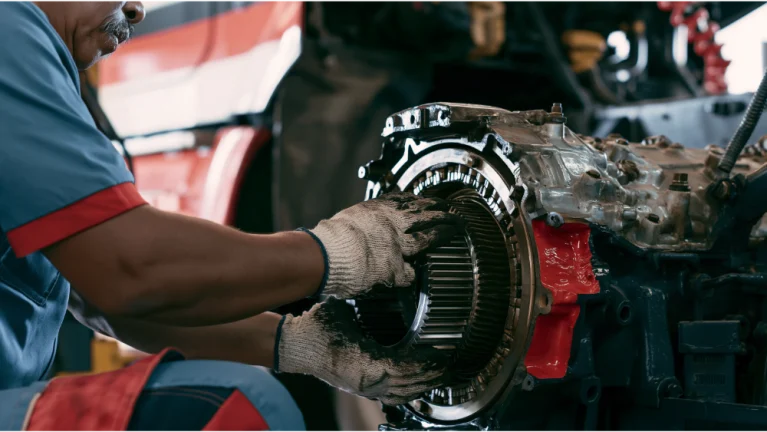
A manual heavy duty transmission puts the driver in full manual control. There’s a clutch pedal, a gear shifter lever, and a mechanical clutch that connects and disconnects the engine from the drivetrain. The driver handles gear selection for the grade, the load, and the road speed, and works the clutch by hand and foot to manually shift gears. Federal CDL rules define a manual simply: a clutch operated by pedal or lever, and a gear-shift mechanism operated by hand or foot. Everything else gets treated as automatic for licensing purposes.
Manual transmission trucks still have a following, especially among heavy-haul operators and drivers who want direct control over engine speed under load. Some older equipment is still on the road too. If a driver knows how to work a manual well, they can hold a gear exactly where they want it on a long grade. Driver preference is real here, and for the right operator a manual gearbox is not a compromise.
The tradeoff is skill. A manual demands driver skill: the ability to float gears, match rpm, and protect the clutch through clean gear changes. Experienced drivers manage this without thinking, but it narrows who you can put in the seat. On the service side, the common concerns are clutch wear, shift linkage, gear and synchronizer issues, transmission fluid condition, and poor shifting habits. A clutch burned up by bad habits is a repair you’ll see again if the habit doesn’t change. Maintenance costs on a manual are usually predictable, but a mistreated clutch pushes them up fast.
What Is a Fully Automatic Heavy Duty Truck Transmission?
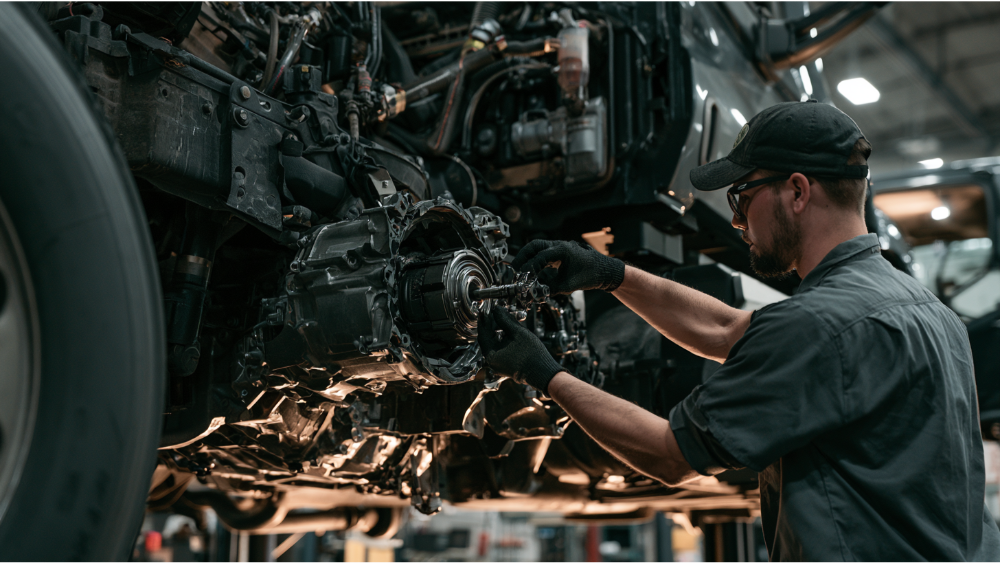
A conventional automatic transmission uses hydraulic torque converters instead of a dry clutch to transfer power. Inside, planetary gear sets and wet clutch packs handle the gear changes with no driver input. There’s no clutch pedal. The driver works two pedals, and power keeps flowing to the wheels even at a crawl. That uninterrupted low-speed delivery is exactly what some jobs need.
True automatics shine in vocational and stop and go traffic work: refuse, utility, local pickup and delivery, concrete, and fire and emergency rigs. Anywhere the truck starts, stops, and starts again all day, the torque converter smooths out what a clutch would otherwise fight.
The Allison 4000 Series is a good concrete example. It handles engines from 380 to 800 horsepower, up to 2,360 lb ft of torque at the input, and runs six or seven forward gears depending on the model. The planetary gears do the work inside. Notice the gear count. Six or seven, against the eleven or twelve you’ll find on a linehaul AMT. That lower count reflects the different job. Service on an automatic leans heavily on transmission fluid spec and the OEM schedule. Allison, for instance, approves specific fluids like TES 668 for its on-highway families, so blanket fluid advice is a mistake. Confirm the model, then match the spec. Wrong fluid in an automatic is a fast path to expensive damage.
What Are Automated Manual Transmissions (AMTs)?
An AMT is where most modern Class 8 trucks land. Under the hood it’s a manual-style gearbox with a real clutch, not a torque converter. The difference is that clutch actuation and every gear change are controlled by a computer, using electronic sensors, actuators, and often the truck’s air system. The driver gets two-pedal operation. The gearbox does the shifting. This is why automated manual transmissions get grouped with automatics even though the hardware underneath is closer to a manual.
Automated manual transmissions (AMTs) dominate linehaul for good reasons. Two-pedal ease cuts driver fatigue over long hours. The transmission control unit optimizes gear selection for fuel economy, often producing better fuel economy than a human can hold, and higher-end systems use terrain and GPS data through predictive cruise control for smarter shift timing: dropping to the optimal gear before a grade instead of after. That kind of automated transmission logic reads engine load and throttle position to pick the right moment, and it is where the real fuel savings live. It also lowers fuel consumption over a full route. Manufacturer-reported take-rates on new over-the-road trucks run high, in the range of 75 percent and up, with some lines exceeding 80 percent. On the OEM side, adoption is even more one-sided. The Volvo I-Shift launched in 2001 and has topped a million units, making up the large majority of new Volvo trucks in recent years. Eaton’s UltraShift dropped the clutch pedal in 2006. The Detroit DT12 arrived around 2013 and now runs 12 forward and 4 reverse speeds, with GCW ratings from 80,000 to 160,000 lb depending on model. The Eaton Cummins Endurant HD comes as a 12-speed overdrive or 11-speed direct drive, rated up to 110,000 lb GCW. An AMT is not a dual clutch transmission, which is a different design more common on passenger cars.
Here’s the operational hook. When an AMT acts up, the problem may live in the air supply, a sensor, the wiring, a voltage issue, the software, or the clutch calibration, not the internal gears. An electronically controlled automated transmission that refuses to shift gears often has healthy gears and a sick sensor. Guessing mechanically on an AMT wastes time.
Manual vs Automatic vs AMT: Quick Comparison
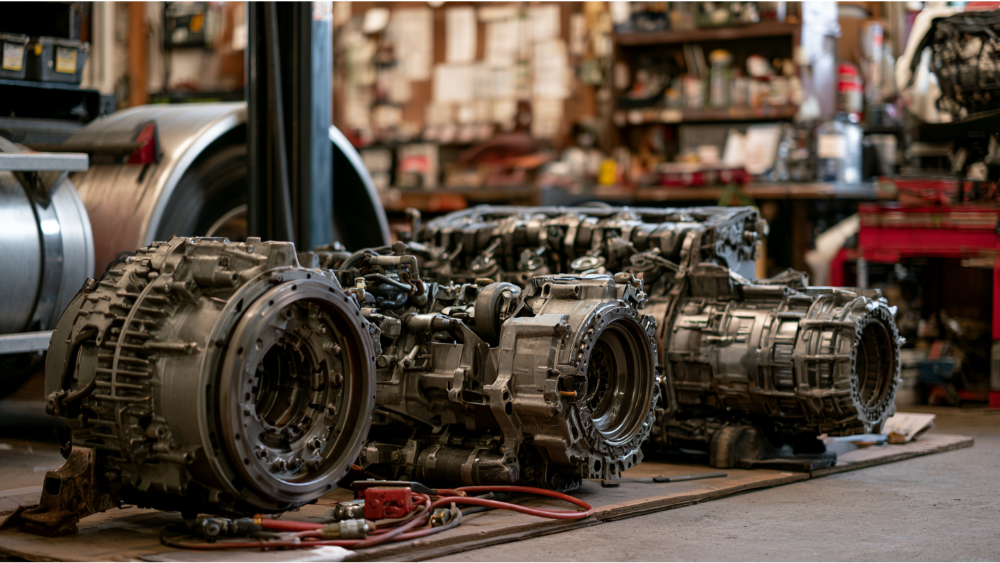
Same job, different machines. This table lines them up so you can see where each one fits at a glance.
| Feature | Manual | Fully Automatic | AMT |
|---|---|---|---|
| Driver controls | Clutch + shifter, driver picks gears | Two pedals, no input | Two pedals, computer shifts |
| Clutch pedal | Yes | No | No |
| Torque converter | No | Yes | No (dry clutch) |
| Typical gear count | 9 to 18 | 6 or 7 | 10 to 12 |
| Best duty cycle | Heavy haul, direct control | Vocational, stop-and-go | Linehaul, regional |
| Maintenance focus | Clutch, linkage, transmission fluid | Fluid spec, cooling | Air system, sensors, software, clutch calibration |
| Diagnostic focus | Mechanical | Fluid, hydraulic, electronic | Air, electronic, software, mechanical |
| CDL implication | No restriction if tested on it | Triggers “E” no-manual restriction | Treated as automatic, triggers “E” |
| Fleet fit | Narrows driver pool | Easy coverage, vocational | Easy coverage, fuel economy |
| Owner-operator concern | Clutch abuse cost | Fluid spec discipline | Correct diagnosis, not gear guessing |
Which Transmission Type Fits Which Truck Job?
The best transmission depends on the job, not on what a driver grew up on. Match it to the duty cycle and the arguments settle themselves.
Linehaul and interstate
AMT. Long hours reward two-pedal operation, and the software squeezes out fuel economy over thousands of highway miles that a manual can’t match consistently. Over a year of linehaul, the fuel efficiency gap between an AMT and a manual adds up to real money on semi trucks running high miles.
Regional haul
AMT. Same logic as linehaul, with the added benefit that any driver can step into the unit without manual experience.
City, pickup and delivery
Fully automatic. Constant starts and stops are where the torque converter earns its keep. No clutch to burn, smooth power off the line, less strain in traffic.
Heavy haul
Split. Some operators still prefer a manual for direct control over gear ratio and engine rpm when they’re loaded heavy and working grades. But automated manual transmissions now spec well past 100,000 lb GCW, and many heavy-haul fleets run them under heavy loads without complaint.
Vocational, utility, and PTO work
Fully automatic. Low-speed control and uninterrupted power delivery suit refuse, concrete, and utility rigs, and automatics handle PTO applications cleanly.
Mixed fleet
Spec for consistency and driver coverage. Running one transmission family across similar units keeps training, parts, and diagnostics predictable, and it keeps any driver eligible for any truck.
Maintenance Differences That Actually Matter
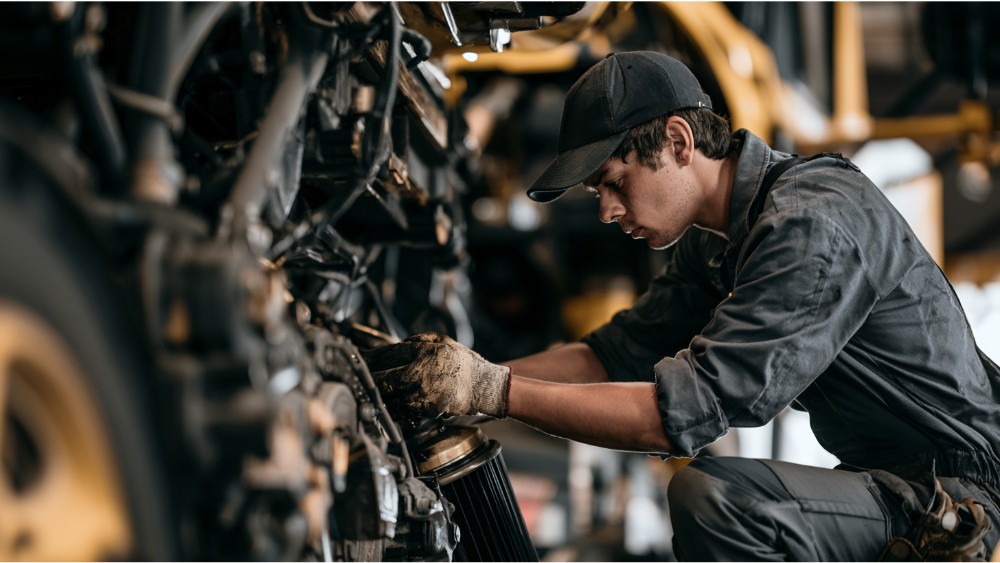
There’s no single service interval for heavy duty trucks. It changes with the model, the fluid spec, the duty cycle, and the GCW. Anyone who quotes you one blanket number is guessing.
Real OEM examples show the spread. The Endurant HD lists an on-highway service interval as long as 750,000 miles or 5 years, but the same transmission in vocational or heavier-duty work drops to around 250,000 miles or 3 years. The Detroit Diesel DT12 transmission fluid intervals run 400,000, 300,000, or 180,000 miles depending on the application. The truck’s job moves the number, sometimes by hundreds of thousands of miles, and that directly shapes your maintenance costs over the life of the unit.
Heat is the biggest enemy of any heavy truck transmission. Overheated transmission fluid breaks down, and that’s when damage to internal driveline components starts. So maintenance isn’t only about swapping fluid on schedule. It’s checking fluid condition, hunting for leaks, and evaluating the cooling system before heat has a chance to cook the gearbox.
AMTs add another layer most articles skip: the air system. The Endurant needs nominal air supply between 99 and 130 psi. Drop out of that range and shift capability degrades or disappears, and the truck may act like the transmission is failing when the real culprit is air. Eaton Cummins recommends servicing the air dryer cartridge at least once a year, because contaminated air can damage the transmission and affect warranty. Beyond air, an automated manual depends on clutch calibration and learned values, plus control-module software that occasionally needs updating. Skip the calibration after a clutch job and the truck will shift rough even with new parts installed. Proper operation depends on getting these learned values right.
The point is simple. Guessing at any of this creates repeat downtime and drives up maintenance costs on trucks that should be earning. Structured Preventive Maintenance PM Service tied to your actual duty cycle catches problems while they’re still cheap to fix.
How Transmission Type Affects Your CDL and Driver Pool
Transmission type has a licensing consequence a lot of operators learn the hard way. If a driver takes the CDL skills test in a truck with an automatic transmission, FMCSA places an “E” no-manual-transmission restriction on the license. And because an AMT is treated as automatic for restriction purposes, testing in an AMT triggers the same “E” code. That driver can’t legally operate a manual transmission.
For fleet managers, this decides who can run which units. If you keep manuals in the fleet, you need drivers whose licenses aren’t restricted, and that pool keeps shrinking. For owner-operators, know this before you test, because the restriction follows the license.
A quick refresher on the thresholds behind all of this. Under FHWA weight classes, Class 6 is 19,501 to 26,000 lb GVWR, Class 7 is 26,001 to 33,000 lb, and Class 8 is over 33,000 lb. On the CDL side, Class A generally covers combinations at 26,001 lb or more when the towed unit tops 10,000 lb, and Class B covers single vehicles at 26,001 lb or more. This is federal, driven by FMCSA, not a state rule.
Warning Signs Your Heavy Duty Transmission Needs Diagnostics

Catch these early and you have options. Ignore them and you’re calling from the shoulder.
- Delayed engagement when you initiate gear selection
- Harsh or clunky gear shift
- Missed gears or the transmission hunting between gears
- Grinding during gear changes
- Clutch slipping under load
- Transmission warning light on the dash
- The truck dropping into limp mode
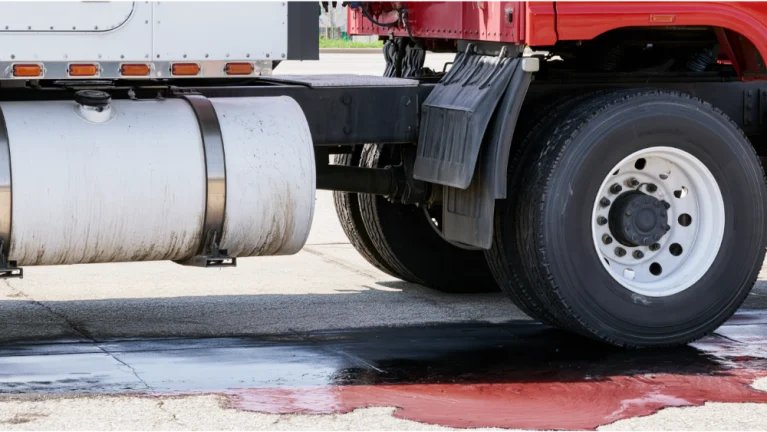
- Fluid leaks or low transmission fluid
- Shift problems tied to air pressure
- Intermittent no-shift or no-engagement that comes and goes
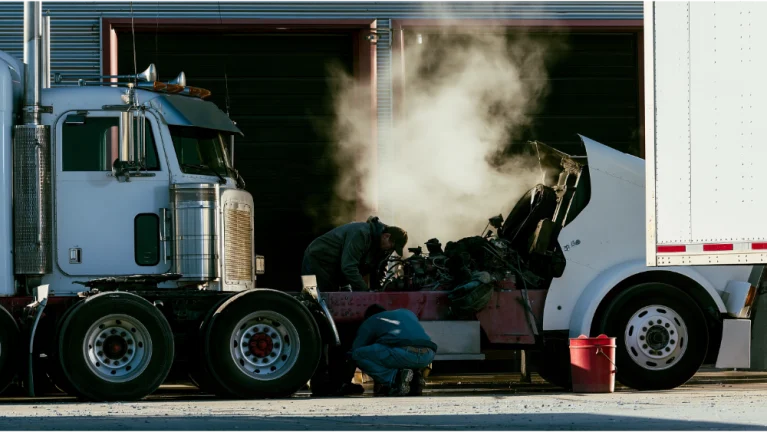
On an AMT especially, don’t assume the gears are gone. Air supply, sensors, wiring, voltage, and software all cause faults that mimic internal failure. That’s why the fix starts with a real diagnosis using proper diagnostic tools, not a teardown. Call when the symptoms start, not after the truck is stuck.
What To Tell the Shop Before They Diagnose It
A good diagnosis moves faster when you hand the shop the right information up front. Before you call, have this ready:
- Truck make and model, and the transmission model if you know it
- Engine and rough mileage or hours
- Any fault codes showing on the dash or ECM
- Load weight at the time of the problem
- Route and duty cycle: linehaul, city, heavy haul, PTO work
- When it happens: cold or hot, loaded, uphill, backing, or in stop-and-go
- Recent service or fluid changes
- Whether it’s a fleet unit with a repeat history
That last one matters. A recurring fault on a fleet truck often points to a root cause the last shop patched over instead of fixing.
How Torpedo Truck Repair Handles Transmission and Clutch Repair

Torpedo Truck Repair was built inside real trucking operations before it opened its bay doors, which is why the shop starts with the diagnosis instead of the guess. For Transmission And Clutch Repair, that means reading the truck properly with OEM diagnostic software, whether the fault lives in the gears, the mechanical linkage, the clutch, or somewhere in an AMT’s air and electronic systems. We service manual, automatic, and automated manual transmissions across the major platforms, from the Volvo I-Shift to the Detroit DT12 and the Eaton Cummins Endurant. When the problem is electrical or sensor-driven, Electrical Diagnostics And Repair finds it instead of throwing parts at it. We also handle related work like engine braking issues that show up alongside shift faults.
You get a full itemized estimate before a single bolt is turned. No surprises, no upsell. The goal is same-day service when possible and getting your truck back on the road, because downtime is the cost that never shows up on the invoice but hits the hardest.
For fleets, Preventive Maintenance PM Service ties transmission and clutch care to your real duty cycle, so intervals match the work instead of a generic chart. That keeps your rigs fuel efficient where they should be and holds maintenance costs down across every unit. Driver satisfaction goes up too, because the trucks shift right and stay working. And if a shift problem strands you along I-5, Hwy 167, or SR-512, 24/7 Emergency Road Service dispatches from the Fife shop across the Seattle-Tacoma freight corridor, within a 50-mile radius.
Certified technicians. Licensed and insured. DOT certified. Call (253) 449-0100 when the symptoms start.
Frequently Asked Questions
Is an AMT the same as an automatic transmission?
No. An AMT is a manual-style gearbox with a real clutch, controlled electronically. A fully automatic uses a torque converter and planetary gears. They drive similarly but fail and diagnose differently.
Do AMT semi trucks have a clutch?
Yes. Automated manual transmissions have a mechanical clutch, but the computer handles clutch engagement automatically using actuators and the air system to automatically shift gears. There’s no clutch pedal for the driver, though many systems offer a manual mode for holding a gear.
Are most new semi trucks manual or automatic?
Most new linehaul semi trucks are AMTs. Manufacturer-reported take-rates on new over-the-road units run around 75 percent and higher, with some lines exceeding 80 percent, driven largely by improved fuel efficiency and driver preference.
Does an automatic transmission CDL restriction matter?
Yes. Testing in an automatic or AMT truck places an FMCSA “E” restriction on the license, meaning the driver can’t legally operate a manual transmission. That limits which units they can run.
Can low air pressure cause AMT shifting problems?
Yes. Automated manual transmissions like the Endurant need air supply in a nominal range around 99 to 130 psi. Fall out of range and shift capability degrades or fails, often mimicking an internal transmission problem when the gears are fine.
Final Takeaway
Choose your transmission by the job, not by habit. Maintain it by duty cycle, not by a generic chart. And when it acts up, diagnose it by system instead of assuming the gears are gone. The label tells you what you have. It doesn’t tell you what’s wrong. Call the moment symptoms start, get an honest estimate in writing, and get the truck back on the road before downtime does the real damage.