Key Takeaway
A transmission leak means lubricant is escaping through a seal, gasket, cooler line, or damaged case, and on a Class 6 through 8 truck it requires immediate diagnosis, not a top-off. Active dripping, falling fluid level, slipping shifts, or high transmission temperature are all reasons to stop now. Driving on a leaking transmission risks internal wear, complete transmission failure, and a DOT out-of-service order.
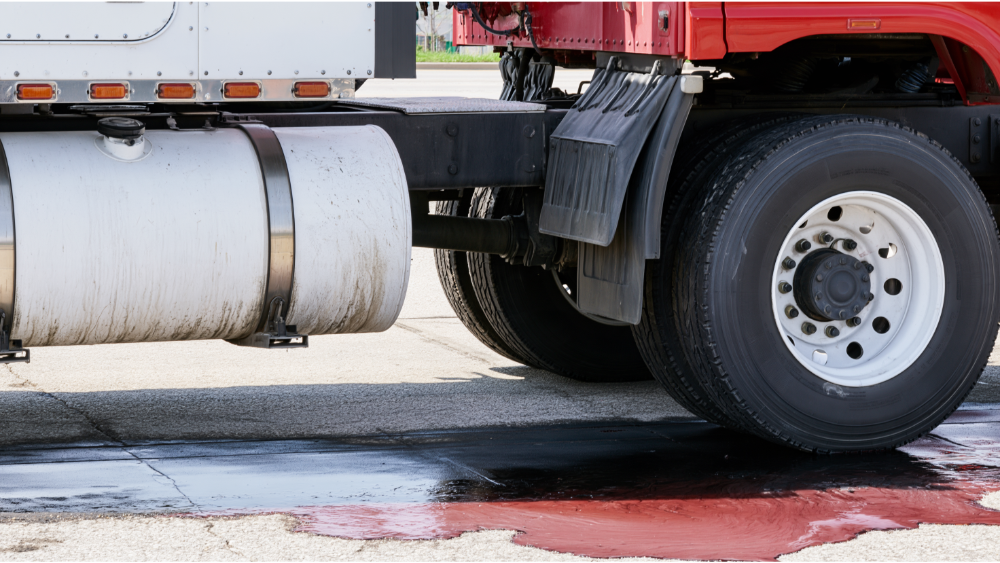
A transmission leak means lubricant is escaping through a seal, gasket, plug, cover joint, cooler line, PTO housing, or a damaged case. On a Class 6 through 8 truck, that puddle under the driveline is a decision point, not a maintenance note. Active dripping, a falling fluid level, a transmission warning message, slipping or delayed shifts, high transmission temperature, or the smell of hot lubricant means you stop and get it diagnosed before a seal turns into a transmission rebuild or a roadside violation.
You’re standing next to a wet spot deciding whether to run the load. Here’s how to make that call, find the real source, and avoid paying for the wrong part.
Is It a Transmission Weep or an Active Leaking Transmission?

Eaton’s heavy-duty service guidance splits this into two conditions, and the whole diagnosis depends on which one you have. A weep is often the first sign: a stained or damp surface, a light oil film, usually with road dirt stuck to it, no dripping. A leak is extremely wet or actively dripping oil. There’s a third tier worth naming: rapid fluid loss, where you can watch the drip rate or the level drops between stops.
A weep gets cleaned, documented, and rechecked at a known interval. It does not get ignored, and it does not get topped off and forgotten. An active leak gets diagnosed now.
Can You Drive With a Transmission Leak? The Honest Answer
Not without verifying the source and the fluid level first. A leak that looked small in the yard behaves differently at 70 degrees hotter, under pressure, loaded, on a grade. A few drops in the morning can be a steady drip at temperature, and a unit that will shift gears cleanly cold can start slipping loaded.
| Stop and call for service when | Never assume it’s safe when |
|---|---|
| Fluid is actively dripping or spraying | The source of the leak hasn’t been found |
| The level is below the manufacturer’s range | The fluid level hasn’t been checked by the correct procedure for that transmission model |
| A transmission or low fluid warning is displayed | The only thing you know is that the puddle “looked small” |
| Shifts are delayed, harsh, slipping, or unavailable | You topped it off and the level came back up |
| Transmission temperature is running high, or fluid is reaching exhaust, brakes, tires, or the roadway | It only leaks “sometimes” |
Federal rules back this up. Under 49 CFR §396.7, a commercial vehicle may not be operated in a condition likely to cause an accident or breakdown, and a vehicle found unsafe on the highway may be moved only to the nearest place where repairs can safely be made. There is no universal safe distance. There is the nearest safe repair location.
What Does Leaking Transmission Fluid Look Like? Brake Fluid, Burnt Fluid, and Color Myths
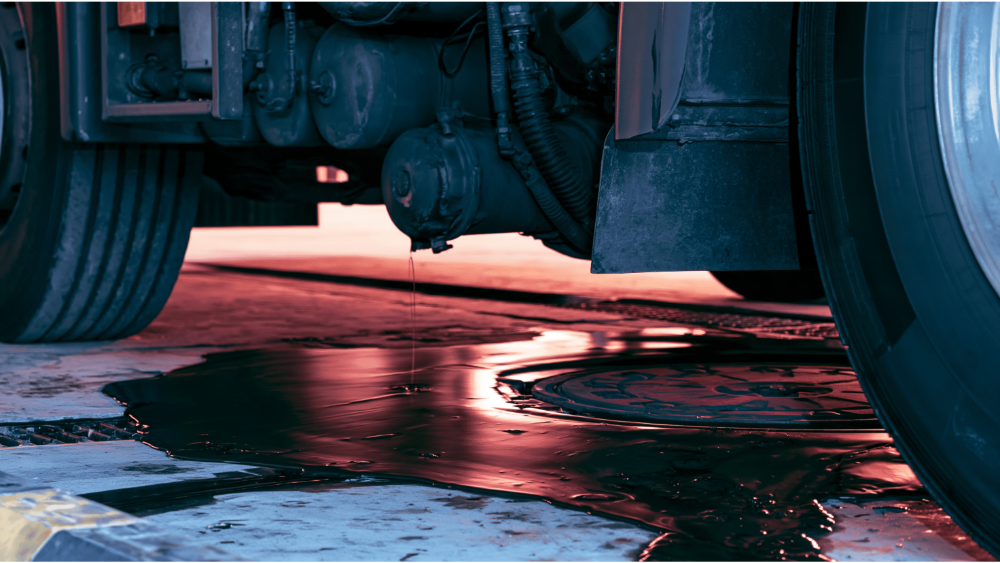
Not always red. That assumption comes from older cars and passenger-car content, and it misleads truck drivers constantly.
Automatic Transmission Fluid vs Manual Transmission Oil
Automatic transmission fluid, in Allison applications and diesel pickups like an F-450 or Ram 3500, is typically bright red or pink when new and darkens to brown as it ages. Burnt fluid looks dark and smells scorched, and that burning smell means heat has already been working on the friction material. Automated manual and manual transmission units (Eaton, Detroit DT12, Volvo I-Shift) run model-specific synthetic gear-type oils that show up amber, honey, or brown. Nothing red about them.
The FTC makes a related point worth repeating: a red oily spot can be transmission fluid or power steering fluid. Engine oil, axle lube, brake fluid, and coolant all land on the same undercarriage. Identify the leak by source and fluid specification, not by color.
Symptoms of Low Transmission Fluid Beyond the Puddle
- Delayed engagement or hesitation when the unit takes a gear
- Slipping gears under load or climbing a grade
- Rough or harsh gear changes from low hydraulic pressure
- Whine, growl, or bearing noise from the case
- Hot lubricant smell after a run
- High transmission temperature readings
- Active transmission fault codes
By the time shift quality changes, clutch packs, gear faces, and bearings have already been running starved. Lost lubricant is lost cooling. An automatic transmission relies on hydraulic pressure as well, and low fluid levels show up fast at the valve body and torque converter. Symptoms show up after the damage starts, not before.
Where Heavy-Duty Transmissions Leak: Transmission Pan Gasket, Output Shaft Seal, and Cooler Lines
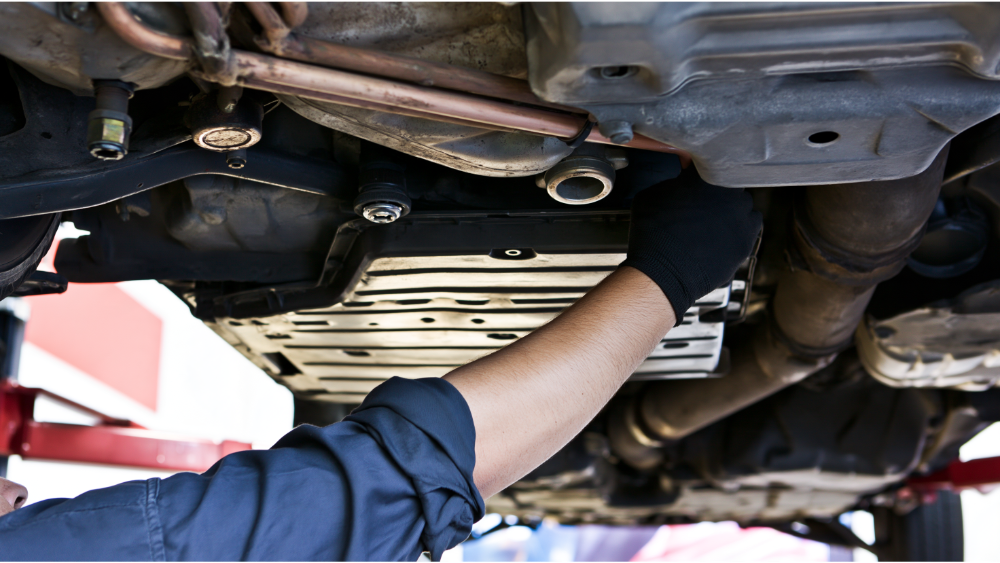
- Fill, check, and drain plugs and O-rings. Common right after an oil change or recent service.
- Transmission pan and transmission pan gasket where equipped, including pans cracked by road debris.
- Case seams, top covers, PTO covers, and shift housing gaskets.
- Input shaft seal, front bearing cover, and the clutch housing area.
- Output shaft seal and yoke area where the driveshaft exits.
- Transmission cooler, transmission cooler lines, rubber hoses, and fittings on automatics.
- Sensor bores, harness pass-throughs, and connector seals.
- Breather or vent discharge caused by overfill, heat, or aerated fluid.
- Cracked or impact-damaged transmission housing.
On diesel pickups, axle and CV axle seals get blamed for transmission leaks regularly. And don’t skip the fill level. Eaton and Detroit both warn that operating above the recommended level can force oil out of the case. That’s a leak symptom with a fill-level cause, and no amount of new gaskets fixes it.
Why the Leak Only Shows Up When It’s Hot, Loaded, or Parked
When a leak appears is diagnostic information. Give it to whoever is diagnosing the truck.
- Only when parked: gravity, static seal seepage, or fluid pooled on the case finally draining off.
- Only when running: internal pressure, rotating shaft seals, pressurized cooler lines.
- Only when hot: thermal expansion, thinner lubricant, vent discharge.
- Only under load or on a grade: fluid shifts in the case and internal pressure climbs.
- Only with the PTO engaged: pump, cover, or fitting under working pressure.
At highway speed, airflow carries fluid rearward and atomizes it across the undercarriage. A parked car drips in one spot. A loaded truck spreads it down the frame. A clean parking spot does not mean a dry transmission.
Why the Wettest Spot Is Usually Not the Leak Source
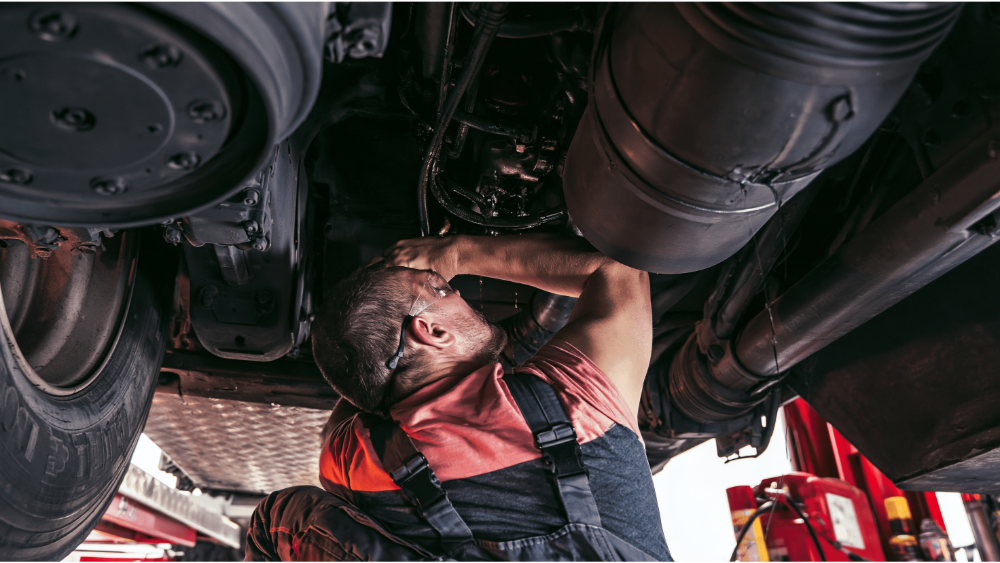
Fluid runs down and back. It crosses the case, the bell housing, crossmembers, and the driveline before it ever drips. An engine rear main seal, an upper engine leak, a shift housing, or a cooler line mounted above the transmission can soak the case and get a perfectly good unit condemned. When fluid escapes at a fitting three feet forward, it still ends up on the transmission.
Eaton’s own guidance tells technicians to confirm oil isn’t traveling from other components forward of or above the suspected leak. The rule is simple: find the highest fresh wet point, then rule out every source above and ahead of it before anyone quotes a seal job. This is exactly where shops guess and drivers pay twice.
How a Professional Transmission Leak Diagnosis Works: Fluid Level, Dye, and Verification
- Confirm the vehicle make, the transmission make and model, and the approved lubricant specification for that unit.
- Check the fluid level by the correct procedure: side check and fill opening, sight glass, dipstick, or an electronic reading through the shift selector. A low transmission fluid level reported electronically gets confirmed manually.
- Clean the area with a cloth or mild soluble degreaser. No pressure washer. High pressure destroys the leak path and drives contamination into the joint.
- Fill to the correct level. On the Eaton Fuller units covered by their troubleshooting guide, one inch below the filler opening is roughly one gallon of oil. That figure is model-specific and does not transfer.
- Visual inspection, plus original equipment manufacturer diagnostic software and fault review where the unit supports it.
- Approved tracer dye and UV inspection when the origin isn’t obvious.
- Operate the truck to normal transmission operating temperature, under load.
- Repair the actual source. Not the first wet gasket in sight.
- Bring it back to temperature, verify the repair holds, then road-ready check.
You get the leak fixed once instead of chased across three visits. At Torpedo, nothing gets turned before you have a full itemized estimate in hand. No surprises, no upsell.
Can a Transmission Fluid Leak Cause a DOT Violation?
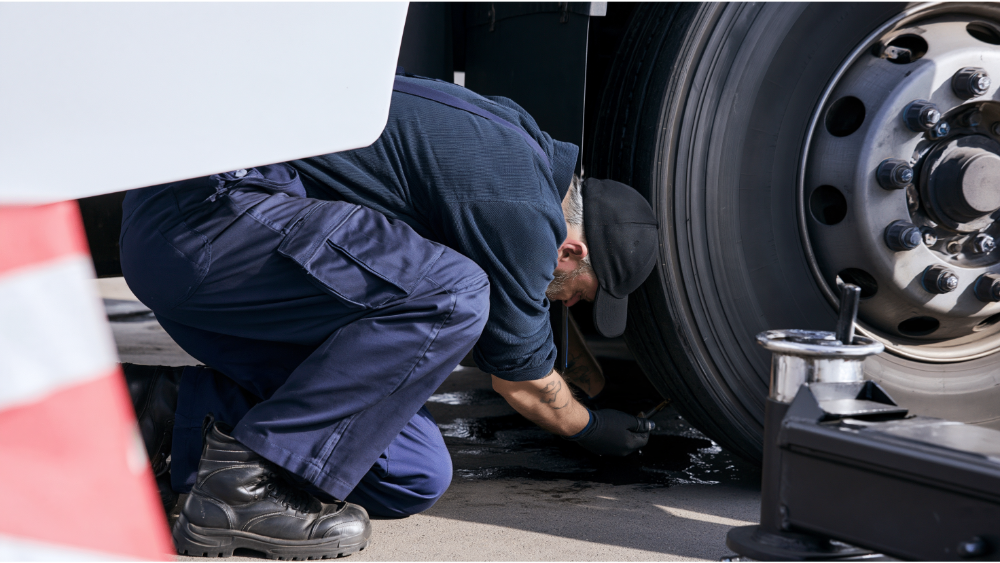
Yes. 49 CFR §396.5(b) requires motor carriers to keep every controlled vehicle properly lubricated and free of oil and grease leaks, so a leaking transmission can be written up as a maintenance violation on its own. §396.7 prohibits operating a vehicle in a condition likely to cause an accident or breakdown. §396.13 puts it on the driver to be satisfied the vehicle is in safe operating condition before moving it.
On the documentation side, a defect that could affect safe operation or cause a mechanical breakdown belongs on the DVIR and gets repaired before the unit runs again. The 2026 North American Standard Out-of-Service Criteria took effect April 1, 2026, and CVSA updates the criteria annually.
Straight answer for safety directors: a damp case is not an automatic out-of-service order. A leak severe enough to create a likely breakdown or hazard can stop the truck where it sits.
Stop-Leak Additives and “Just Top It Off”: Why Neither Is a Repair
Eaton does not recommend additives or friction modifiers in Fuller transmissions. Detroit guidance says not to use fluid additives or mix incompatible fluid types and brands. So the position is straightforward: no stop-leak product goes into a heavy-duty transmission unless the transmission manufacturer approves that product for that application.
Topping off restores a number, not a condition. It doesn’t confirm the right transmission fluid went in, find the leak source, measure the leak rate, or tell you whether internal components have already started to wear. New transmission fluid poured into a leaking case buys hours. A transmission flush isn’t a leak repair either. Repeat top-offs are an unresolved defect with a paper trail.
How Fleets Keep Fluid Leaks From Coming Back
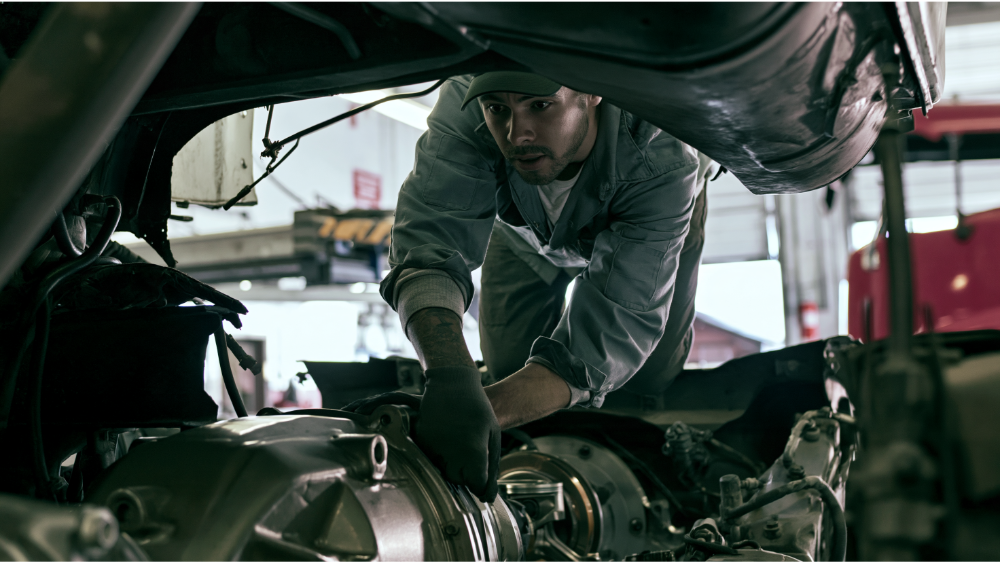
Build leak checks into PM service instead of waiting for a driver report. Check automatic transmission fluid at every oil change interval on applicable units. Inspect transmission lines, cooler lines, and rubber hoses for chafing, cracking, and corrosion. Replace worn pan gaskets, cover gaskets, and tired transmission seals rather than retorquing the same joint twice. Re-inspect after any transmission, clutch, PTO, cooler line, or driveline work.
Log recurring wet areas by unit number so the pattern shows up before the failure does. Verify every repair at operating temperature. Custom PM schedules, consistent repair quality across the fleet, and DOT compliance documentation are what keep the same unit off the list next quarter.
Transmission Leaking? Get It Diagnosed and Get Back on the Road
Call (253) 449-0100. 24/7 emergency roadside dispatch covers trucks down on I-5, Hwy 167, and SR-512, within 50 miles of the Fife shop: Fife, Tacoma, Auburn, Sumner, Puyallup, Milton, Algona, and Pacific. In-shop Transmission And Clutch Repair runs out of 7495 26th St E Ste B, Fife, WA, Mon through Fri, 8:00 AM to 5:30 PM, with same-day service when possible. Certified technicians, OEM diagnostic software, itemized estimate before a single bolt is turned. Licensed and insured. DOT certified.
Not an emergency? Request Service Quote. Takes under 60 seconds, no obligation.
Have this ready when you call: truck make, model, and year; transmission model if you know it; fluid color and odor; where the leak shows; whether it leaks parked, running, hot, or under load; any warning messages or fault codes; current shift behavior; whether a PTO or transmission cooler is installed; and roughly how fast it’s losing fluid.
Frequently Asked Questions
How serious is a transmission leak?
Serious enough to stop for. Lost lubricant means lost cooling and, on an automatic, lost hydraulic pressure. Even a small leak accelerates internal wear and can end in complete transmission failure well before you reach the delivery.
How much does it cost to fix a transmission seal leak?
It depends on the transmission model, the leak location, whether the unit or PTO has to come out, and whether internal damage has already started. Torpedo quotes each job after diagnosis and gives you a full itemized estimate first. No published rates, no surprises.
Can a leaking transmission be fixed?
Usually. Many leaks trace back to transmission seals, gaskets, plugs, covers, or cooler lines. A professional repair only holds when the actual source is identified and then verified at operating temperature, not just cleaned and hoped over.
How long can I drive with a transmission seal leak?
There is no safe universal distance. If the level checks out, it’s a weep, and the unit is still shifting properly, it’s a scheduled repair. If it’s dripping or shift quality has changed, drive only to the nearest place where the repair can safely be made.