Key Takeaway
White smoke on a diesel engine is almost always caused by unburned fuel or coolant and water vapor passing through the exhaust. Cold-start vapor that clears within a few minutes is normal condensation. Persistent white smoke on a fully warmed engine points to faulty injectors, low compression, a blown head gasket, or a leaking EGR cooler and requires immediate diagnosis, not continued driving.
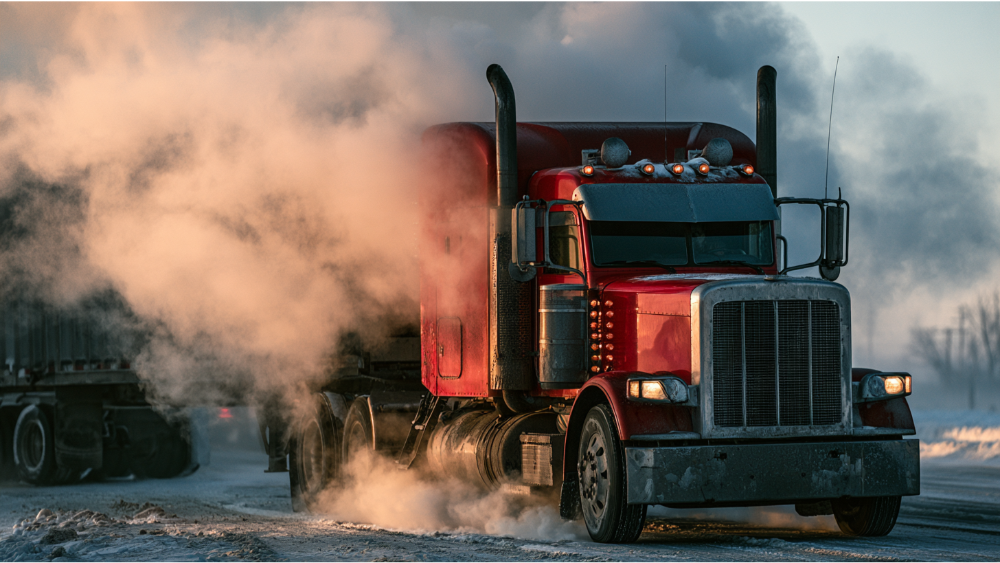
You’re looking at white exhaust smoke and deciding whether to roll or shut it down. Here’s the direct answer: diesel engine white smoke is almost always unburned fuel or water and coolant vapor passing through the exhaust system. Thin white vapor that clears as the engine warms is usually condensation burning off. White smoke that persists after warm-up points to injectors, fuel quality, compression, the cooling system, an EGR cooler, or aftertreatment. This article covers what the smoke is telling you, when you can keep driving, and how a verified diagnosis works on Class 6 through 8 equipment. Color is a symptom. It is not a diagnosis.
Is It White Smoke or Normal White Vapor?
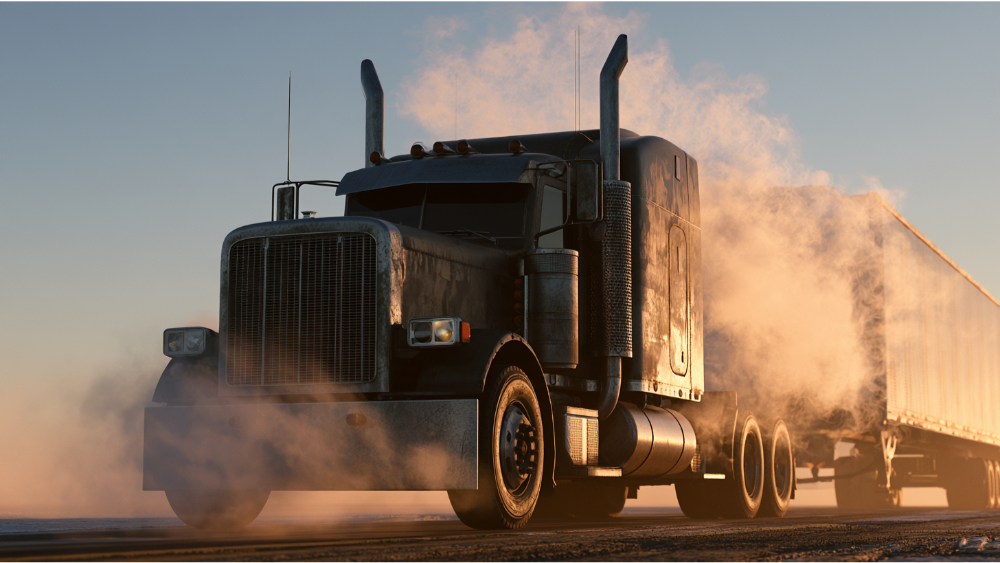
Four things separate harmless vapor from a problem you need to chase.
- Density: thin and translucent versus dense and billowing.
- Engine temperature: present on a cold start versus present on a fully warmed engine.
- Behavior: clears as the engine comes up to temperature versus constant.
- Operating condition: idle only versus under load.
Cummins guidance says condensation can be visible in cold or very dry air and should clear within a few minutes of normal operation. That is the honest standard. There is no universal 30-second or one-minute cutoff, and the exact window depends on the engine, ambient temperature, and the aftertreatment strategy on that platform. Anyone handing you a stopwatch number is guessing.
Can You Keep Driving a Diesel Truck Blowing White Smoke?
Use the condition of the truck, not the look of the cloud.
- Green: thin vapor only during cold startup, clears during warm-up, no warning lights, no coolant loss, no power loss. Monitor it and flag it at the next PM service.
- Yellow: the smoke repeats, hard starting, rough idle, it started after a recent fuel stop, a water-in-fuel lamp, or intermittent power loss. Schedule diagnosis before the next long run.
- Red: rising coolant temperature, dropping coolant level, a red stop-engine warning, severe misfire or knock, major power loss, or heavy white smoke pouring out of a fully warmed engine. Stop at the first safe opportunity and call for service.
Coolant entering a combustion chamber does not stay a cheap repair for long. Keep running it and you trade a gasket for costly engine damage. A shutdown you choose costs less than a shutdown the engine chooses for you.
White Smoke Diagnostic Table: When It Happens and What It Points To
When the smoke shows up narrows the list faster than anything else.
| When It Appears | Other Symptoms | Most Likely Systems | Urgency |
|---|---|---|---|
| Cold start only | Clears in a few minutes | Normal condensation, cold combustion | Green |
| Idle after warm-up | Rough idle, misfire | Injectors, injection timing, weak cylinder | Yellow |
| After long low-load idling | Low coolant temp reading | Overcooling, thermostat, aftertreatment | Yellow |
| During active regen | Strong exhaust odor | Hydrocarbon slip, air management | Yellow |
| Under acceleration or load | Power loss, hesitation | Fuel delivery, injectors, compression | Yellow |
| Constant at all temperatures | Hard starting, misfire | Compression, injectors, fuel quality | Red |
| With coolant loss, sweet smell at the stack | Overheating, no external leak | Head gasket, cracked head, EGR cooler | Red |
What Cause White Smoke on Diesel Engine? The Main Causes, Ranked
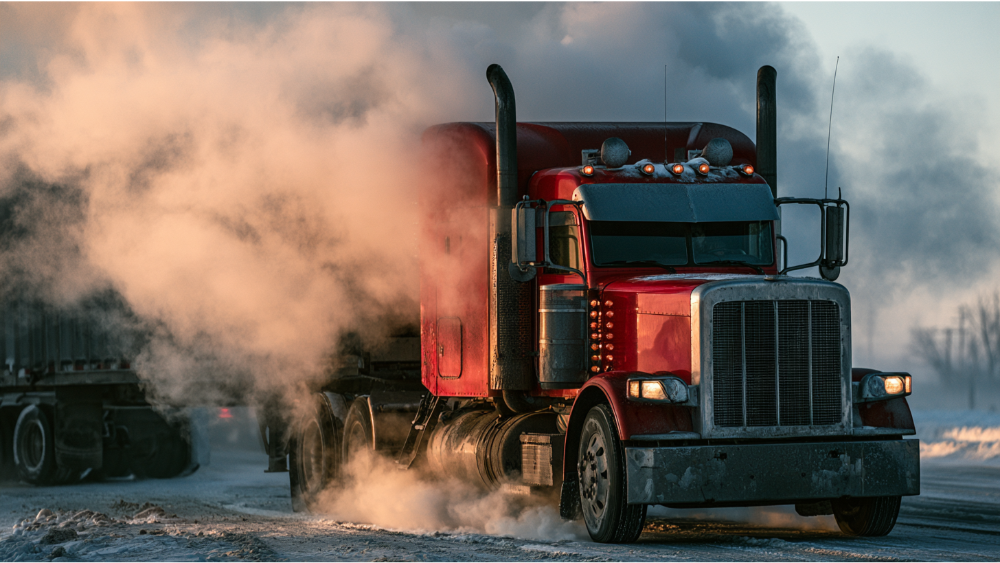
Search “what cause white smoke on diesel engine” and you get a parts list. Here is the order a technician actually rules them out: most common and least invasive first, teardown last.
Cold Starts, Cold Weather, and Low Combustion Temperature
Diesel ignites from compression heat, not spark. Cold cylinder walls and cold intake air mean some of the injected fuel never burns completely, and the unburned fuel exits as white smoke. Incomplete combustion during startup is physics, not a fault. Perkins puts it in plain terms: starting a diesel at 0°F is about five times harder than starting it at 80°F. Weak batteries and slow cranking make it worse on cold mornings. If the engine produces white smoke only on a cold start and it clears within a few minutes, you are watching normal behavior.
Failed Glow Plugs, Grid Heaters, and Cold-Start Aids
Glow plugs and grid heaters exist to raise intake or cylinder temperature enough for clean combustion. When one or more fail, the affected cylinders fire late or not at all, and raw diesel leaves through the exhaust system as white smoke. You’ll usually see hard starting and rough running that smooths out as the engine warms.
Faulty Fuel Injectors and Injection Timing
An injector has to deliver the right quantity, at the right pressure, in the right spray pattern, at exactly the right moment in the cycle. Miss any one of those and fuel enters the cylinder in a form that won’t burn completely. A leaking or dribbling injector, a distorted spray pattern, or an injection pump timing fault all produce white smoke, usually with rough idle, misfire, and poor performance. This is also where shops guess most often. Faulty injectors get condemned on a hunch every day, and the smoke comes right back.
Clogged Fuel Filter, Water in Fuel, and Poor Fuel Quality
A restricted fuel filter chokes fuel flow and degrades spray quality at the nozzle. Water pulled through the fuel system flashes to steam in the cylinder and disrupts combustion outright. Low-cetane fuel burns late and produces excessive white smoke. One Cummins manual recommends a minimum 40 cetane above 32°F and 45 below, which is an OEM application example rather than a rule for every engine. Since all highway diesel is ULSD at 15 ppm sulfur or less, your fuel variables are cetane, water, and particulate contamination.
Low Compression, Worn Rings, and Valve Problems: What a Compression Test Shows
Without enough cylinder pressure, the charge never gets hot enough to ignite the fuel completely. Worn piston rings, scored cylinder bores, worn or damaged valves, incorrect valve lash, head gasket failure, and cylinder head damage all show up here. High mileage engines are the usual candidates. A compression test and cylinder contribution testing confirm low compression. Smoke color never does.
Coolant Leaks Into the Combustion Chamber: Head Gaskets, Cracked Heads, Cracked Blocks
Coolant entering the combustion chamber through a blown gasket, a cracked cylinder head, a cracked engine block, or a dropped liner produces thick white smoke that does not clear with warm-up. Blown or cracked head gaskets also push combustion gases the other way, into the cooling system, which shows up as pressurized coolant and no puddle under the truck. Coolant mixing with oil turns the dipstick milky. Exhaust that smells sweet is a clue worth writing down, but it is not proof. Ethylene glycol itself is odorless, and odor is not a diagnostic test. White smoke alone does not prove a blown head gasket, and condemning a cylinder head without a cooling system pressure test is how a shop turns a two-day job into a week of someone else’s downtime. Ignore it long enough and a gasket becomes major engine damage.
Cracked or Leaking EGR Cooler
On modern diesel engines, an EGR cooler failure routes coolant straight into the intake manifold and the combustion chamber. OEM service documentation has tied this to white exhaust, coolant loss with no external leak, reduced power, and overheating. The symptoms mimic a head gasket almost exactly. That’s precisely why pressure testing comes before anyone pulls a head.
Overcooling and Extended Low-Load Idling
Until the engine reaches operating temperature, combustion stays cool and fuel burns incompletely. A stuck thermostat, a faulty coolant temperature sensor, or long stretches of low-load idling all drive combustion temperature down. The result is white smoke, higher fuel burn, and weaker aftertreatment performance.
DPF Regeneration on Modern Diesel Engines: Hydrocarbon Slip and Air-Management Faults
Brief white vapor after prolonged idle can be normal on aftertreatment-equipped engines. White smoke during an active regen often means hydrocarbon slip: dosed fuel that doesn’t fully combust and passes through the DPF. That points at air management, not a failed filter. A DPF should never be condemned on smoke color alone. DEF and SCR systems have been standard on on-road trucks since 2010, and deleting or disabling emissions controls is prohibited under the Clean Air Act. It is not a repair.
Diesel Exhaust Smoke by Color: White vs. Blue vs. Black
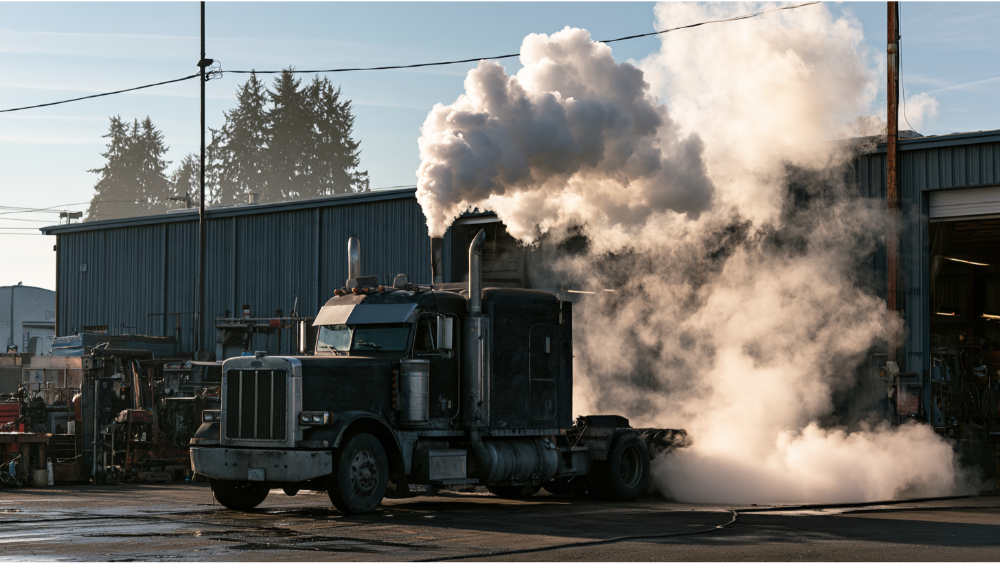
- White: unburned fuel, or water and coolant vapor. Think combustion temperature, fuel delivery, or coolant intrusion.
- Blue or gray smoke: engine oil burning. Worn piston rings, worn valve seals, valve guides, or turbo seals. Plenty of articles list oil as a white-smoke cause. That sends you after the wrong system.
- Black: too much fuel or not enough air. Restricted air filter, turbo or charge-air problems, or overfueling.
Exhaust smoke color narrows the system. It does not name the part.
Safe Checks Before You Call a Shop, and Diesel Exhaust Precautions
- Record active fault codes and any dash messages exactly as displayed.
- Note precisely when the smoke appears: cold, warm, at idle, under load, or during a regen.
- Check coolant level on a cold engine only, per OEM procedure, and log the loss over time.
- Check the dipstick and the underside of the oil cap for milky residue or an overfull reading.
- Note any recent fuel stop or water-in-fuel lamp, and drain the water separator if equipped.
- Note smoke density and whether it clears as the engine warms.
Two hard stops. Never open a hot cooling system. Never deliberately inhale exhaust, and never touch or taste tailpipe residue. Diesel exhaust is a recognized health hazard, and ethylene glycol ingestion causes serious kidney, cardiac, and neurologic injury. If you notice an odor from a normal standing distance, write it down. That’s it.
How a Professional Diesel Diagnosis Should Work
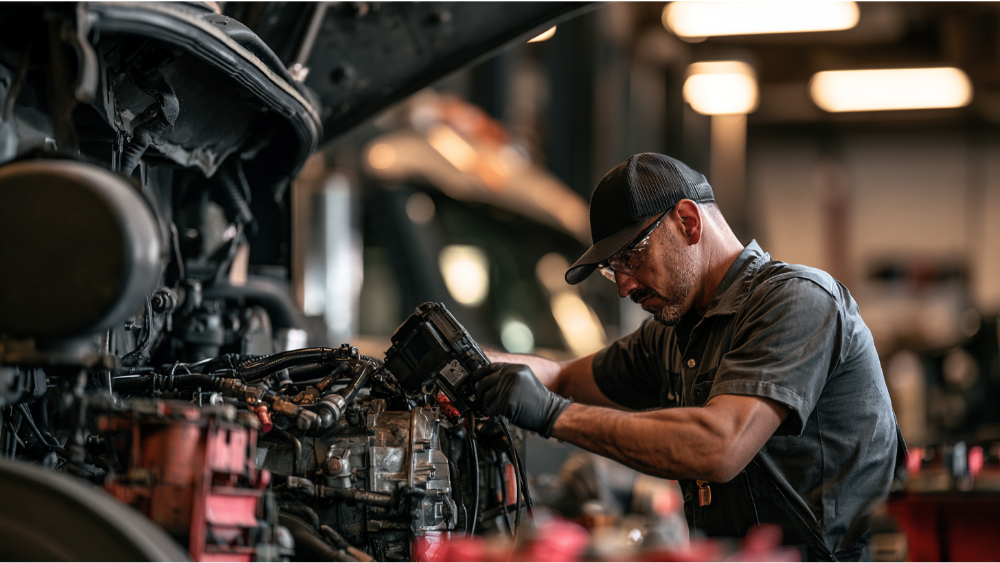
White smoke has too many plausible causes to repair by assumption. The sequence matters more than the parts list.
- OEM fault-code scan and review of regeneration history.
- Verify engine operating temperature, thermostat function, and cold-start aid operation.
- Pull a fuel sample. Inspect the water separator and fuel filter.
- Test fuel pressure and check for air in the fuel.
- Run injector balance, return, and cutout testing, and inspect injectors directly where the platform allows.
- Pressure test the cooling system and the EGR cooler.
- Compression test, valve lash check, and cylinder contribution testing.
- Verify aftertreatment and air-management operation.
Each step either eliminates a system or confirms one. Nothing gets replaced until a test proves it. We run this on Class 6 through 8 platforms with OEM diagnostic software and certified technicians, and findings go into a written, itemized estimate before any work starts. A wrong first diagnosis doesn’t just cost parts. It costs a second round of downtime, and that’s the expensive half.
Prevention: Monitor Coolant Levels and Catch Warning Signs Early
- Follow OEM PM intervals for your engine rather than a generic mileage number.
- Service fuel filters and drain water separators on schedule.
- Pressure test and inspect the cooling system at PM service.
- Monitor coolant levels between intervals and log any loss, even small.
- Verify glow plug or grid heater function before cold weather arrives.
- Source fuel with adequate cetane for the season.
- Limit unnecessary extended idling.
- Keep DPF, DEF, SCR, and EGR systems functional and the service documented.
A fleet PM program catches these warning signs early in the bay, where it’s a scheduled line item instead of a roadside event.
Frequently Asked Questions
How do you fix white smoke in a diesel engine?
You fix the verified cause, not the smoke. Depending on test results that means cold-start aid repair, injector service or replacement, fuel system cleanup, cooling system or EGR cooler repair, or internal engine work. The repair follows the test result, never the color.
What are three causes of white smoke in a diesel engine?
Unburned fuel from cold starts or failed glow plugs. Injector or fuel quality faults that prevent complete combustion. Coolant entering the combustion chamber through a head gasket, cracked head, or EGR cooler.
Is white smoke from a diesel bad?
Diesel white smoke at cold start that clears during warm-up is normal. Persistent smoke on a fully warmed engine is not. Paired with coolant loss or rising temperature, it is a shutdown condition, not a monitor-it condition.
Does white smoke always mean a blown head gasket?
No. Injectors, fuel quality, low compression, EGR coolers, and regen events all produce white smoke. Confirm with cooling system pressure testing and compression testing before anyone opens the engine.
Get a Verified Diagnosis Before Anyone Replaces a Part
Torpedo Truck Repair diagnoses white smoke on Class 6 through 8 trucks and trailers using OEM diagnostic software and structured, verified testing across Freightliner, Kenworth, Peterbilt, Volvo, Mack, International, and Western Star. You get an itemized estimate before a single bolt is turned. No upsell, no surprises, and a same-day service focus when possible. Licensed and insured, DOT certified, 4.9 stars across 146 Google Reviews.
Call (253) 449-0100 for 24/7 emergency dispatch. Shop hours are Monday through Friday, 8:00 AM to 5:30 PM. Not an emergency? Request a Service Quote. Takes under 60 seconds. No obligation.