Key Takeaway
To check compression on a diesel engine, start with an OEM relative compression test using diagnostic software to screen all cylinders without disassembly. If a cylinder reads more than 10 to 15 percent below the strongest, confirm it with a diesel-rated compression tester through the injector or glow plug port. Always compare results against the OEM minimum and cylinder-balance specification for that exact engine serial number, never a generic PSI figure.
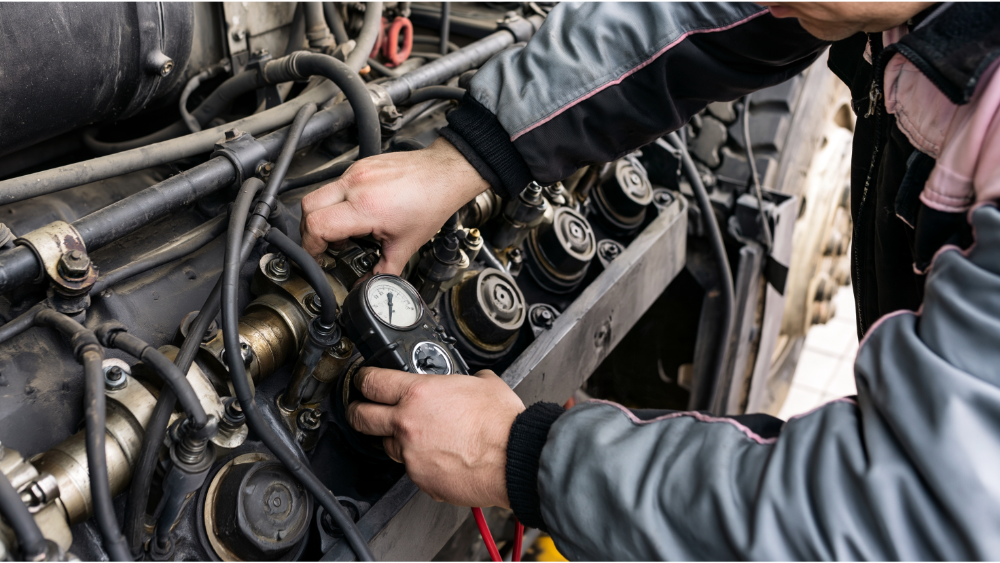
On a modern Class 6 through 8 truck, start with the OEM relative compression test if the engine’s diagnostic software supports it. That screens all the cylinders without opening the fuel injection system. If one cylinder comes back weak, confirm it mechanically with a diesel-rated compression tester installed through the fuel injector or glow plug port the service procedure specifies, with fuel disabled and cranking speed held steady. Compare the engine’s compression numbers against the minimum and cylinder-balance specification for that serial number. Not a generic PSI figure off the internet.
This is written for the driver, owner-operator, or tech looking at a hard-start, misfire, or low-power truck who needs to know whether the problem is actually inside the engine before anyone authorizes a teardown. A diesel engine compression test answers that question.
What Does a Diesel Engine Compression Test Actually Tell You?
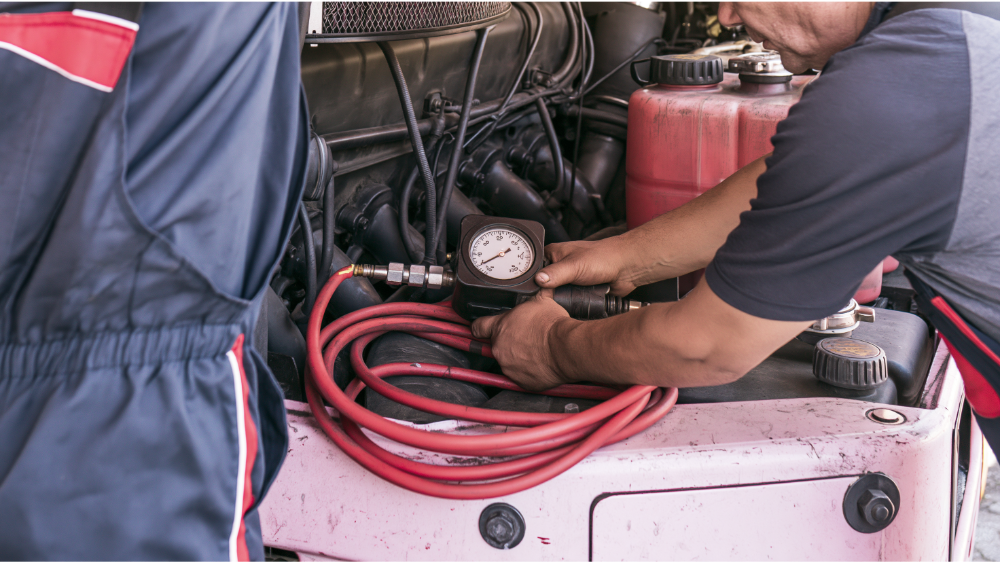
A mechanical engine compression test measures peak cylinder pressure while the engine cranks. That tells you one thing: whether the combustion chamber can seal and build pressure. It does not tell you which component failed.
Compression pressure and compression ratio are different measurements. Ratio is a fixed design number. Pressure is what the cylinder actually produces right now, and it shifts with cranking speed, engine temperature, valve timing, and how well your compression tester seals. There is also no throttle plate to hold wide open the way there is on a gasoline engine. A diesel runs on compression ignition with no spark, so the engine’s compression is what starts the combustion process and lights the diesel fuel in the cylinder. Lose it and hard starting or a misfire shows up fast. A healthy engine reads close to spec on every hole. Compression loss tells you where the engine problems live, but the gauge points at a cylinder. It does not write the repair order.
When Should You Check Compression on a Diesel Engine?
A compression check belongs in the middle of a diagnosis, not at the front. Pull fault history, verify the fuel system supply and fuel pressure, and check air management and valve lash first. Otherwise you’ll be pulling fuel injectors to chase a delivery fault that lives in the filters, the lift pump, or the injection pump.
- Hard starting or a crank/no-start condition
- Uneven cranking
- Rough idle or a suspected misfire
- White smoke
- Low power
- Excessive blow-by or oil consumption
Three Ways to Test Diesel Compression: Relative, Mechanical, and Leak-Down
| Test | What it outputs | Access required | Best used for | Limitation |
|---|---|---|---|---|
| Relative compression | Percentage comparison between cylinders | None (software or starter-current clamp) | Screening all cylinders fast | No PSI value |
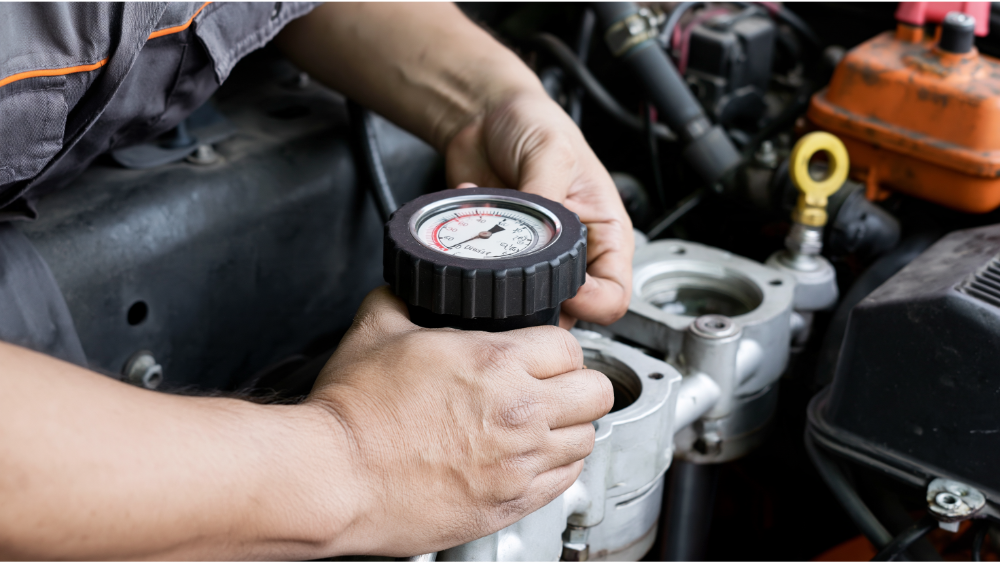
| Mechanical (absolute) | Peak PSI per cylinder | Fuel injectors or glow plugs removed | Confirming a suspect cylinder | Invasive, sensitive to test conditions |
| Cylinder leak-down | Leak path and rate | Fuel injectors or glow plugs removed, engine at TDC compression | Locating where pressure escapes | Follow-up test only |
Relative compression compares the work the starter does on each compression stroke using crank-speed or starter-current data. Leak-down feeds regulated shop air into a stationary cylinder and you listen for air leaks: air at the intake means leaking valves on the intake side, air at the exhaust means the exhaust valves, air at the breather means damaged piston rings or a scored cylinder wall, and bubbles in the cooling system or pressure in an adjacent cylinder point at the head gasket, cylinder head, or liner.
Start With a Relative Compression Test on Modern Trucks
Relative compression is the fastest way to cut downtime, because you get a cylinder-by-cylinder comparison without touching the high-pressure fuel injection system or pulling a single fuel injector. A Pico heavy-duty starter-current capture runs about five seconds.
Detroit’s published relative compression procedure assigns the strongest cylinder a value of 100%. In that procedure, a cylinder more than 15% below the best (under 85%) triggers a manual compression test. A separate Detroit GHG17 workflow uses a 10% cylinder-to-cylinder threshold, then looks for a mechanical reading 344 kPa (50 PSI) lower than the rest. International/Navistar documents relative compression across medium- and heavy-duty families and notes it can flag worn cylinders, valves and valve-train faults, and bent connecting rods.
Those numbers are OEM examples, not a universal rule. Thresholds, adapters, and test sequences get revised. Verify against current service information and manufacturer specifications for the engine serial number in the vehicle in front of you.
Tools and Information: Choosing the Right Diesel Compression Tester
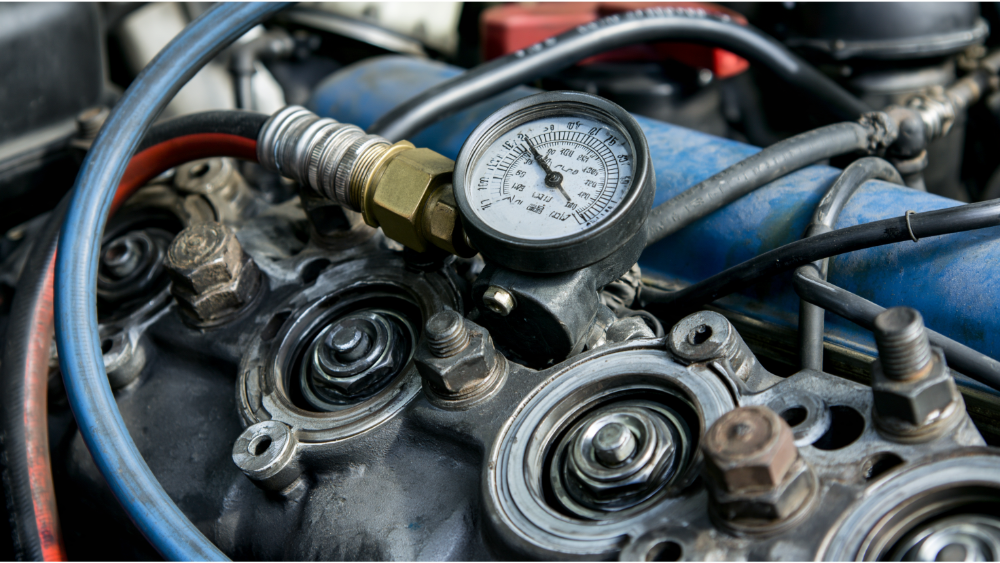
The right tools decide whether your number is usable. Guessing with the wrong adapter will not identify issues. It will invent them.
- Current OEM service procedure and technical manual for that exact engine serial number
- A diesel-rated compression tester and kit. A pressure gauge built for gasoline engines can be damaged by diesel cranking pressure. One U.S. Navy technical reference specifies a diesel gauge reading to roughly 600 PSI, and Cat lists a professional cylinder compression gauge at 0 to 1,000 PSI (0 to 7,000 kPa)
- The correct compression gauge adapter for the fuel injector or glow plug port on that engine
- Engine-specific tooling to pull the fuel injectors, plus any replacement seals, washers, or high-pressure lines the procedure requires
- A wrench set and hand tools
- A battery charger to hold voltage and cranking speed
- A written worksheet to record every cylinder. Fleets should keep it in the unit file as documentation before any internal engine work is authorized on that vehicle
Safety Steps Before You Open the Fuel System or Pull a Glow Plug
High-pressure diesel fuel will penetrate skin. The current Detroit Gen 5 Heavy Duty operator manual requires the engine to sit at least 10 minutes before servicing that high-pressure circuit. A Cummins service bulletin warns never to crank the engine with a high-pressure fuel joint open, because cranking can build fuel pressure capable of causing serious injury or death.
Park the vehicle, set the brakes, chock the wheels, and disable accidental startup. Watch hot and rotating components. Clean thoroughly around every fuel injector and glow plug opening before removal, because contamination in a common-rail fuel injection system becomes your second failure.
How to Check Compression on a Diesel Engine: A Step by Step Guide
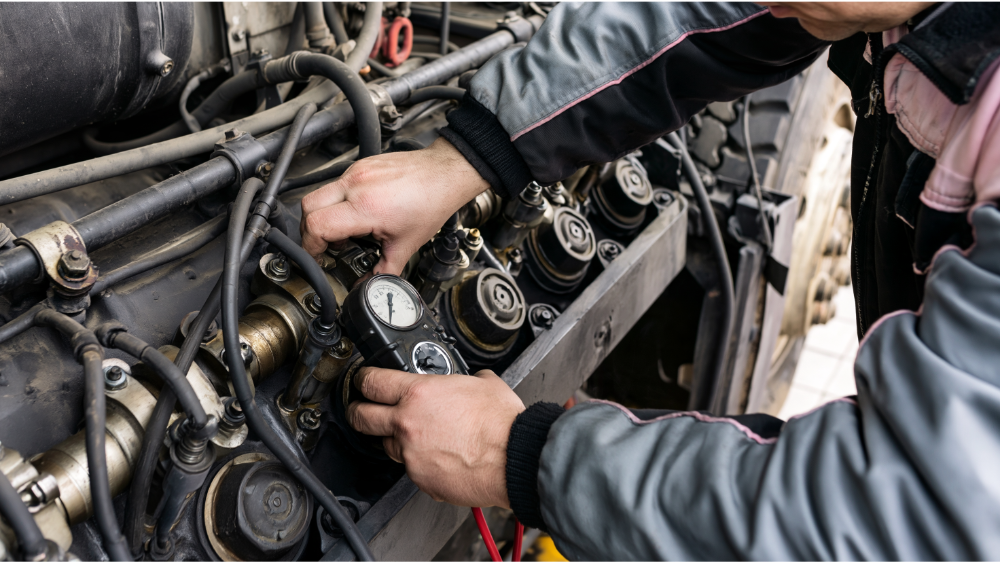
Work these methodical steps in order. Skipping one is how you end up with a number nobody can trust.
- Identify the exact engine, serial number, and published compression specification. Manufacturer specifications vary by family and by emissions year.
- Warm the engine to operating temperature when possible and record the test temperature. If the engine stays cold because the truck won’t start, document that and use the cold compression test spec if the OEM publishes one.
- Disable fuel using the OEM method for that engine. Generic fuse or relay tips do not transfer between platforms or vehicles.
- Connect a battery charger to hold voltage and consistent cranking speed.
- Clean the area around the access points.
- Remove the valve cover, fuel injectors, or glow plugs the procedure calls for, and remove all of them, not just the suspect cylinder.
- Install the correct adapter in the injector bore or glow plug hole and seal it to the specified torque.
- Crank roughly four to six compression strokes, or until the reading stops climbing.
- Record peak pressure for that cylinder.
- Reset the tester and test compression on every remaining cylinder under identical conditions: same temperature, same voltage, same stroke count.
- Reassemble with OEM seals, torque sequence, and any required fuel injector coding or calibration.
- Start the engine, check the fuel connections for leaks, and clear and recheck fault codes.
How to Read Diesel Engine Compression Test Results
Compare against the OEM minimum and the cylinder-balance limit first. Older technical training material cites a rough average near 275 to 400 PSI. Treat that as background only, never as pass/fail, and never as a substitute for manufacturer specifications.
- One low cylinder: localized. Move to valve lash inspection, then leak-down and borescope. Valves and rings are the usual suspects.
- Two adjacent low cylinders: suspect a blown head gasket path between them.
- All cylinders low: check batteries and cranking speed before anything else. A weak battery or slow cranking produces false low readings across the board. Timing is the other candidate, and on pump-driven engines that includes injection pump timing.
- Readings that fall as testing continues: your batteries are dropping. Stop and recharge.
No shop should quote a rebuild off a single compression gauge reading, and no fleet should authorize costly repairs on one.
What Causes Low Compression in a Diesel Engine?

- Rings, piston, liner: worn piston rings or broken rings, glazed or worn bores and liners, damaged pistons
- Valves and valve train: burned or leaking valves on the intake and exhaust side, bent valves, incorrect lash holding valves off their seats, worn guides and seats, engine-brake component faults on applicable heavy-duty engines
- Head and gasket: a blown head gasket, a cracked cylinder head or a warped one, a damaged block
- Sealing at the head: a fuel injector or glow plug not sealing correctly, or a damaged injector sleeve
Coolant loss with no external leak often traces back to the head gasket. White smoke, hard starting, and low power also come from fuel supply, fuel injection faults, air management, timing, and glow-system problems. Symptoms alone prove nothing about the engine’s compression.
What to Check After You Find a Weak Cylinder
- Repeat the test and verify your adapter and compression tester are sealing.
- Review relative compression and cylinder-balance data together.
- Check valve lash and valve-train operation, including rocker, cam, and engine-brake condition. Detroit’s published workflow puts valves ahead of any mechanical reading that drives the repair decision.
- Run a leak-down test to separate the potential issues and find the leak path.
- Borescope the cylinder for scoring, valve damage, and piston-crown condition.
- Check blow-by where the OEM publishes a procedure, and evaluate the fuel injectors separately.
When to Stop and Call a Heavy-Duty Diesel Shop
Stop if the OEM pressure-release procedure isn’t in front of you, if fuel injector removal needs specialized tooling or single-use parts, if metal, coolant, or fuel contamination turns up, if the engine cranks unevenly or may be hydrolocked, or if relative and mechanical results contradict each other. A loaded truck disabled on the shoulder is no place to pull injectors.
Torpedo Truck Repair runs OEM diagnostic software and structured, verified diagnostic workflows out of our Fife, WA shop on Freightliner, Kenworth, Peterbilt, Volvo, Mack, International, and Western Star platforms. You get an itemized estimate before a bolt is turned. No surprises, no upsell, with a same-day service focus when possible. Shop hours are Mon through Fri, 8:00 AM to 5:30 PM. Our 24/7 emergency roadside dispatch covers 50 miles from Fife across I-5, Hwy 167, and SR-512 throughout the Seattle-Tacoma freight corridor.
Call now: (253) 449-0100. Not urgent? Request a service quote. Takes under 60 seconds. No obligation.
Frequently Asked Questions
What are the symptoms of low compression in a diesel engine?
Hard starting or crank/no-start, uneven cranking, misfire, rough idle, white smoke, low power, and excessive blow-by. All of these overlap with fuel injection and air-management faults, so confirm with a diesel engine compression test before assuming the engine is worn.
What is normal compression on a diesel?
There is no universal number. The OEM minimum and cylinder-balance limit for your specific engine control the answer. Legacy technical material cites roughly 275 to 400 PSI as an average, which is background context only.
Is low compression usually valves or piston rings?
A leak-down test answers it. Air escaping the intake or exhaust points at the valves. Air at the crankcase breather points at the piston rings or the cylinder wall. Bubbles in the coolant point at the head gasket or the cylinder head. Guessing between valves and rings is how a shop ends up doing head work on an engine that needed the bottom end.
How do you do a compression test on a diesel engine without a gauge?
Run an OEM relative compression test or a starter-current analysis. Both compare cylinders without a compression tester or disassembly. That’s the real no-gauge method. Everything else is guesswork.
Do diesels run on compression?
Yes. Diesels use compression ignition, with no spark. Heat from compressing air lights the fuel. When the engine’s compression drops, starting and running faults follow directly.
Can a bad injector look like low compression?
Yes. A leaking or failing fuel injector produces the same misfire, rough idle, and white smoke a weak cylinder does. Rule out the fuel injectors and injection pump delivery separately before authorizing internal engine work.