Key Takeaway
To prime a diesel engine after running out of fuel, add at least 2 to 5 gallons of correct diesel, then cycle the ignition key to RUN for 30 seconds at a time (or work the hand primer on heavy-duty rigs) to push air out of the low-pressure system before cranking. Do not loosen high-pressure common-rail fuel lines and do not crank more than 10 to 20 seconds at a time. Proper priming protects the lift pump, injectors, and high-pressure fuel pump from dry-run damage.
Your truck ran dry, you added fuel, and now it cranks but won’t fire. Here’s the short version on how to prime a diesel engine after running out of fuel: add enough of the correct diesel, prime the low-pressure fuel system the way your engine specifies (usually electric key cycles or a hand primer), and purge the air before you crank. Do not keep hammering the starter, and do not loosen high-pressure common-rail lines to bleed air. That’s a downtime problem, and every failed crank burns time, battery, and starter life. This guide is for owner-operators, independent drivers, and dispatchers who need the truck moving again without turning a fuel-out mistake into a repair bill.
Why Won’t a Diesel Engine Start After Running Out of Fuel?
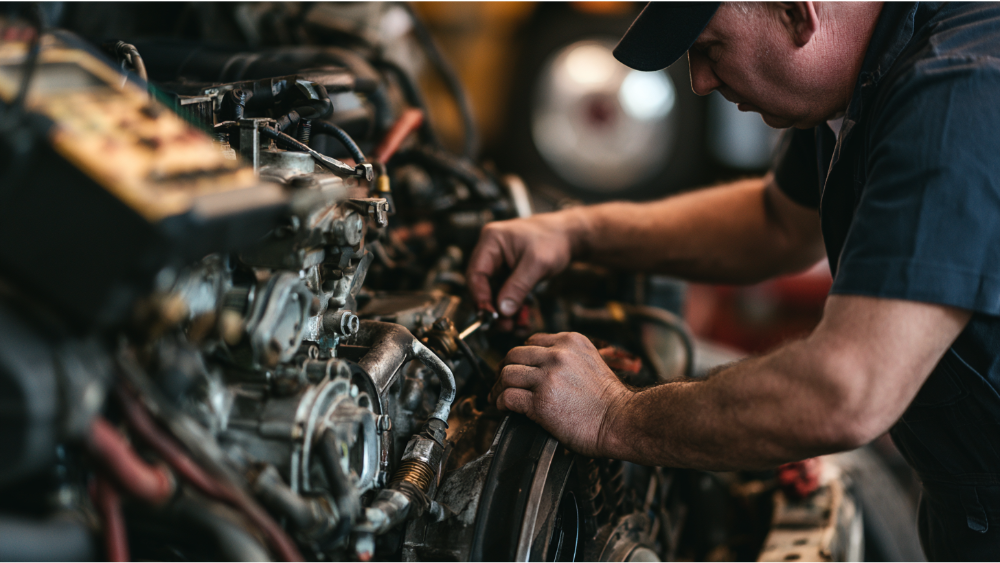
When the tank goes empty, air gets pulled into the low-pressure supply side and into the injector lines. Air compresses. Diesel does not. So even with diesel fuel back in the tank, the injectors can’t build the pressure needed to fire until that air is out of the system. This is why a diesel engine behaves differently from gasoline cars. There is no spark plug or ignition coil to force combustion in the combustion chamber. A diesel relies on compression and a solid, air-free column of fuel, so an air pocket anywhere in the fuel lines will stop the motor from firing.
The fuel filter and supply lines may be sitting empty too. Priming refills that side and pushes the air out. Cranking alone rarely does it well, and it drags the batteries down while you wait. On many diesel trucks the primary and secondary fuel filter housings hold a surprising amount of volume, and both have to fill before fuel reaches the injection pump.
Modern high-pressure common-rail systems make this worse. They depend on a steady fuel supply and on diesel itself for lubrication. Run one dry and you stress the lift pump, the high-pressure fuel pump, and the injectors. Do it repeatedly and you shorten the life of expensive parts. Light-duty platforms like the VW TDI and other TDI-based pickups are just as unforgiving here, because their injection pump and injectors count on fuel for cooling and lubrication. That’s the reason you prime instead of crank: you’re protecting the fuel system, not just chasing a start.
First: Roadside Safety and the Basics to Confirm Before You Prime
If you’re stopped on a shoulder, handle safety before you touch anything under the hood.
Get safe and legal on the shoulder
Hazards on immediately, and keep them flashing until your warning devices are out. Federal rules require those devices placed as soon as possible and within 10 minutes of stopping.
- Most two-way roads: one device about 10 feet from the truck toward traffic, one at about 100 feet toward traffic, one at about 100 feet behind.
- Divided or one-way highways: 10 feet, 100 feet, and 200 feet toward approaching traffic.
- Your power unit should carry 3 reflective triangles or 6 fusees, plus a fire extinguisher rated at least 5 B:C (10 B:C for placarded hazmat).
In Washington, you can dial 911 for a roadway hazard or a disabled vehicle blocking traffic through WSDOT’s Incident Response program. Use that for the safety side. For the actual repair, keep reading.
Confirm the basics before priming
- Enough of the correct diesel in the fuel tank (amounts below).
- Correct fuel: Ultra Low Sulfur Diesel, the 15 ppm sulfur standard the EPA requires for on-highway use. Grab it from a truck-friendly gas station or fuel island, not a jerry can of the wrong grade.
- No gasoline, alcohol, or ether shortcuts. They strip lubricity, damage the fuel system, and can be explosive when mixed with diesel.
- Truck as level as you can get it, since the position of the tank relative to the supply line changes how easily fuel reaches the pump.
- Batteries with enough charge to prime and crank.
- Fuel shutoff valve open, if your setup has one.
- A quick look for leaks, a loose filter cap, a water-in-fuel warning, a cracked line, or gelling before you work the primer.
How Much Diesel Fuel to Add Before Priming
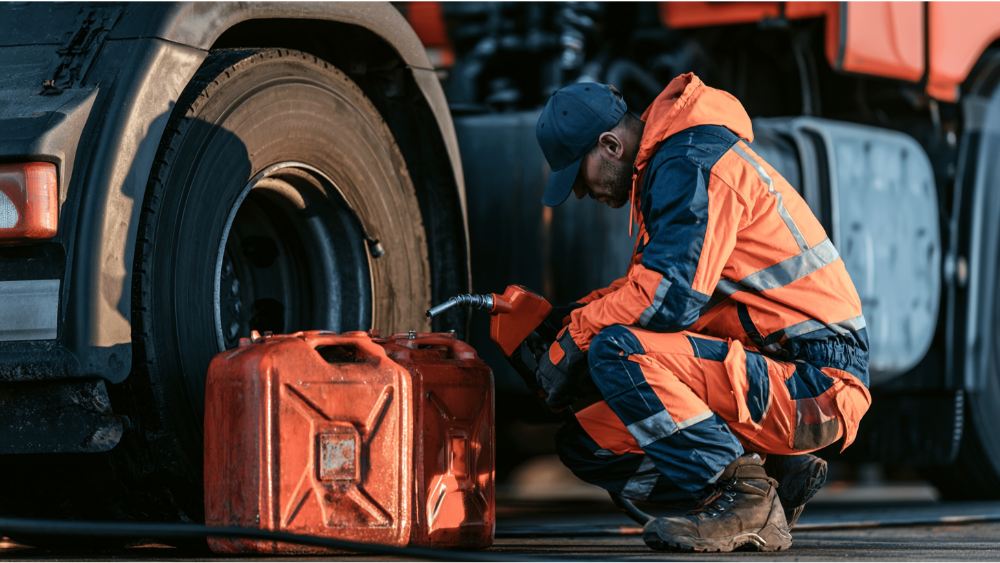
Most diesels need fuel in the tank before priming will do anything. How much you fill depends on the platform. These are OEM examples, not a universal number, so check your engine’s procedure.
| Platform | Fuel to add |
|---|---|
| Ram 2500/3500 diesel | About 2 to 5 gallons before priming |
| Ford diesel | Normally 4 to 5 gallons, more on a steep grade |
| GM Duramax | At least 2 gallons on level ground, up to 5 on a slope |
| Detroit DD Gen 5 (Class 8) | Minimum 10% of total tank volume if only partial filling is possible |
Uneven ground usually means you need more. The tank position matters here: if the pickup sits high relative to the fuel level, the lift pump has to work harder to pull fuel up. A heavy-duty rig needs far more than a pickup to get fuel back to the supply line, and dual-tank trucks add another wrinkle if the crossover line has drained.
How to Prime a Diesel Engine After Running Out of Fuel
There’s no single procedure, because there’s no single fuel system. Figure out which one you have, then follow its method. The OEM numbers below are examples to show how the systems differ, not instructions for every engine.
Electric fuel pump priming (key cycles)
Many newer diesels prime with the ignition. Turn the key to RUN so the electric lift pump runs and pulls fuel through the fuel filter. Do not crank during the prime cycle unless your manual tells you to. Some light-duty TDI and common-rail pickups run an in-tank electric fuel pump that is self priming each time you cycle the ignition, which is why cars and newer trucks often recover with nothing more than a few key turns.
- Ford: key on 30 seconds, off, repeat six times to purge trapped air.
- Ram: three cycles of 30 seconds in RUN, then at least 30 seconds off.
- GM Duramax: 30 seconds key-on so the pump can prime before you crank.
Listen for the lift pump. Let the fuel system stop making noise before you go to the starter. That quiet usually means the supply side is full. On some diesels the glow plugs will cycle at the same time, so wait for the wait-to-start light to clear before you start cranking. If your platform has a schrader valve on the rail or filter head, a good mechanic can use it to confirm supply pressure with a gauge instead of guessing.
Hand primer priming (heavy-duty)
Class 7 and 8 engines often use a hand primer on the fuel filter module. Pump it until resistance firms up or air-free fuel appears, depending on the system.
- PACCAR MX-13: loosen the primer knob, operate the pump for about 150 seconds at a maximum of 30 strokes per minute, wait 60 seconds, then give it 25 more strokes.
- Detroit DD (emergency hand primer): up to 3 minutes or 250 strokes.
Keep every drop of fuel clean. If you’re installing a new filter, fill it with clean diesel first so you’re not pushing fresh air back into the system. Check for leaks around the module and along the fuel lines when you’re done, and look for any weep or crack at the filter head that could pull air back in.
Older bleed-screw systems
Some older and medium-duty engines still use a bleed plug. On an Isuzu-style setup, you loosen the air-bleed plug, work the hand primer 20-plus cycles until the fluid runs without air bubbles, tighten the plug, then pump 10-plus more before starting.
That approach, and the old trick of cracking injector lines, does not carry over to modern high-pressure common-rail engines. Ram and PACCAR both warn against loosening fuel line fittings on those systems. The high-pressure spray can cause serious injury and can crack a fitting under load. If your engine is common-rail, prime it the way the manual specifies and leave the high side alone.
Restarting the Engine, and What NOT to Do
The restart
Crank only within your manual’s limits. The point is to fire the engine, not to prime it with the starter.
- Ford: no more than 10 seconds cranking, then 30 seconds off.
- Ram: no more than 15 seconds, then two minutes between attempts.
- Detroit: 20-second crank, 60-second cooldown, up to three cycles before you contact service.
Some engines have starter protection that will lock out cranking for up to 10 minutes after too many attempts (PACCAR). Once the engine starts, let it idle and self-purge. A short stretch of run rough or white smoke can be normal while the last of the air clears the injectors. As the first cylinder catches, the pump pulls a stronger vacuum on the supply side and helps draw the rest of the air out. PACCAR calls for about 5 minutes of idle after a start. Watch for leaks. If it keeps trying to run rough or stalls after the engine starts, stop and diagnose instead of cranking it again. Repeated air ingestion after a good prime usually points to a suction-side leak or a cracked line, not a failed procedure.
What not to do
- Don’t keep cranking. Using the starter and fuel pump to prime can damage the starter, the fuel pump, and the injectors.
- No ether or starting fluid unless your manual specifically allows it. Detroit warns it can wreck injectors, and on engines with glow plugs it can ignite early and bend a rod.
- No gasoline or alcohol in the tank.
- Don’t loosen high-pressure fuel lines on common-rail systems.
- Don’t ignore a water-in-fuel warning or gelling.
- Don’t drive away with a fuel leak.
When to Stop and Call a Diesel Mechanic
There’s a point where more cranking only costs you money. Stop and get a technician if:
- The hand primer never builds resistance.
- Fuel won’t reach the fuel filter.
- The engine starts and stalls again, repeatedly.
- You’re pulling low fuel pressure codes.
- Air keeps coming back after you prime, which often means a cracked line or a leaking fitting on the suction side.
- You suspect a filter, lift pump, injection pump, suction-side leak, injector leak, or high-pressure pump problem.
Repeated cranking burns battery, starter life, and your schedule. Correct diagnosis gets you back on the road faster. That’s the whole game. Here’s the good advice most drivers wish they’d had sooner: don’t chase a start you can’t win on the shoulder. A shop with the right machine can pressure-test the supply side, confirm whether the fuel pump is actually pulling, and find the crack or bad fitting instead of you guessing. If a part is done, they replace it once and correctly rather than patching around it.
Down on I-5, Hwy 167, or SR-512 in the Seattle-Tacoma freight corridor and it won’t prime? Call (253) 449-0100. Torpedo Truck Repair runs 24/7 Emergency Road Service and mobile dispatch within a 50-mile radius of our Fife, WA shop. We work on every vehicle from diesel pickups to Class 8 rigs, and we chase performance and reliability, not billable cranks. We’re licensed and insured, DOT certified, and our certified technicians use OEM diagnostic software to find the actual fault instead of guessing. Our shop hours are Mon through Fri, 8:00 AM to 5:30 PM, but emergency roadside dispatch is available 24/7.
Frequently Asked Questions
How do I get my diesel to start after I run out of fuel?
Add the correct diesel, prime the low-pressure system with key cycles or a hand primer, purge the air, then crank within your manual’s time limits. Don’t over-crank trying to force it. If the engine starts and then dies, stop and check for air getting back into the fuel lines.
How do I bleed a diesel after running out of fuel?
Older systems use a bleed plug and hand primer until air-free fuel appears. Modern common-rail engines self-prime through the lift pump and key cycles, so do not loosen high-pressure lines to bleed them.
How do I prime a diesel after running out?
Follow your engine’s method. Newer diesels and TDI pickups prime by cycling the ignition to RUN so the electric fuel pump fills the system; heavy-duty engines often use a hand primer on the fuel filter. Either way, let the fuel system go quiet before you crank. The whole process moves faster once you know which system you have.
What happens when you let a diesel engine run out of fuel?
Air enters the injector lines and the supply side, and the engine won’t fire until it’s primed out. Running out of fuel repeatedly risks the lift pump, injectors, injection pump, and high-pressure pump, which is why fuel policy and preventive maintenance matter.
Fleets that keep seeing loss-of-prime don’t have a driver problem, they have a fuel system problem worth catching early. Head it off with Preventive Maintenance PM Service and Fuel System Repair And Diagnostics, and we’ll rinse the contamination and fix the root cause, not just the symptom. Request a quote, or call (253) 449-0100.