Key Takeaway
Heavy-duty truck transmission fluid change intervals range from 12,000 miles in severe service on older fluid to 750,000 miles for Eaton Endurant linehaul applications running PS-386 synthetic. The correct transmission fluid change interval for heavy-duty trucks depends on the transmission model, approved fluid spec, and duty cycle. Use the OEM chart for your exact unit, then adjust for how the truck actually runs. Mileage, engine hours, and calendar months each trigger service independently, and whichever limit arrives first applies.
How Often Should You Change Heavy Duty Truck Transmission Fluid?

There is no single mileage number that fits every heavy-duty truck. A modern synthetic automated manual in clean linehaul service can run 250,000 to 750,000 miles between transmission fluid changes. A severe-duty automatic on older trans fluid can need service as often as every 12,000 miles. The transmission model, the approved fluid spec, the filter type, and the work the truck actually does set the interval, not a shop’s default guess.
If you’re an owner-operator planning your own PM, a fleet manager building a schedule, or a driver worried you’re overdue, that’s the honest answer. The right number lives in the OEM chart for your transmission and the fluid it runs, then gets adjusted for duty cycle and service history. A diesel semi truck pulling 80,000 lbs over grades does not run the same intervals as a box truck on flat urban routes, even with the same gearbox.
Here’s our position at Torpedo: a generic mileage number is a guess. Guesses either cost you money on service you didn’t need or cost you a transmission you didn’t have to lose. Both are downtime. Below is how to find the number that’s actually yours.
Why There Is No Single Interval for Every Heavy Duty Truck
Four variables control the interval, and change any one of them and the number moves:
- Transmission family. An Eaton AMT, an Allison automatic transmission, a Detroit DT12, and a Mack mDRIVE each publish different service intervals.
- Approved fluid spec. Synthetic extended-drain fluid can stretch an interval by a factor of eight over mineral oil in the same gearbox.
- Filter type. Filters often carry their own interval, separate from the fluid.
- Duty cycle. Linehaul, vocational, and severe duty are worlds apart, and that’s before you factor in engine hours, calendar time, heat, PTO use, weight, and what the service records actually show.
Fresh transmission fluid isn’t cosmetic. It carries the load film that keeps gear teeth from wearing, holds hydraulic pressure for clean shifts in an automatic, and moves heat out of the case. As fluid ages it shears down, oxidizes, and loses that protection. Old fluid runs hotter, shifts worse, and drags on fuel economy. Heat is the accelerant: run hot and heavy, near 65,000 lbs GVW and up, and the fluid breaks down faster than the odometer suggests. That’s the plain-language “why” the OEM charts leave out, and it’s why a driver who ignores the tranny until it grinds usually pays more than one who schedules on time. If you’ve been wondering whether you’re overdue, that instinct is worth acting on.
Transmission Fluid Change Intervals for Heavy Duty Trucks by Transmission Type

You’ll see general rules online: change a manual every 100,000 to 150,000 miles, an automatic every 50,000 to 75,000 miles, longer on synthetic. Those are passenger and light-truck rules of thumb, closer to a Ford pickup or an LQ horse trailer tow rig than a working Class 8 tractor. They do not govern Class 6 through 8. Heavy-duty OEM specs override them completely. Here are the published transmission fluid change intervals by transmission family for the fluid spec listed:
| Transmission | Linehaul / Normal | Vocational / Severe |
|---|---|---|
| Eaton manual / AMT (PS-386 synthetic) | 500,000 mi / 5 yr | 180,000 mi / 3 yr vocational |
| Eaton same trans (mineral fluid) | 60,000 mi / 1 yr | 60,000 mi / 1 yr |
| Eaton Endurant HD (PS-386) | 750,000 mi / 5 yr | 250,000 mi / 3 yr vocational |
| Eaton Endurant XD (PS-386) | 500,000 mi / 5 yr | 250,000 mi / 3 yr vocational; 2,500 hr / 3 yr stationary |
| Allison 1000/2000 (TES 668 / TES 295) | 150,000 mi / 4,000 hr / 48 mo general | 75,000 mi / 3,000 hr / 36 mo severe |
| Allison 3000/4000 (TES 668 / TES 295) | 300,000 mi / 6,000 hr / 48 mo general | 150,000 mi / 6,000 hr / 48 mo severe |
| Detroit DT12 (MY2017+) | 400,000 mi / 5 yr (≤80k lb); 300,000 mi / 5 yr (80k–140k lb) | 180,000 mi / 3 yr severe / heavy-haul |
| Mack mDRIVE (97318 / 97319) | 500,000 mi / 60 mo normal | 250,000 mi / 2,500 hr severe / crawler |
These are OEM-published figures for the exact fluid spec named. Notice the spread: from 60,000 miles on mineral oil to 750,000 on approved synthetic. Those are the big ones that separate a shop that reads the tag from one that guesses. Model coverage inside each family varies, so verify the exact interval by VIN, transmission tag, and model year before you schedule. That verification is where a lot of shops skip a step and you pay for it later. The published number in your owners manual is the starting point, not the final call, because the manual assumes a duty cycle that may not match your truck.
Linehaul vs Vocational vs Severe Duty: Which One Is Your Truck?
Duty class is the single biggest reason two trucks with the same transmission need different service. The OEMs draw the lines like this:
- Linehaul. Eaton counts it as over 50,000 miles a year with 80% of trips running more than 30 miles between starts and stops. DTNA calls its long-haul class over 60,000 miles a year with minimal stop-and-go and low idle.
- Vocational. Eaton puts it under 60,000 miles a year, off-highway, or under 30 miles between starts and stops: city delivery, construction, refuse, logging, yard tractors.
- Severe duty. Running near max GCW/GVW, dirty or wet environments, and grades over 8%. Allison classes on/off-highway, refuse, city transit, and shuttle transit as severe.
Severe service can cut an interval by 30 to 50%, which is why the same gearbox drops from 300,000 miles general to 150,000 severe. Heavy loads, mountain grades, and high ambient heat all stress the fluid chemistry faster. A truck that spends its life at max weight is aging its trans fluid at a rate the odometer never shows.
This matters for trucks working the Seattle-Tacoma freight corridor. A rig running I-5, Hwy 167, and SR-512 with port and drayage work, stop-and-go city delivery, and grades often lands closer to a vocational or severe schedule than clean linehaul, even when the odometer looks like long-haul numbers. Honest assessment of how the truck actually runs beats an assumed class every time. That same honesty applies to the whole vehicle: the transmission, the engine oil change intervals, and the coolant schedule all shift when the duty cycle is heavier than the paperwork suggests.
Should You Go by Mileage, Engine Hours, Calendar, or Fluid Analysis?

The rule the charts use is “whichever comes first.” Mileage, engine hours, and months each trigger service on their own. That matters for idle-heavy and PTO-heavy trucks, which pile up hours far faster than miles, so the hour limit or the calendar can come due long before the odometer.
Fluid analysis is the most precise method when you can use it. Allison recommends it as the primary way to set change intervals: pull a sample, let the fluid’s actual condition drive the call instead of a date on the wall. A lab report tells you whether the automatic transmission fluid still has additive life left or whether it’s oxidized and loaded with wear metals. Onboard prognostics do the same math automatically. DTNA’s Maintenance System computes optimal DT12 intervals from real powertrain data and operating conditions rather than mileage alone, which keeps the driveline at optimal performance without over-servicing it.
Which method fits depends on how your truck runs and whether it’s spec’d for prognostics. What we won’t do is hand you a default number and call it a plan. A straight answer starts with reading the truck.
Why Fluid Spec Matters as Much as Mileage
Fluid spec is the biggest lever on how long an interval runs. Put Eaton PS-386 synthetic in a heavy-duty gearbox and you get 500,000 miles. Put mineral fluid in the same transmission and it drops to 60,000. Allison’s general interval on TES 668 or TES 295 is 150,000 miles for a 1000/2000; on TES 389 it falls to 50,000, and 12,000 in severe service.
The right spec is not optional. The DT12 uses MB 235.16 75W-85 and MB 235.11 75W-90, and 235.16 is not approved for MY2016 and older units. Mack runs 97318 for normal duty and 97319 for severe and crawler gears. Approved fluids only. The wrong automatic transmission fluid voids the interval and can cook the transmission, and it can put your warranty at risk. Confirm the approved fluid by model year before anyone tops off, flushes, or refills. A complete flush that pushes the wrong fluid through the case is worse than no service at all, and a good mechanic checks the manufacturer recommendations before touching the fill port. Never let the wrong fuel or fluid spec near the wrong system.
Does the Transmission Filter Get Changed With the Fluid?

Not always on the same schedule. OEM charts often list filters on their own line. On an Allison 3000/4000, the main filter comes due at 75,000 miles / 3,000 hours / 36 months even when the fluid runs to 300,000, while the internal filter is listed at overhaul. Eaton says transmission filters should be changed during regular lube intervals and inspected at every PM check.
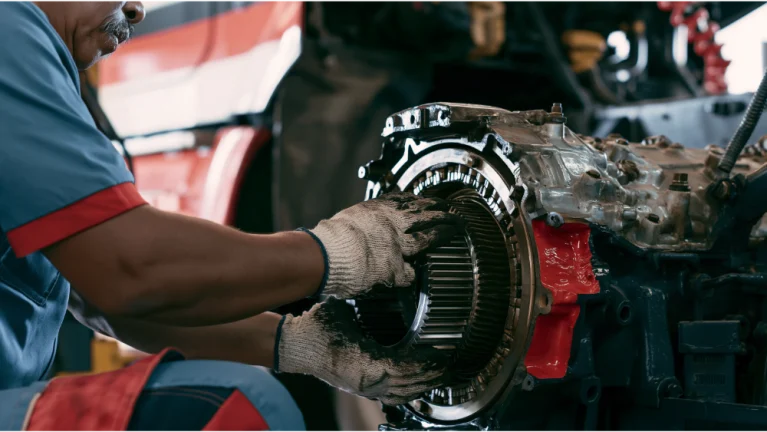
There’s a difference between a drain-and-fill and full pan service. A drain-and-fill empties and refills to spec. A complete service drops the pan, works to replace filter and gasket, installs a new filter, and refills to the mark on the dipstick or fill port. A full flush moves more of the old fluid out of the torque converter and cooler lines than a simple drain, which matters when the fluid is dark or overdue. Torpedo does this as documented work, with an itemized estimate in your hand before we open anything up. No surprises when the invoice lands.
Signs Your Truck Needs Transmission Service Before the Scheduled Interval
These override the calendar. Any one of them is a reason to schedule service with a diagnostic scan now, not at the next interval:
- Harsh or delayed shifts, or other shifting problems
- Slipping under load or hunting between gears
- Transmission fault codes on the input or output side
- Overheating (Eaton warns transmissions must not run above 250°F / 121°C; above that, loaded gear-tooth temps can exceed 350°F / 177°C and cause premature gear failure)
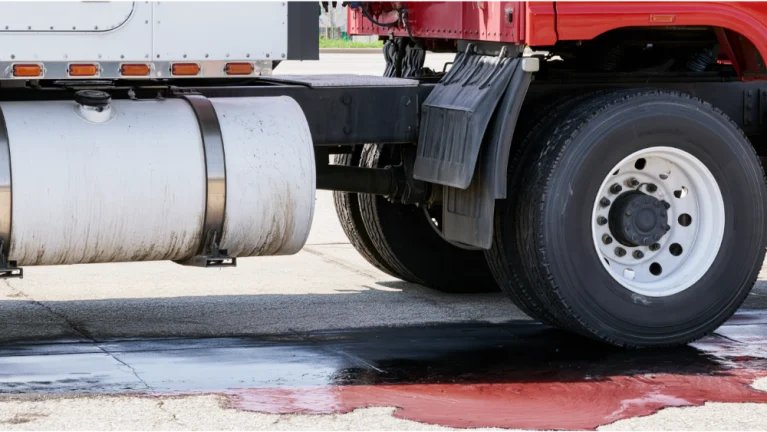
- Fluid leaks
- Burnt smell or dark fluid
- Metal debris on the drain plug
- Low fluid levels on the dipstick
- Rough engagement when the trans is cold on a first start of the day
- Unknown or missing service history on a used truck
Heat is usually the culprit behind the worst of these. High ambient temps, high horsepower, restricted airflow, heavy PTO use, and prolonged high RPM all push case temperature up. A struggling cooling system feeds the problem too, since a motor running hot on old coolant shares that heat load with the driveline, and a failing thermostat or clogged radiator makes it worse. Engines at 400 hp and 1,400 lb-ft and above often require an external transmission oil cooler for exactly this reason. If your truck runs hot and you don’t have one, that’s a conversation worth having before the fluid tells you the hard way.
Building Transmission Preventive Maintenance Into a Fleet Management Schedule

FMCSA requires every carrier to systematically inspect, repair, and maintain its vehicles, and to keep maintenance records for any vehicle it controls for 30 consecutive days or more. What FMCSA does not do is set a transmission fluid change interval. The carrier sets it. That means your business needs a documented, defensible schedule built on OEM specs, real duty cycle, and service history, not a number someone guessed. The failures tend to occur when the paperwork and the actual duty cycle drift apart.
Good preventive maintenance ties the transmission fluid change into the same rhythm as the oil change, coolant service, and DOT inspection, so a unit comes off the road once and gets everything it needs. It also keeps an eye on the systems that share the load, from the brake fluid to the fuel tank and lines. Torpedo builds custom PM schedules by transmission and application, keeps consistent repair quality across every unit, and documents service for DOT compliance. Fleet account billing and priority scheduling keep the paperwork and the timing predictable, so a fleet management team isn’t chasing units week to week. Consistency across units is what keeps a fleet audit-ready and keeps trucks off the shoulder.
Frequently Asked Questions
How often should I change the transmission fluid in a diesel truck?
There is no universal number. It depends on the transmission model, the approved fluid spec, and the duty cycle. Heavy-duty intervals span from roughly 12,000 miles in severe service on older fluid to 750,000 miles for some Eaton Endurant linehaul applications on PS-386 synthetic. Verify by VIN and transmission tag, and check the manual for your exact model year.
What is the Eaton Fuller transmission fluid change interval?
On approved PS-386 synthetic, many heavy-duty Eaton transmissions run 500,000 miles or 5 years in linehaul and 180,000 miles or 3 years vocational. On mineral fluid the interval drops to 60,000 miles or 1 year. Endurant HD on PS-386 can reach 750,000 miles linehaul.
Does severe duty shorten the transmission fluid interval?
Yes, often by 30 to 50%. Near-max weight, dirty or wet environments, grades over 8%, and stop-and-go work all shorten the interval. An Allison 3000/4000 drops from 300,000 miles general to 150,000 severe on the same fluid.
Should the transmission filter be replaced every time?
Not necessarily on the same schedule as the fluid. Filters often have their own interval. An Allison 3000/4000 main filter comes due at 75,000 miles even when the fluid runs to 300,000, and the internal filter is listed at overhaul. Confirm the filter interval for your model before you replace anything.
Is a transmission flush better than a drain-and-fill on a semi truck?
It depends on the transmission and how overdue the fluid is. A flush moves more old fluid out of the converter and cooler lines, but the right service is whatever the OEM specifies for your gearbox with the approved fluid. Never let a shop flush the wrong spec through the case.
When to Schedule Service With Torpedo Truck Repair
If you’re unsure of your interval, staring at an OEM chart that doesn’t match how your truck runs, or you’ve seen any of the warning signs above, bring it to our Fife, WA shop at 7495 26th St E Ste B. We handle Transmission And Clutch Repair, Preventive Maintenance PM Service, and Electrical Diagnostics And Repair when fault codes or TCM concerns are in play. We’ll verify the transmission by tag and model year, confirm the approved fluid, and give you an itemized estimate before any work starts. If you want the spec chart for your exact model year, we can pull the right page and walk you through it. If you’re down on the road, our 24/7 emergency dispatch covers the corridor. Call (253) 449-0100 and we’ll get you a straight answer and a plan to keep the truck road-ready.