Key Takeaway
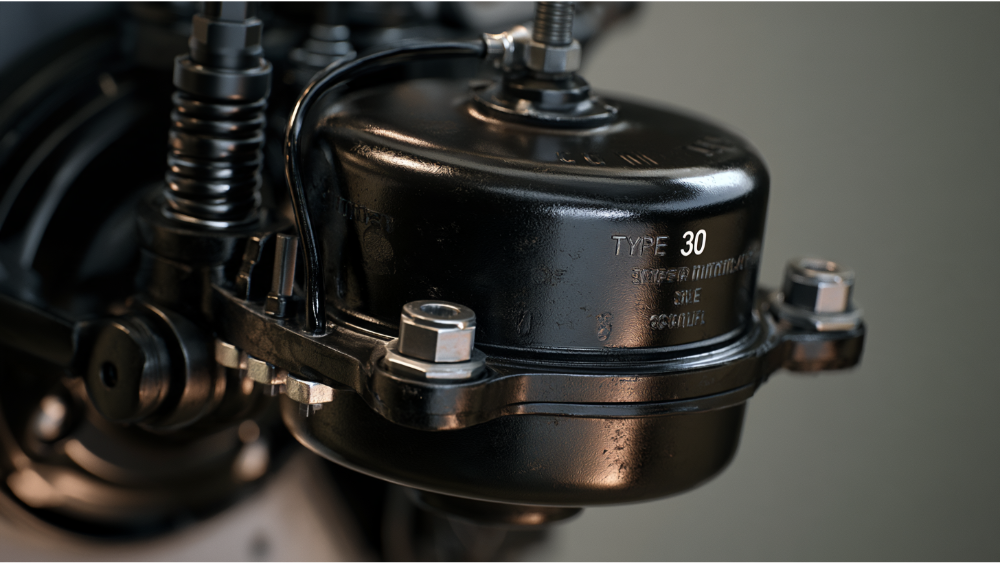
An air brake chamber converts compressed air pressure into mechanical force at the wheel end to apply the foundation brakes. Service chambers handle normal stops, while spring brake chambers use stored spring energy for parking and emergencies. Federal rules reject any truck with an audible leak, broken pushrod, or stroke past the legal limit, which for a Type 30 chamber is 2 inches standard or 2.5 inches long stroke.
An air brake chamber turns compressed air into mechanical force at the wheel end and applies the foundation brakes. Service chambers handle normal braking. Spring brake chambers add stored spring force for parking and emergency stops. Any leak, binding pushrod, damage, or stroke past the readjustment limit gets inspected before the truck moves.
Hearing a hiss at a wheel end? Brakes that will not release? Here is how the chamber works, what failure looks like, and what a correct diagnosis has to verify.
How Brake Chambers Work in Semi Truck Air Brake Systems

You press the treadle, air pressure acts on a flexible diaphragm, and the diaphragm drives the pushrod. The pushrod moves the clevis and slack adjuster, the camshaft rotates the S-cam, and the shoes contact the drum.
Service Brake Chambers vs. Spring Brake Chambers
A service-only chamber has one air port and one job: apply the brakes when you tell it to. A combination chamber, also called a piggyback, adds a sealed parking spring section with its own port. It is designed to apply the brakes mechanically when air pressure drops or is released. That difference is what holds the truck when the air is gone.
What Type 30 and 30/30 Markings on Brake Chambers Mean

The type number is nominal effective diaphragm area in square inches. Type 16, 20, 24, and 30 are the common sizes. A single number is a service-only chamber. A double designation (30/30, 24/30) names the service section first, the spring section second.
Chambers also come in standard stroke and long stroke versions, which changes the legal readjustment limit. Identification comes from the stamped tag, port arrangement, old part number, and OEM build data. Many suppliers stock only common sizes, so do not let price or availability decide the spec. Match size, rated stroke, mounting, pushrod length, clevis, and port orientation before anything goes in a cart.
How Do You Know if a Brake Chamber Is Bad?
Signs a chamber is failing:
- Audible hiss at the wheel end, or air leaks you cannot account for
- Brakes that drag, release slowly, or leave a hot wheel end
- Bent, binding, or broken pushrod, or a loose chamber
- Cracks, corrosion, blocked drain holes, or missing caging hardware
- Applied stroke past the readjustment limit
Appendix A to 49 CFR Part 396 rejects a vehicle for broken pushrods or mounting bolts, a loose chamber, an audible leak including a ruptured diaphragm, and stroke beyond the limit. Note that a hiss near a wheel end can just as easily be a fitting, hose, or valve. Mechanics who jump to a conclusion there replace good parts and leave the leak. Leak-detection solution isolates the source. Never use oil.
Can You Keep Driving With a Leaking Brake Chamber?

No. Audible leaks, dragging brakes, damage, or over-limit stroke all require evaluation before the truck rolls. Do not cage a spring brake to finish a run; caging removes the parking and emergency brake operation you need if pressure drops again. CVSA’s 2026 International Roadcheck logged 5,451 brake out-of-service violations, 39.1% of all vehicle OOS violations.
Why Excessive Pushrod Stroke Is Not “Just a Slack Adjuster Adjustment”
Over-stroke can occur for several reasons. A failing automatic adjuster, worn foundation brake components, bushings, clevis geometry, or drum wear all lead to stroke past the limit while the chamber itself is fine. Air-braked CMVs built on or after October 20, 1994 must meet automatic brake adjustment requirements under FMVSS 121 and 49 CFR 393.53, and federal inspection standards say the underlying problem gets corrected, not manually readjusted. The usual advice is to turn the adjuster. That buys a few weeks and books a second round of downtime.
Federal Pushrod-Stroke Limits for Clamp-Type Brake Chambers

| Chamber type | Standard stroke | Long stroke |
|---|---|---|
| Type 12 | 1⅜ in. | 1¾ in. |
| Type 16 | 1¾ in. | 2 in. |
| Type 20 | 1¾ in. | 2 in. |
| Type 24 | 1¾ in. | 2 in. |
| Type 30 | 2 in. | 2½ in. |
Actuators not listed may not exceed 80% of the marked rated stroke. Full text: 49 CFR 393.47.
Two measurement contexts, and they differ. Federal periodic inspection measures fully applied stroke, engine off, at 80 to 90 psi. CVSA’s field procedure blocks the wheels, releases the spring brakes, builds to 90 to 100 psi, marks the rods, then applies and measures travel. Free stroke is no substitute. The table covers S-cam drum brakes.
What a Verified Diagnosis and Chamber Replacement Includes
- Confirm the complaint and isolate air leaks with leak-detection solution, not guesswork.
- Identify chamber type and rated stroke from the tag and build data.
- Inspect mounting, pushrod alignment, clevis, adjuster, and foundation brake components for wear.
- Match both ends of the axle in chamber size, rated stroke, and slack adjuster length per 49 CFR 393.47 to ensure balanced braking.
- Block the wheels, drain system pressure to zero, then cage the spring and remove the old chamber.
- Clean the mounting surface, verify pushrod length, and install with new self-locking nuts torqued to 144 ± 11 ft-lbs.
- Leak-test, re-measure applied stroke, confirm the parking brakes apply and release.
No step gets skipped, which is what keeps a truck from getting parked twice. Common sizes are stocked in the shop, so the job moves quickly instead of waiting on a parts order. You get an itemized estimate covering parts and labor before the work starts. No surprises.
Caging a Spring Brake Chamber: Where the Safety Boundary Is

The caging bolt compresses and holds the parking spring so the actuator comes off safely. The spring section is factory sealed and never disassembled, because the stored energy in it can cause serious injury. Procedure, rotation direction, and tool requirements vary by design, and impact tools are prohibited on some units. Use a hand wrench on the caging bolt and follow the Bendix or OEM instruction written for that actuator. If you are unsure of the procedure, it is technician work.
Fleet PM Checks That Keep Brake Chambers Off the Roadside
Fleet managers get more out of trend data than generic tips. These checks belong in every PM:
- Record chamber type and rated stroke by unit and axle position.
- Inspect for corrosion, cracks, loose mounting, blocked drain holes, and boot condition.
- Measure and trend applied stroke between PM intervals. That is more efficient than a roadside replacement.
- Flag units with repeat adjustment complaints for wheel-end diagnosis.
- Stock the chamber sizes your fleet runs so a replacement is not a two-day wait.
- Keep findings in PM and DOT inspection documentation that shows the unit meets federal braking requirements.
Federal periodic inspection is required at least every 12 months (49 CFR 396.17), and carriers carry a systematic maintenance duty under 49 CFR 396.3. Wheel ends checked regularly stay compliant. A fleet maintained on paper only does not. CVSA’s 20% defective-brake threshold is why one chamber out of adjustment parks a whole combination.
What Does It Cost to Replace a Brake Chamber?

Price depends on chamber type, rated stroke, axle position, and what the wheel-end diagnosis turns up. That is why the estimate is itemized before work begins.
Get the Chamber Diagnosed Right the First Time
Torpedo Truck Repair services Class 6 through 8 trucks and trailers, including Freightliner, Kenworth, Peterbilt, Volvo, Mack, International, and Western Star. Certified technicians, itemized estimates before work begins, same-day service focus when possible. Shop in Fife, WA, Mon-Fri 8:00 AM to 5:30 PM, with 24/7 emergency dispatch and roadside response.
Call Now: (253) 449-0100. Request Service Quote takes under 60 seconds. No obligation.