Key Takeaway
Diesel engine oil leak repair begins with locating the highest fresh leak source, not the wettest spot, since oil routinely travels far from where it originated. Shut the engine down immediately if you see a pressure or stop-engine warning, oil spraying or streaming, or oil contacting hot exhaust components. Surface seeps with a stable oil level can be scheduled, but active leaks require roadside service or a tow. FMCSA recorded 54,481 oil and grease leak violations in 2023 inspections alone.
Diesel engine oil leak repair starts with positively locating the highest fresh leak source. That usually means cleaning the engine, running it, and inspecting from the top down, with UV dye or pressure testing when visual inspection can’t confirm the source. Then the failed gaskets, seals, lines, fittings, or housing get replaced or resealed and verified at operating temperature. If oil is actively dripping or pooling, the oil level is falling, a pressure or stop-engine warning is on, or oil is reaching hot exhaust parts, shut the truck down and get roadside service or a tow. Written for owner-operators, drivers, and fleet managers making a run-or-stop call right now. Call (253) 449-0100 for 24/7 emergency roadside dispatch.
Is It an Oil Seep or an Active Oil Leak?
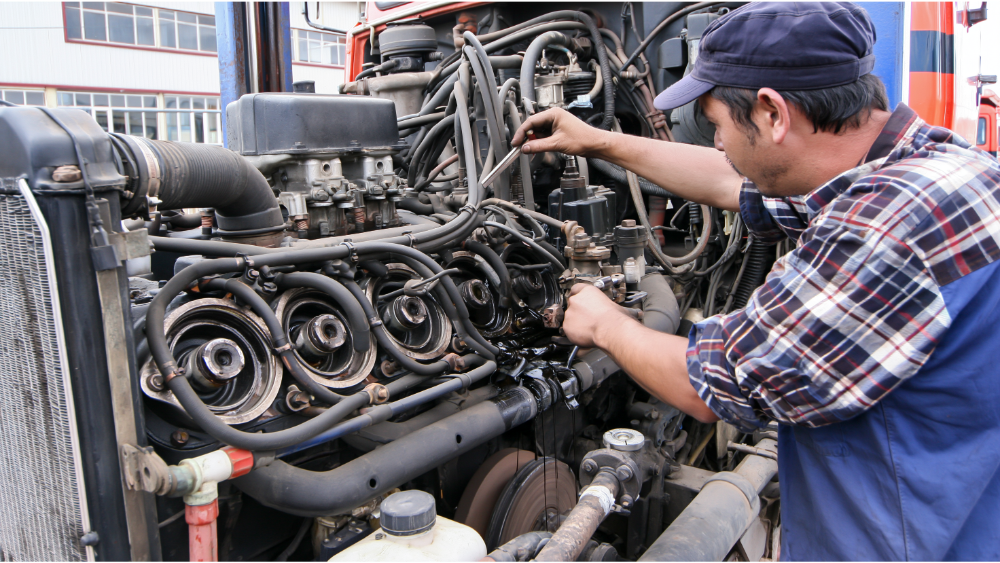
The rest of this article depends on knowing which one you have.
A seep leaves damp residue on the component surface. It darkens with road grime. Nothing reaches the ground.
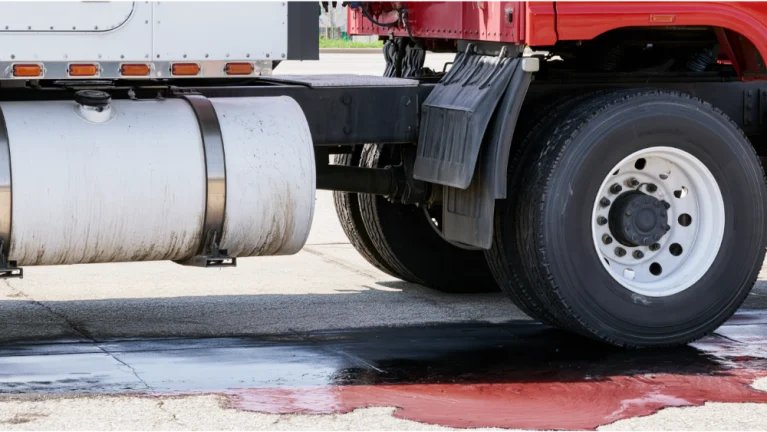
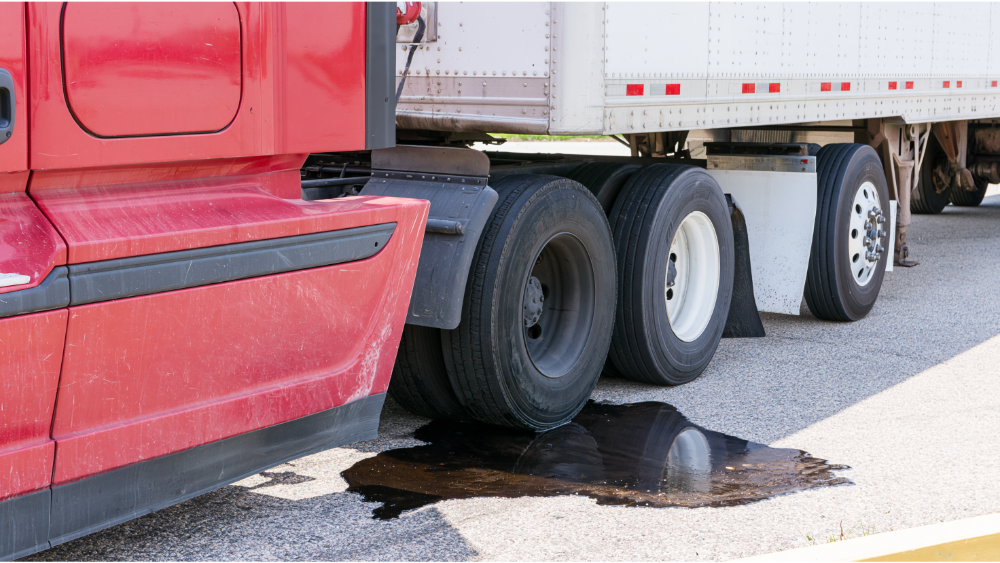
A leak is wet enough to drip, pool, or spray, and you can measure the oil loss on the dipstick between checks.
A seep gets scheduled and monitored. An active oil leak gets triaged now. Plenty of pages online tell you every small leak is an instant catastrophe, and that isn’t accurate. But small leaks aren’t something you carry for two years either. Worn gaskets and hardened seals only get worse under heat cycling and hours. Watch the oil level. If it starts moving, the condition changed.
Both are forms of external leak. Oil disappearing with no drips underneath is a different problem: oil burning past worn piston rings and a scored cylinder wall shows up as consumption and exhaust smoke, not a puddle.
When Should You Shut a Diesel Engine Down for an Oil Leak?
Some leaks are a scheduling problem. Some are a fire and engine-damage problem. The warning signs that separate them are not subtle.
| Decision | Conditions | Action |
|---|---|---|
| Shut down now | Oil pressure or stop-engine warning. Rapidly falling oil level. Active spray or a steady stream. Smoke or a strong burning-oil smell. Oil visible on the turbocharger, exhaust manifold, or exhaust piping. Oil-soaked belts or hoses. A large leak immediately after an oil change or repair. | Stop safely. Do not restart. Call for roadside service or a tow. |
| Get a roadside assessment | Steady drips with no identified source. Loaded and away from home base. Oil level moving but pressure normal. | Get eyes on it before you commit to the next leg. |
| Schedule prompt shop service | Surface residue only. Stable oil level. Nothing reaching the ground. | Book a bay. Keep checking the dipstick until it’s traced. |
There is no universal safe number of miles. Leak rate changes with oil temperature, engine speed, crankcase pressure, and load, so a leak that drips at idle can stream at 1,400 RPM under a full trailer. Federal rules back this up: under 49 CFR §396.3, a vehicle with an unsafe condition discovered on the road may only be moved to the nearest place repairs can safely be made, and only when moving it is less hazardous than leaving it where it sits.
One more thing while you wait. Contain the oil. Keep it out of catch basins and storm drains. Used motor oil is slow to degrade and carries heavy metals, and the cleanup obligation lands on you.
Why the Puddle Doesn’t Show Where the Engine Started Leaking Oil
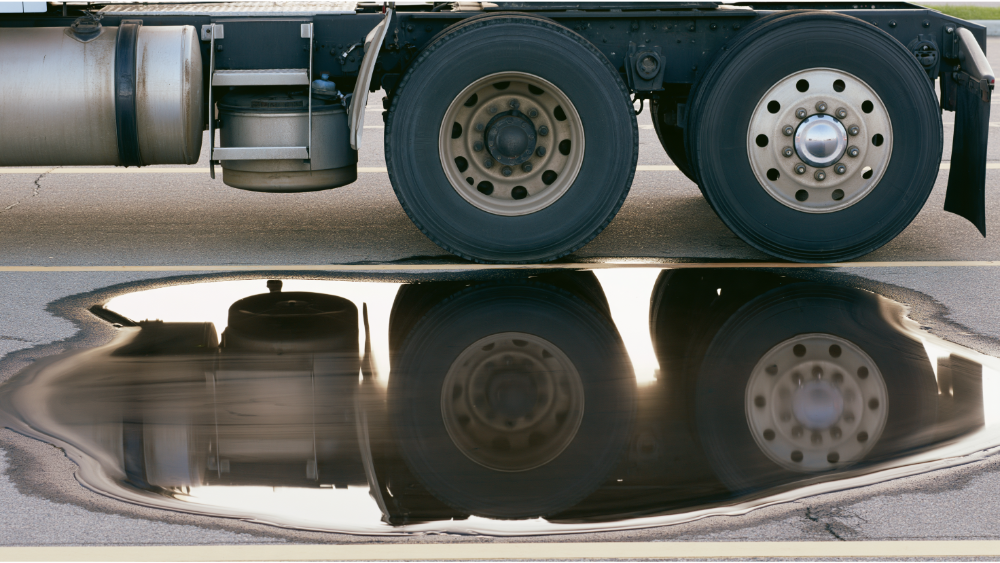
Many oil leaks show up a long way from where they started. Oil tracks down the engine block and rearward. Fan blast, airflow at road speed, gravity, and road grime carry it away from the failure point, so the wettest component is frequently not the one that failed. Oil pooled at the bellhousing may have started at a valve cover four feet forward and above it.
Diagnosis starts at the highest fresh oil trace, not the lowest or the wettest. Replacing the wettest gasket without cleaning and tracing the path buys you a second repair and a second round of downtime. A mechanic working off the puddle alone is guessing, and it happens constantly.
Before any part comes off, recent service gets ruled out. A loose or improperly installed oil filter. A loose oil drain plug or a damaged drain plug gasket. Oil spilled during a fill. An overfill. A loose filler cap. When one of those is genuinely the source, the fix is tightening a filter or replacing a gasket, not opening the engine.
Oil Change Errors: Oil Filter and Oil Drain Plug Gasket Leaks
A real share of the leaks we trace start at the last oil change. That’s not a knock on anybody. It’s where the sealing surfaces were disturbed most recently, and it’s the cheapest thing to rule out before we start pulling covers.
What gets checked first after any oil change:
- Oil filter seals. A dry filter gasket, an old gasket left stuck to the housing when the previous oil filter came off, or a spin-on cranked past spec will all leak under pressure. So will a cartridge-style filter with a nicked or reused O-ring set.
- Oil drain plug gasket. On most platforms it’s a one-time crush washer. Reuse it and the drain weeps. Overtighten the plug and the pan threads let go, which turns a cheap gasket into a damaged oil pan.
- Fill level. Oil spilled during the fill bakes off for days and reads exactly like a leak. Overfilling raises crankcase pressure and pushes oil past seals that were holding fine yesterday.
- Filler cap and dipstick tube seals. Small parts, easy to miss, and oil drips from them onto everything below.
- Valve cover bolts. If the cover came off for a valve adjustment, the bolts get retorqued with a torque wrench in the OEM sequence, not snugged by feel.
Run the oil grade the engine manufacturer specifies. Where the platform calls for synthetic, correct-viscosity synthetic oil does more for gasket and seal life than anything you can pour in from a bottle. Regular oil level checks, plus a dry re-inspection a few hundred miles after every oil change, catch an installation error while it’s still a small leak and not a shutdown.
Where Diesel Engines Leak Oil: Gasket and Seal Failure Points on High Mileage Engines
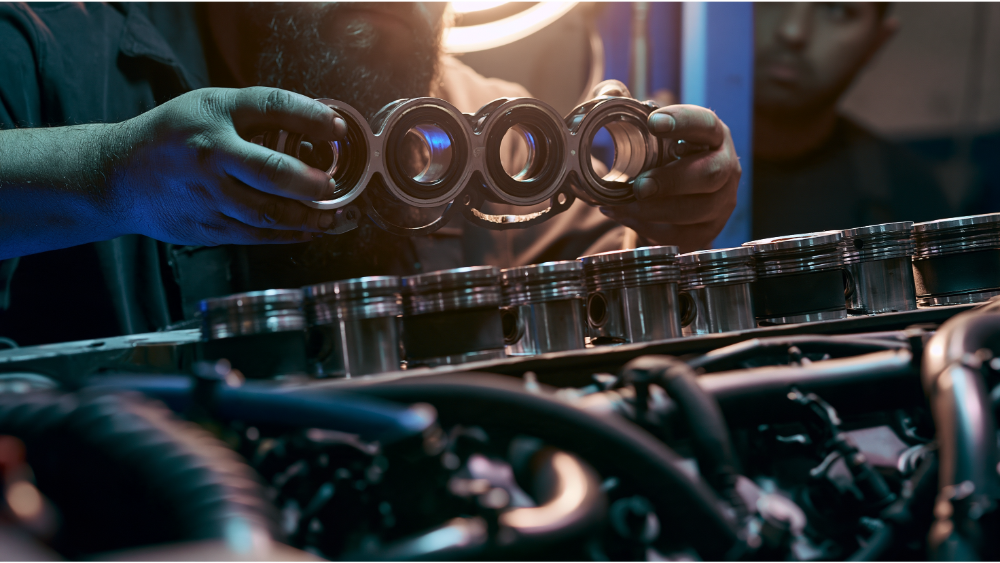
These are inspection points, not diagnoses. Oil showing up at any of them means look, not replace.
Top of the engine: valve cover gaskets and seals
Valve cover or rocker cover gaskets, grommets and bolt seals, camshaft housing seals, gallery seals, injector harness O-rings, and the cylinder head gasket where it meets the block. The valve cover gasket is one of the most common oil leak sources on diesel engines, because it sits in the hottest, most heat-cycled position and hardens first. Leaks up here run down over everything below and confuse the picture fast.
Front of the engine
Front crankshaft oil seal and the timing cover or gear cover gasket. Fan blast spreads front leaks across the whole engine bay.
Side of the engine
Oil cooler or oil coolant module, oil filter and filter housing gaskets, turbocharger oil supply and return lines, and the air compressor mounting area. Turbo feed lines carry pressurized oil, which is why a failure there can put oil directly onto hot exhaust components.
Bottom of the engine
Oil pan, oil pan gasket, pan bolts, the oil drain plug and its gasket. This is also where migrating oil collects, so a wet pan rail proves nothing on its own.
Rear and bellhousing
Rear main seal, also called the rear crank seal, and the flywheel housing gaskets. Oil at the bellhousing does not prove the rear main seal failed. Oil from anywhere above it ends up there. On units with automatic transmissions, transmission fluid reads like engine oil until the fluid is confirmed. That’s a transmission-out repair if you get it wrong, which is exactly why the trace matters.
Heavy-duty diesel engines see this more than light vehicles for straightforward reasons: higher compression, sustained heat cycling over long hours, and rubber seals and paper gaskets that harden and lose sealing tension across high mileage.
How Professional Diesel Oil Leak Diagnosis Works
A defensible workflow looks like this:
- Interview the driver: oil-loss rate, warning lights, recent service, when it started, and under what conditions.
- Confirm the fluid is engine oil and not fuel, coolant from a weeping water pump, transmission fluid, or hub lubricant.
- Inspect before cleaning to find the heaviest concentration and the direction of travel.
- Clean the engine and undercarriage with brake cleaner or an approved degreaser, without soaking connectors, sensors, or harnesses.
- Run the engine and inspect from the highest point down.
- Apply approved fluorescent dye or run a pressure test when visual inspection can’t positively identify the source.
- Check the crankcase ventilation system and measure crankcase pressure when multiple seals leak or a new seal fails again.
- Repair the confirmed component using the engine-specific OEM procedure, sealant, and torque sequence.
- Bring the engine to operating temperature and re-inspect.
- Document the source, the repair, and the verification before release.
When Crankcase Pressure Is the Real Cause
If several gaskets and oil seals are leaking oil at once, or a new seal fails again within weeks, stop replacing parts and measure crankcase pressure. A clogged breather, collapsed breather hoses, a failed ventilation system, or a worn cylinder kit sends pressure into the crankcase, and that pressure pushes oil out through whichever seal offers the least resistance. Install five new gaskets against high crankcase pressure and you’ll be back for the sixth. The ventilation system gets corrected first. Then the sealing components get replaced.
That’s how we work at Torpedo. OEM diagnostic software, UV dye and pressure testing on the platforms we service, certified technicians, and post-repair verification at temperature. You get a full itemized estimate before a single bolt is turned. No surprises, no upsell.
What the Repair Involves, and Why the Timeline Varies
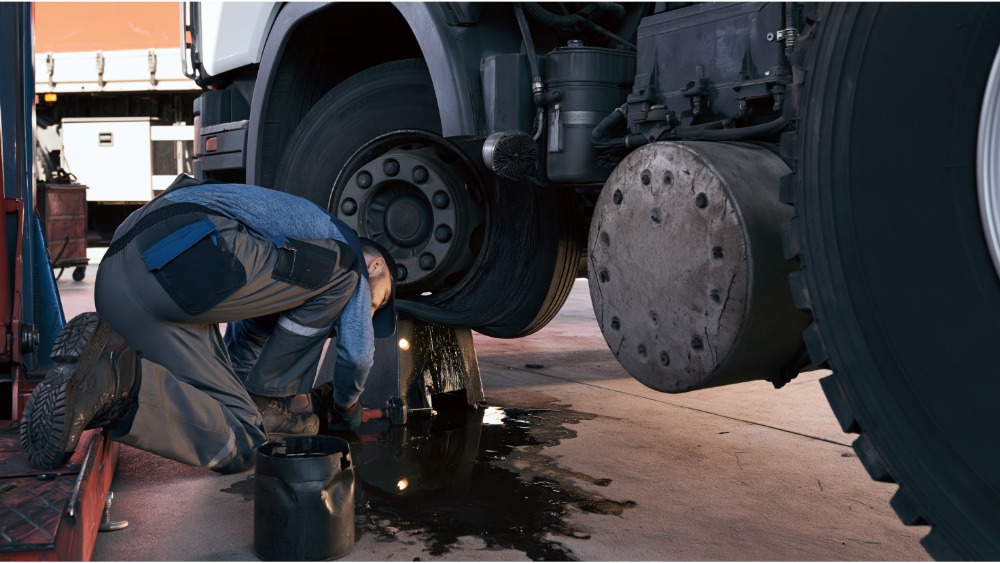
Scope depends entirely on what’s confirmed. Common repairs include gasket or O-ring replacement, oil line and hose replacement, oil pan or housing repair, filter housing and oil cooler resealing, and front cover or rear seal work. The part is the easy half. Surface preparation, the correct OEM torque sequence, and the right sealant determine whether it holds. New gaskets installed on a contaminated or warped sealing surface leak again, usually within a few thousand miles.
Timeline varies for reasons you can’t see from the driver’s seat: how accessible the component is, whether the transmission or flywheel housing has to come out, parts availability, how much oil has soaked into belts, hoses, wiring, and surrounding engine parts, and whether crankcase pressure caused the failure in the first place.
Our position on this is firm. Diagnosis comes before any timeline or estimate. A shop quoting hours before it has located the source is guessing, and that guess costs you money twice. We stock commonly used parts in the shop and work toward same-day service when possible, but the number comes after the source is confirmed.
Can an Oil Leak Cause a DOT Violation?
Yes. 49 CFR §396.5 requires motor carriers to keep vehicles properly lubricated and free of oil and grease leaks. §396.3 requires systematic inspection, repair, and maintenance with parts kept in safe operating condition. §396.13 puts it on the driver to be satisfied the vehicle is safe before driving.
FMCSA recorded 54,481 oil and/or grease leak violations during 2023 inspections, one of the 20 most frequently recorded vehicle violations. That’s violation counts, not unique trucks and not out-of-service orders.
Here’s the nuance most pages skip: a violation and an out-of-service order are not automatically the same thing. CVSA updates its North American Standard Out-of-Service Criteria annually, with the current criteria effective April 1, 2026, and the OOS decision depends on the specific condition found.
For safety directors, the file matters as much as the fix:
- Confirmed leak source, documented
- Gaskets, seals, and other parts replaced, plus the procedure used
- Technician verification at operating temperature
- Release record attached to the unit file
Do Stop Leak Additives and High-Mileage Oil Actually Fix a Diesel Oil Leak?
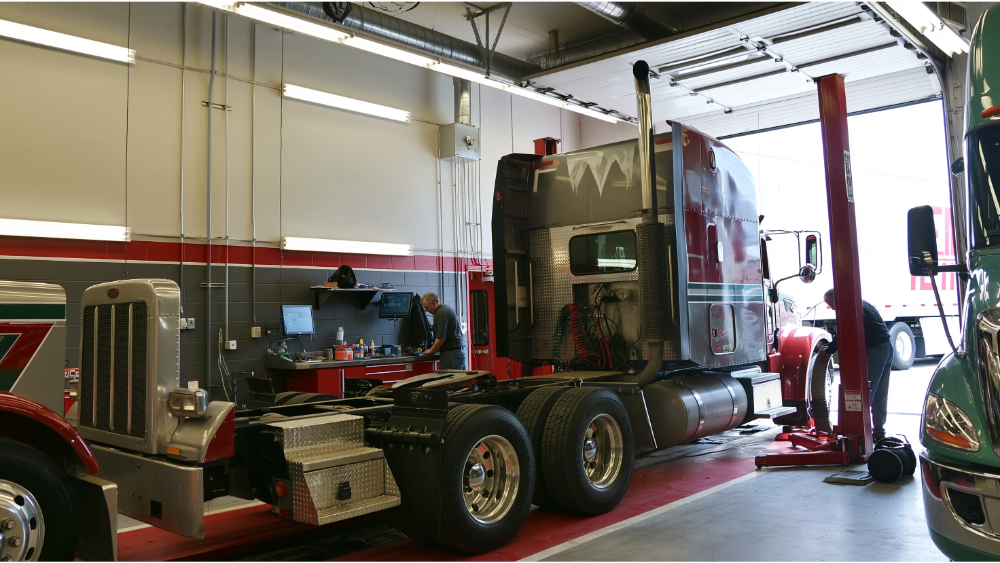
Additives sold to stop oil leaks can swell aging rubber and temporarily slow a minor seep. That’s a temporary fix, and it’s why they sell.
They do nothing for a cracked housing, a failed oil line, a damaged sealing surface, or excessive crankcase pressure. Worse, they mask the symptom while oil keeps reaching belts, hoses, wiring, sensors, and exhaust components. Detroit does not recommend regular continued use of supplementary lubricant additives. A current PACCAR operator manual states aftermarket oil additives are unnecessary and may reduce the oil’s ability to protect the engine.
Don’t pour a stop leak product into a heavy-duty diesel unless that exact product and use are approved by the engine manufacturer.
How to Prevent Repeat Oil Leaks Across a Truck or Fleet
Build the leak check into PM instead of reacting to puddles. Inspect the engine dry, so fresh oil is obvious. Track dipstick trends and oil consumption per unit rather than waiting for something to hit the pavement. Re-inspect after every oil change and after major engine work, since that’s when installation errors show up. Service the breather and crankcase ventilation system on the engine’s schedule.
For fleets, track gasket and seal failures by engine platform and mileage or hours. A pattern shows up on unit three, not unit eight. Left alone, one seep per unit turns into a big problem across the yard. We build custom PM schedules, run priority fleet scheduling, keep DOT compliance documentation with the work, and handle fleet account billing with consistent repair quality across every unit.
Diesel Engine Oil Leak Repair on the Seattle-Tacoma Freight Corridor
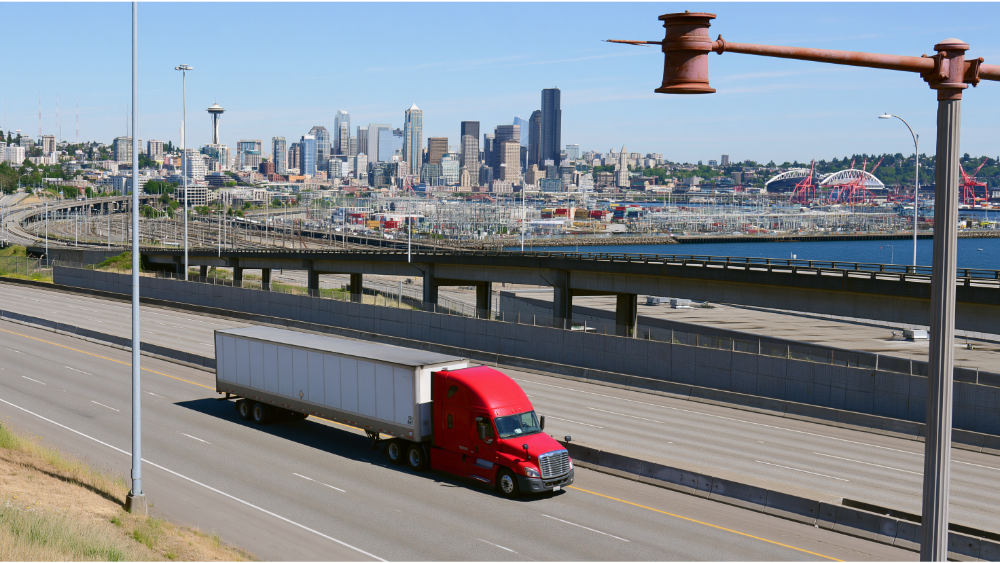
Our shop is at 7495 26th St E Ste B, Fife, WA 98424, near I-5 and Hwy 167. Mobile dispatch covers a 50-mile radius along I-5, Hwy 167, and SR-512, including Tacoma, Fife, Auburn, Sumner, Puyallup, Milton, Pacific, and Algona. Shop hours are Monday through Friday, 8:00 AM to 5:30 PM, closed weekends. 24/7 emergency roadside dispatch is always available, including hours the shop is closed.
We service Freightliner, Kenworth, Peterbilt, Volvo, Mack, International, and Western Star. Est. 2017, 7+ years serving drivers and fleets, licensed and insured, DOT certified, 4.9 stars across 146 Google Reviews.
If oil reaches or is likely to reach a storm drain or waterway, Seattle requires reporting within 24 hours of discovery and Washington requires immediate reporting for oil entering water. Contain it and keep it out of catch basins while help is dispatched.
Call Now: (253) 449-0100. Or Request a Service Quote. Takes under 60 seconds. No obligation.
Frequently Asked Questions
How can I stop an oil leak in my diesel engine?
Locate the source first, then tighten or reseal what actually failed. Simple fixes exist, like a loose oil filter or a worn oil drain plug gasket. But a verified diagnosis comes before any part gets replaced, or you’ll be back for a second repair.
Is it worth fixing an engine oil leak?
Yes. Continued oil loss damages hoses, belts, wiring, and sensors, creates fire risk on hot exhaust components, and exposes you to a §396.5 violation. The repair costs far less downtime than the failure it prevents.
Is it common for diesel engines to leak oil?
Common, not normal. High compression, sustained heat cycling, and age harden gaskets and seals over time. A leak is still a defect to be traced and fixed, not a characteristic you accept and top off around.
Is there an engine oil stop leak that actually works?
Some slow a minor seep temporarily. None repair a cracked housing, a failed line, a damaged sealing surface, or excessive crankcase pressure. Don’t use one unless your engine manufacturer approves that exact product for that use.
Oil on the ground and a load to move? Call (253) 449-0100. 24/7 emergency roadside dispatch, and an itemized estimate before a single bolt is turned.