Key Takeaway
Heavy duty clutch replacement is necessary when a clutch still slips under load after correct adjustment, or when friction discs show wear, contamination, or heat damage confirmed by inspection. A complete job on a Class 6 through 8 truck covers the flywheel, pressure plate, discs, release bearing, and clutch brake together. A 15.5-inch assembly weighs about 145 lb and requires proper tooling, AMT calibration, and a road test before the unit returns to service.
The clutch is slipping, the trailer is loaded, and the clock is running. Here is the straight answer: a heavy duty clutch should be replaced only after a verified diagnosis rules out adjustment, linkage, hydraulic, release-bearing, and clutch-brake problems. If engine RPM climbs without matching road speed after correct adjustment, or the friction discs are worn, contaminated, or heat-damaged, replacement is the repair. A burning friction odor means extreme slippage and heat. This is for owner-operators and fleet managers deciding whether to pull a Class 6 through 8 unit out of service.
When Does a Heavy Duty Clutch Need Replacement, and When Is It Just Adjustment?
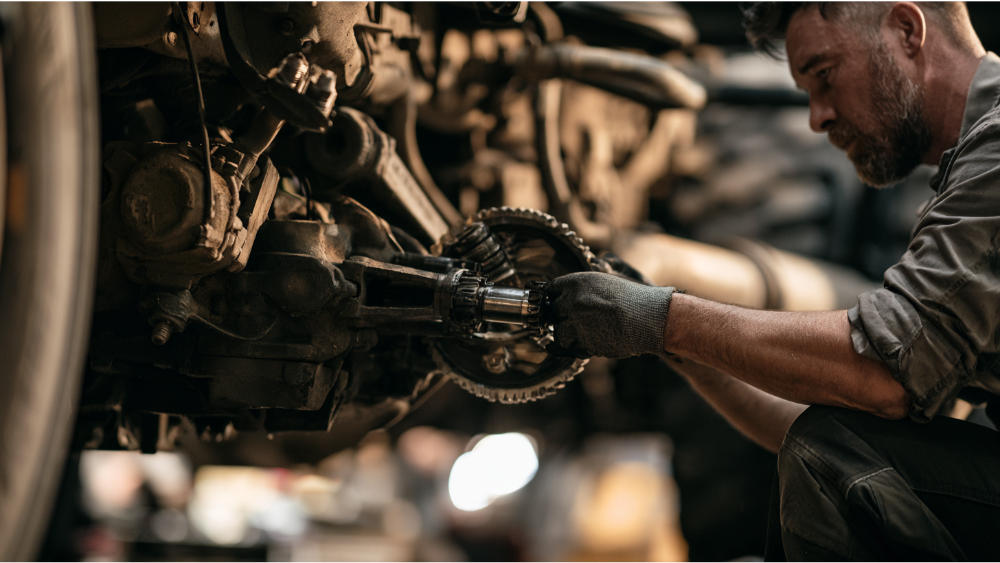
A symptom is not a diagnosis. Eaton’s guidance calls for inspection when free pedal drops to half of OEM spec and never below 1/2 inch. A heavy duty clutch that still slips after correct adjustment is past its useful life. Hydraulic linkage hides that warning, which is why self-adjusting units are specified there. Master and slave cylinders get checked for leaks before new parts go in, and the pressure plate and discs are always replaced together.
| Driver complaint | Checked first | Likely outcome |
|---|---|---|
| Slips under load | Adjustment, linkage, wear indicator, heat damage | Adjust or replace |
| Grinds into gear at a stop | Clutch brake, release travel | Clutch brake or clutch repair |
| Chatter | Mounts, oil contamination, flywheel, input-shaft splines | Related repair or replacement |
| Heavy or changing pedal | Linkage, bushings, hydraulic leaks, lube | Release-system service |
| Noise with pedal down | Release bearing | Bearing or full clutch service |
What a Complete Heavy Duty Clutch Replacement Includes
- Confirm engine, transmission, torque rating, linkage, spline count, and clutch part number. Size runs roughly 14 to 15.5 inches, one or two discs, ceramic buttons standard.
- Scan for AMT faults, then pull the transmission.
- Inspect the flywheel for heat cracks and scoring, plus pilot bore, housing runout, input shaft, release fork, and clutch brake. Eaton’s covered-application limits: 0.008 in flywheel face, 0.005 in pilot bore, 0.012 in housing ID.
- Update the itemized estimate before any added work.
- Install, align, set clearances, calibrate AMT where required, then road-test.
A 15.5-inch assembly runs about 145 lb and an Endurant clutch about 125 lb, so pros use guide studs and a clutch jack. On manual units the flywheel gets measured; machining an out-of-spec AMT flywheel is not recommended on covered applications because it can block calibration. Access, PTOs, parts availability, and calibration all move turnaround, so no universal hour figure applies. Common clutch parts are stocked in the shop. Same-day service focus when possible.
Buying Heavy Duty Truck Clutches by Part Number
Sellers list a full line of heavy duty truck clutches by brand and part number, show an MSRP, and put an add-to-cart button beside it. That works only when the spec is already confirmed. Torque rating, spline count, and release travel decide which kit fits, and a kit designed for one engine and transmission pairing burns up fast behind another. Comparing one MSRP against another means nothing if the flywheel is cracked or the input shaft is worn. A heavy duty clutch is industrial machinery; nothing on light vehicles sees that duty cycle. We confirm the spec on the truck in front of us, then quote parts and labor in writing.
Frequently Asked Question
Can you keep driving with a slipping clutch?
No. Heat destroys the friction discs and the flywheel, and FMCSA Part 396 prohibits operating a unit likely to break down.
Resurface or replace the flywheel?
Measure first and follow the OEM procedure. AMT machining is often not permitted.
Does an AMT clutch need calibration?
Yes. Mechanical installation is not the finish line. Calibration and fault-code verification are required.
Get a verified diagnosis and an itemized estimate before a bolt is turned. Our certified technicians use OEM diagnostic software on every Transmission And Clutch Repair. No upsell, no surprises. Request Service Quote (under 60 seconds, no obligation) or call (253) 449-0100.