Key Takeaway
The air brakes test is commonly 25 multiple-choice questions, and the federal passing score is 80%, meaning you need 20 correct answers and can miss no more than five. Some states use a shorter version of around 20 questions. The exact question count is set by your state licensing agency, not federal rule, so verify before test day.
Reviewed September 2026
The CDL air brakes knowledge test is commonly 25 multiple-choice questions. The federal passing score is 80%, so on a 25-question version you need 20 correct and can miss five. Some states run a shorter version, closer to 20 questions. The exact count is set by your state licensing agency, not by federal rule, so confirm it before test day.
If you’re testing this week, or you already hold a CDL and you’re trying to clear an L restriction, here’s what matters: the scoring math, what’s actually on the air brake portion, and the restriction that lands on your license if you fail it or take the skills test in the wrong vehicle.
How Many Questions Are on the Air Brake Portion, and How Many Can You Miss?
Plan on 25 questions. That’s the current published format in states like Washington, Michigan and Utah, and it’s also the count used for L and Z restriction removal in Pennsylvania. Other states use around 20. The variation exists because states administer CDL knowledge testing themselves under the federal minimum standards in 49 CFR Part 383, drawing from an FMCSA-preapproved question pool. Federal rules dictate the content and the score, not the length.
The one number that never moves is the passing score. Under 49 CFR §383.135, you must answer at least 80% of the questions correctly on every CDL knowledge test.
| If your test has… | Correct needed at 80% | Most you can miss |
|---|---|---|
| 20 questions (scoring example) | 16 | 4 |
| 25 questions (common format) | 20 | 5 |
| 30 questions (scoring example) | 24 | 6 |
The 20- and 30-question rows are there to show the math, not to claim a particular state uses those formats. Delivery details vary too. The Texas CDL knowledge test, for example, is administered in English only. Call your state licensing agency or open the current state CDL manual and verify your exact question count before you show up.
What’s Covered in the Air Brakes Section of the CDL Test?
Federal regulation 49 CFR §383.111 defines seven air brake knowledge areas every air-brake-equipped CMV driver has to understand. Your state’s questions are built off these:
- Air brake system terminology and brake system components.
- Contaminated air supplies: dirt, moisture and oil.
- Severed or disconnected air lines between power unit and trailer.
- Low air pressure readings and warning devices.
- A safe, accurate and complete pre-trip inspection procedure.
- En-route and post trip inspections, including air loss and warning-device checks.
- Safe operation: braking technique, ABS, emergency stops and parking brakes.
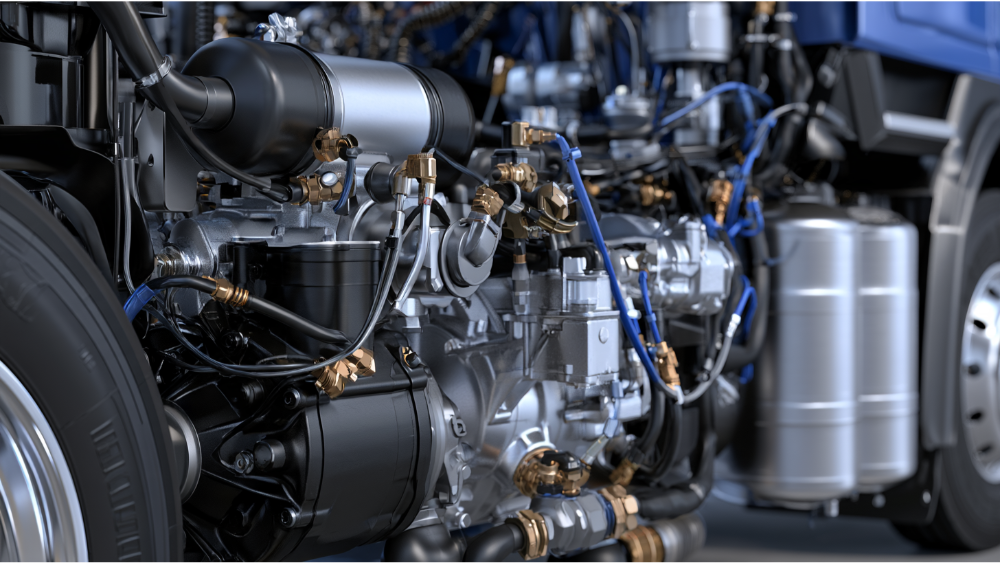
In practice, that means questions on the air compressor governor cut-in and cut-out pressure, air tanks and draining moisture, the difference between service brakes, parking brakes and emergency brakes, slack adjusters, brake pedal application, and the pressure levels where the low-air warning activates and the spring brakes come on. Expect items on how the compressor is driven off the engine, how brake drums shed heat on a long grade, and how spring pressure sets the parking brakes once air is gone. Disconnected line questions come back to the tractor protection valve, which closes off the tractor’s air supply when a trailer line lets go. Moisture left in the tanks can freeze in cold weather and cause brake failure, so draining tanks and checking the air dryer come up often.
Most manuals also walk through single and dual air brake system operation, because dual circuits with separate primary and secondary systems are commonly found on highway tractors. The same fundamentals carry into the single vehicle and combination vehicles portions of the exam, and they sit alongside the general knowledge test you already have to pass. Every one of those areas is a safety question wearing a technical costume. Air brakes don’t respond like the hydraulic system in a car: there’s a lag between the pedal and the moment the brake system applies pressure at the wheels, and a slow leak shows up as air you lose on a timed static check. The test is checking whether you know what the brake system does when it starts losing air at highway speed. Definitions are the easy half.
Downhill technique is on there too. You maintain a safe speed with the engine and controlled applications instead of riding the pedal, which burns brake life and fuel. Exact pressure values can vary by manufacturer and equipment. Learn the numbers in your state manual, then learn the numbers on the truck you’ll actually test in.
Is the Air Brake Endorsement Test Actually an Endorsement?
No. The federal CDL endorsements are T, P, N, H, X and S. Air brakes isn’t one of them, so the air brake endorsement test is not filed with the endorsement tests for hazmat, passenger or school bus. What you’re doing is avoiding or removing a restriction, which is why the paperwork uses two codes:
- L restriction: no operating a CMV equipped with any type of air brakes. Applied if you fail the air brake knowledge portion, skip it, or take the skills test in a vehicle without air brakes (49 CFR §383.95).
- Z restriction: no operating a CMV with full air brakes. Applied when the skills test is done in an air-over-hydraulic vehicle. Narrower than L, but still limiting.
An L restriction takes most Class A and Class B seats off the table. Tractor trailers, dump trucks, most straight trucks in that weight class and transit buses are air-brake equipped, and trucks like those are exactly where the work is. That’s a hiring and earning problem, not a paperwork problem.
Air Brake Knowledge Test vs. Skills Test: The Part Drivers Get Wrong
Answering 20 of 25 correctly does not, by itself, clear the air brake issue. If your skills test vehicle isn’t equipped with full air brakes, you can still walk out with a restriction.
| Air brake knowledge test | CDL skills test |
|---|---|
| Multiple-choice questions | Vehicle inspection, basic control, on-road driving |
| Minimum 80% to pass | Performance-scored by the examiner |
| Tests brake system knowledge | Tests inspection and driving ability |
| Question count varies by state | Procedure varies by state testing model |
The skills test has three federal segments under 49 CFR §383.133: vehicle inspection, basic vehicle control and on-road skills. Your air brake check sits inside the vehicle inspection segment, and examiners expect the full sequence, not a partial pass. Slack adjusters out of adjustment are one of the most common out-of-service findings on a roadside inspection, which is part of why examiners want to see you check them. There is no single universal inspection script. AAMVA’s modernized CDL skills test exists alongside the previous version, and jurisdictions may use either one. Work from your state’s current skills-test manual and the procedure for your actual test vehicle. Also budget for the federal 14-day minimum CLP hold before you can complete the skills test. That’s separate from any written-test retake rule.
How to Pass the CDL Air Brakes Test Without Memorizing One Practice Test
A CDL practice test is good for finding your gaps. It’s a bad memorization strategy. Federal test-generation rules require a different version on a retake, with at least 25% new questions and the response order changed. A memorized question bank fails you the second time. Free online practice sets are frequently outdated on top of that.
- Work from your state’s current CDL manual, not a third-party PDF someone emailed you.
- Learn why each threshold exists (governor cut-out, low-pressure warning, spring brake activation) so unfamiliar wording doesn’t sink you.
- Run practice sets from more than one source and treat every wrong answer as a study assignment.
- If you’re in a CDL school, have an instructor walk the complete air brake check with you during the pre trip on the actual test vehicle. A good CDL school will drill the inspection out loud until it’s automatic.
- Most CDL training programs cover this material, but verify with your state agency before test day: exact question count, correct answers needed, retake waiting period and attempt limits, appointment rules, available languages, current skills-test manual and testing-vehicle requirements.
Frequently Asked Questions
How hard is the air brake test?
Straightforward if you’ve read the manual. Most failures come from guessing on pressure thresholds and inspection sequence, not from trick questions. You need 80% correct, which means five misses on a 25-question version.
What questions are on the air brake test?
Multiple-choice questions across the seven federal knowledge areas: brake system components, contaminated air, disconnected lines, low pressure readings, pre-trip inspection, en-route and post-trip checks, and safe operation including ABS and parking brakes.
Do I need an air brake endorsement to drive a truck with air brakes?
There is no separate air brake endorsement. You pass the air brakes section of the knowledge test and test in an air-brake vehicle, and no L or Z restriction gets added to your license.
What is the 7-step air brake test?
It’s a commonly taught inspection sequence, not a nationwide standard. Jurisdictions use different testing models, and the modernized skills test changed how some checks are scored. Follow your state’s current skills-test manual and the procedure for your test vehicle.
How do you pass the CDL air brakes test?
Study your state manual, understand how the air brake system behaves when it loses air instead of memorizing answers, and take your skills test in a full-air-brake vehicle if that’s what you plan to drive.
A test question about low air pressure is one thing. A real low-pressure warning on the road is a safety problem with freight attached. Torpedo Truck Repair handles Truck And Trailer Brake Repair, air brake system diagnostics and DOT inspection support on Class 6 through 8 equipment, with 24/7 emergency road service. Call (253) 449-0100.