Key Takeaway
A dual air brake system splits a truck’s service brakes into two independently protected circuits, primary and secondary, both controlled by one dual foot valve. If one circuit loses pressure, the other still delivers braking force to its axle. Federal standard FMVSS No. 121 requires each circuit to have its own reservoir, plumbing, and pressure gauge, and both systems must reach at least 100 psi before driving.
A dual air brake system splits a vehicle’s service brakes into two separately protected circuits, primary and secondary, both worked by one dual foot valve under your right boot. Each circuit has its own air tanks, its own delivery plumbing, and its own gauge reading. Each circuit operates independently once air leaves the supply reservoir. Lose pressure in one system and the other system still gives you braking ability. What’s left exists to get you stopped, not to keep you rolling.
This is written for drivers, owner operators, fleet managers, and CDL applicants running Class 6 through 8 equipment. Here’s how the system operates, what the two needles tell you, and what to do when one drops.
Primary vs. Secondary Circuit: What Does Each One Control?
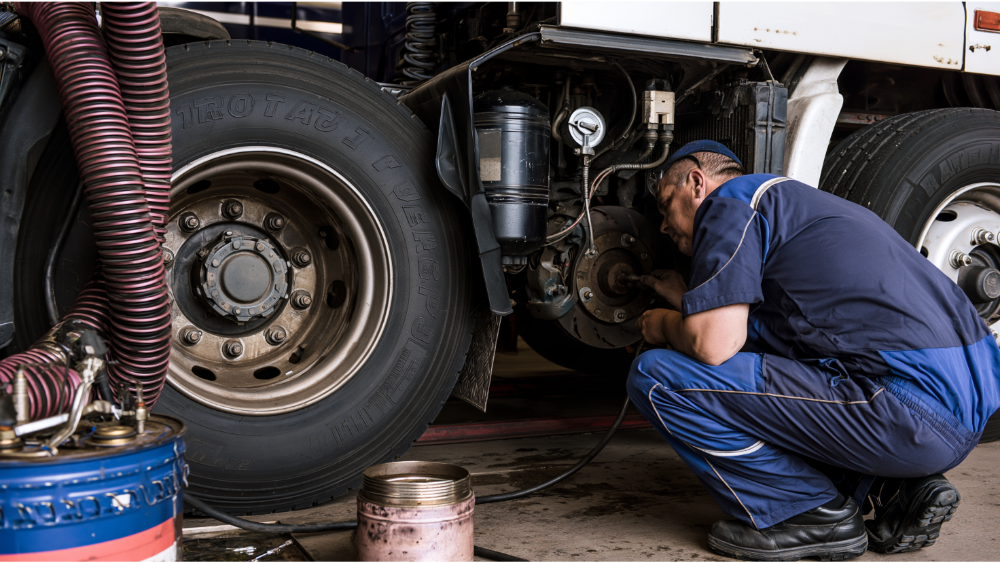
The primary circuit typically operates the rear drive axle service brakes. The secondary circuit typically operates the front axle, feeding the steer chambers. Each side draws from its own reservoir, reports on its own gauge needle, and keeps working if the other one quits.
| Circuit | Typically serves | Own reservoir | Own gauge needle | If the other circuit fails |
|---|---|---|---|---|
| Primary | Rear/drive axle chambers | Yes | Yes | Still applies rear service brakes |
| Secondary | Front axle, steer chambers | Yes | Yes | Still applies front service brakes |
Say “typically” and mean it. The piping arrangement varies by configuration, and some designs put part of a rear axle group on the secondary side. OEM piping diagrams show which chambers sit on which circuit for your truck. On a two axle vehicle the split is usually front and rear. Trailer supply feeds through the tractor’s protection valves, not a third system. Whatever the layout, the basic dual circuit principles hold: the two halves work independently downstream of the check valves.
How Does a Dual Circuit Air System Work?
The air path runs in a fixed order:
- Engine-driven air compressor builds pressure, controlled by the governor.
- Air dryer removes moisture and oil before storage.
- Supply (wet) reservoir holds the charge, with a safety valve protecting against over pressurization.
- One-way check valves feed the primary and secondary tanks separately. The dual circuits start here.
- Dual foot valve meters both circuits from one brake pedal.
- Air moves through the service lines to the front and rear brake chambers.
- Each chamber pushes a pushrod into the slack adjuster and applies the foundation brake at the wheel end. Most current trucks run automatic slack adjusters.
The dual foot valve controls both circuits from a single treadle. Two sections sit stacked in one body: one section controls the primary, the other feeds the secondary. That’s why you press one pedal instead of two foot valves. Both sides carry the same type of compressed air, but there is no blended air between them once the check valves close. The tradeoff is honest. More valves, more lines, more reservoirs, more places to leak. PM service on air brake systems is not optional.
What Do the Two Circuits Share, and What Stays Separate?
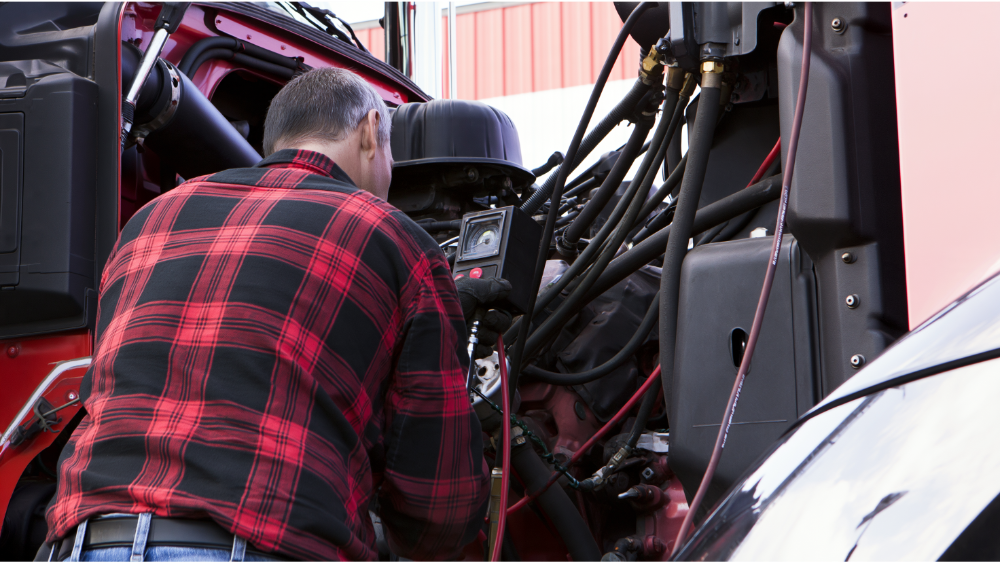
Shared: the compressor, the governor, the air dryer, the supply tank, and the foot valve body. Separate: each circuit’s reservoir, its service plumbing, and the chambers it feeds. The two systems draw from one supply, then split at the one-way check valves that keep a leak on one side from draining the other.
So the accurate description is separately protected service circuits, not two separate air brake systems. Federal rule 49 CFR §571.121 (FMVSS No. 121) requires each service reservoir system to be protected against air loss from failure between the reservoir and its pressure source.
What Happens If One Air Brake Circuit Fails?
Primary circuit failure means the rear service brakes on that circuit may not apply. Pedal feel changes and the stop takes noticeably longer. The dual foot valve still meters air to whichever side is holding. Lose the secondary and the front chambers are the ones affected.
You do not lose exactly half your brakes. Front and rear contribution isn’t a 50/50 split, and allocation varies by truck. What you’re left with is reduced service braking and a longer stopping distance.
One Circuit Failed: What You Do Next
- Get off the road at the first safe location. Do not attempt to finish the run.
- Don’t pump the pedal down chasing pressure.
- Secure the truck and get the fault diagnosed before it moves again.
Washington’s Commercial Driver Guide tells drivers to stop immediately in a safe place and have the system repaired. OEM operator manuals agree: don’t operate the vehicle until the low-pressure condition is corrected. Partial braking is a controlled stop. It is not a road-ready truck.
How to Read the Two Air Pressure Gauges and Low Pressure Warning Devices
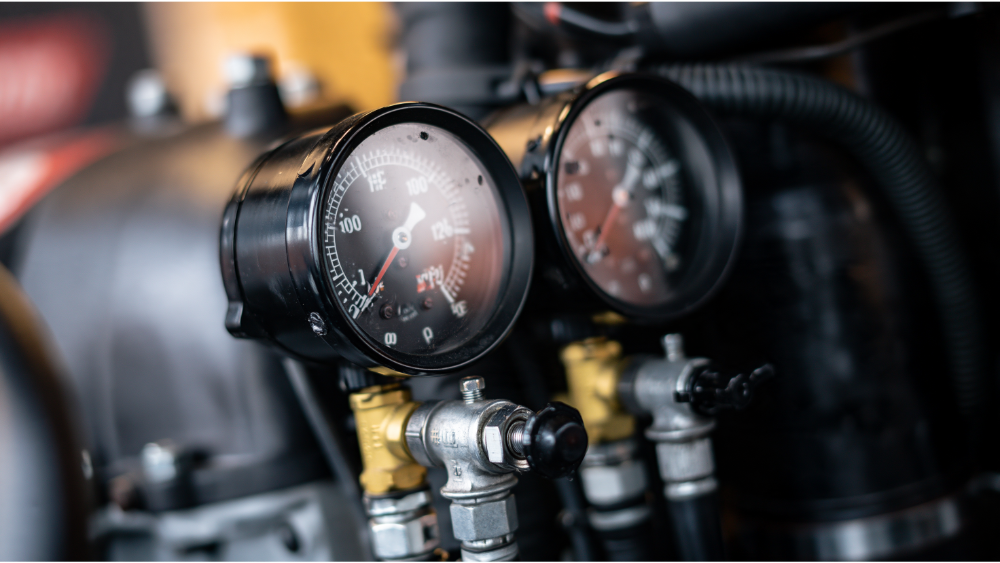
At first glance the two needles look redundant. They aren’t. They give you clues, not diagnoses:
- Both needles rising together: normal charging.
- One needle falling while the other holds: fault isolated to that circuit.
- Both falling, or both slow to build: points toward shared charging or supply-side components.
- Warning stays lit after startup: don’t move the truck.
- Which needle is which: on many dual gauges the left side needle reads primary. Confirm against your truck’s labeling.
Separate the numbers by source. FMVSS No. 121 requires a gauge for each service brake system and a continuous low-air warning below 60 psi. Washington’s Commercial Driver Guide says build both systems to at least 100 psi before driving, expects 85 to 100 psi in 45 seconds at operating rpm, and sets static leak limits of 2 psi per minute for a single vehicle and 3 psi for a combination. Run the check with the foot valve released, then again with the treadle held down, where allowable rates are higher.
Washington CDL applicants: the modernized skills-test supplement uses 55 psi or the manufacturer’s specified level for warning activation. Follow the current state manual and the tested truck’s specs.
Dual Air Brakes vs. Spring Brakes, Parking Brake, and the ABS Modulator Valve
Service brakes are your regular brakes: air pressure applies them through the dual foot valve. Spring brakes work the other way, since air pressure holds them released. The yellow dash control valve sets the spring parking brakes, and the emergency function is spring brakes applying automatically when air pressure drops far enough, generally somewhere in the 20 to 45 psi range depending on the truck.
Here’s what most explanations get wrong: primary circuit failure does not necessarily apply the spring brakes right away. Release air can come through a two-way check valve from whichever circuit still holds pressure, so the parking brakes stay off until both sides drop. ABS works at the wheel end through a modulator valve that cycles air to the chamber during an application. It is not a third circuit and it doesn’t replace lost air.
Signs Your Air Brake System Needs Professional Diagnosis

- One reservoir loses pressure overnight while the other holds.
- Slow build, or the compressor cycling more often than normal.
- Audible leak at a fitting, line, foot valve, or chamber.
- Low-air warning that stays active after the system charges.
- Delayed or uneven application, or pulling on stops.
- Spring brakes that drag or won’t release fully.
- Chafed or cracked air hose.
A falling needle can trace back to a line, a fitting, the foot valve, a protection valve, a reservoir, a brake chamber, a slack adjuster, an ABS modulator valve, or the warning device itself. Structured, verified testing under Truck And Trailer Brake Repair identifies which one instead of swapping parts and guessing. Caged-spring chamber work belongs in a shop, not on a shoulder.
Dual Air Brake System FAQ
What is a dual braking system?
Two separately protected service brake circuits on one truck, controlled by a single dual foot valve. Each has its own tank and plumbing, so a failure on one side leaves braking on the other.
What are the three types of air brake systems?
Service, parking, and emergency. Those are three basic functions inside one basic air system, not three separate installations. Parking and emergency both work through the spring brakes, and both sit among the brake controls the driver operates from the dash.
How many air pressure gauges are there on a dual air brake system?
One reading per circuit. Most heavy duty vehicles use a single dual gauge with two needles, though some run two separate gauges.
At what psi does the governor cut out?
The system typically operates between cut-in and cut-out. Washington’s skills-test procedure uses a typical range of 120 to 140 psi for cut-out, and FMVSS No. 121 sets a minimum cut-in of 100 psi for trucks. Use the values specified for your truck.
Low Air Warning on the I-5 Corridor? Call Now.
A needle dropping, a warning that won’t clear, a loaded truck on the shoulder. Torpedo Truck Repair runs 24/7 emergency road service with mobile dispatch within 50 miles of our Fife shop, covering I-5, Hwy 167, and SR-512 through Tacoma, Auburn, Sumner, Puyallup, Milton, Algona, and Pacific. Shop: 7495 26th St E Ste B, Fife, WA, Mon through Fri, 8:00 AM to 5:30 PM, with 24/7 emergency dispatch always available. Itemized estimate before work starts. No surprises, no upsell, same-day service focus when possible.
Call Now: (253) 449-0100. Fleets: Request Service Quote for PM scheduling on air brake systems across all units.