Key Takeaway
Transmission noise in a heavy-duty truck is a symptom, not a verdict – the critical factor is when and how it occurs, not just what it sounds like. Stop driving immediately if noise comes with slipping, a lost gear, overheating, a major fluid leak, or a warning light. Some gear noise is normal on heavy-duty manual transmissions; a new, worsening, or condition-specific noise always needs professional diagnosis.
A new noise your transmission makes is a symptom, not a diagnosis. What matters is when you hear it: does it track engine RPM or road speed, does the clutch pedal change it, does it show up in one gear or all of them, and does it appear under load or on coast? Stop driving if the noise comes with slipping, a lost gear, overheating, a major transmission fluid leak, or a transmission warning light.
This is written for owner-operators, independent drivers, and fleet managers running Class 6 through 8 units. You get a drive-or-stop call, a breakdown of transmission noises by operating condition, and what a real diagnosis looks like before anyone quotes you a transmission rebuild.
Stop Driving or Keep Rolling? A Noisy Transmission Triage Table
| Symptom + Additional Warning Sign | Urgency | Next Move |
|---|---|---|
| Grinding plus a gear you can no longer get into | Stop | Shut it down. Roadside service or tow. |
| Whining noises plus slipping or loss of power under load | Stop | Get off the road. Do not load-test it further. |
| Sudden howl plus high transmission temperature or a burning smell | Stop | Park safely. Heat destroys lubrication fast. |
| Major transmission fluid puddle under the vehicle | Stop | Do not move it until the source is identified. |
| AMT dropping to neutral or flashing a transmission warning | Stop | Stop cycling the key. Call for diagnosis. |
| Heavy driveline clunk or severe vibration | Stop | Treat as a driveline failure until proven otherwise. |
| Faint whining or humming, shifts normally, no other symptom | Schedule | Book diagnosis promptly. Log the conditions. |
No single noise automatically means a tow or an out-of-service violation. The defect behind it does.
When Do the Noises Happen? The Question That Beats “What Does It Sound Like?”
Start by separating engine-RPM noises from road-speed noises. If the sound rises and falls with engine RPM while the vehicle sits in neutral, the suspect list is the engine, clutch, input side, or normal gear rollover. If it tracks road speed no matter which of the gears you’re in, look at output-side bearings, the driveshaft, carrier bearing, differential, axle bearings, wheels, and tires.
Log the conditions where unusual noises occur, not just the adjective:
- Idle in neutral
- Clutch pressed versus released
- Selecting first or reverse
- Shifting gears under load
- While accelerating or pulling a grade
- On coast or engine brake
- One gear or one range only
- At one specific road speed
- During turns or trailer articulation
The condition narrows the repair faster than the adjective ever will.
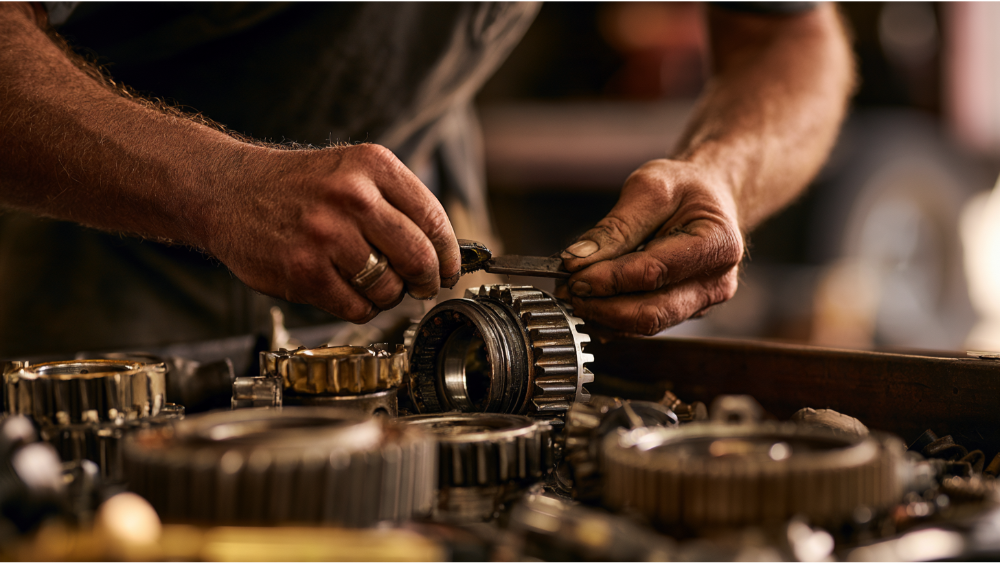
Common Transmission Noises: Whining, Clunking Noises, and Clicking Noises
| Sound | What It Can Indicate | Non-Transmission Lookalikes |
|---|---|---|
| Whining noises or squealing | Can point toward gear wear, mismatched gearsets, tight bearing clearance, or insufficient lubrication | Engine accessories, pump noise, belt drives |
| Grinding or gear clash | May indicate worn gear teeth or internal damage | Clutch drag, clutch brake, shift technique |
| Growling or rumbling | Can point toward gear timing errors or bearing wear | Differential, axle bearings |
| Rattling noise at idle | Often normal gear rollover on heavy-duty manual transmissions | Rough engine idle, worn clutch disc damping |
| Clunking noises on engagement | May indicate loose or damaged transmission components | Worn U-joints, failed mounts, loose U-bolts |
| Humming or howling that changes with speed | Can point toward worn bearings | Tires, wheels out of balance, ring and pinion |
| Clicking noises or rhythmic knocking | Must be verified: possible damaged gears or a cracked tooth | U-joints, torque converter at low speed |
| Gurgling | Can suggest low fluid or aeration | Cooling system, fluid routing |
Some gear noise is expected on heavy-duty manual transmissions, and a car’s transmission is no reference point here. The red flag is a noise that’s new, worsening, or tied to a specific operating condition.
Manual Transmissions, AMT, or Automatic Transmission: Why Type Changes the Answer
Heavy-Duty Manual Transmissions
Unsynchronized gearboxes, clutch brake, clutch release, range and splitter air system, input bearing. Countershafts and mainshaft gears can take 3 to 5 seconds to stop after clutch disengagement without a working clutch or countershaft brake. That’s why grinding while shifting into first or reverse is usually clutch clearance, clutch brake, linkage, or technique, not a transmission rebuild.
Automated Manual (AMT)
Manual transmissions under electronic control. Clutch and shift actuators, position sensors, grounds, connectors, and J1939 data all affect how the vehicle’s transmission behaves. An electrical fault or a bad ground can feel completely mechanical from the driver’s seat, including an unexpected neutral command.
Conventional Automatic Transmission and the Torque Converter
Transmission fluid level and specification, pump, filter, torque converter, hydraulic pressure, cooling, electronic controls. A struggling torque converter can produce whining noises that change with load rather than with gear. The manufacturer’s own platform is the authorized tool to diagnose these systems. Generic scanners return incomplete information and send a diagnosis down the wrong path.
When Noises From the Transmission Aren’t the Transmission
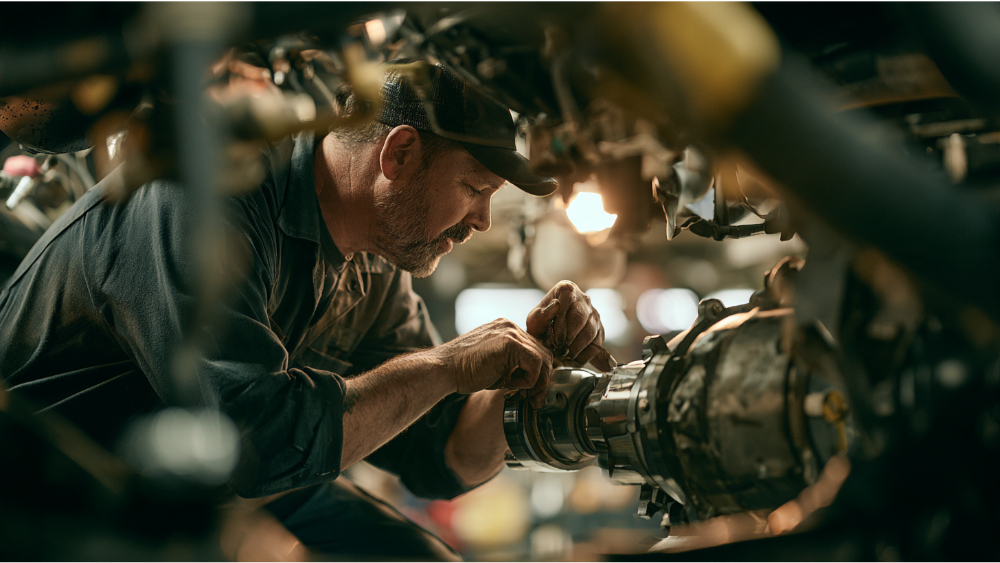
OEM troubleshooting material is blunt about this: the transmission case picks up and amplifies noises generated elsewhere in the vehicle. Common issues outside the gearbox:
- Clutch disc damping or release bearing: noise changes with pedal position
- Engine or transmission mounts: clunking noises on torque reversal
- Worn U-joints or unequal joint angles: clunk when taking up load
- Driveshaft imbalance: vibration locked to road speed
- Loose or worn center bearing: rumble that grows with speed
- Ring and pinion wear or axle bearings: howl that changes on coast versus power
- Wheels out of balance, tires, loose U-bolts, warped brake drums: speed-related humming or thump
- Engine accessories, loose heat shields, or rough idle: buzzing sound in neutral, unaffected by gear
Approving internal transmission work off a sound description alone is how operators pay twice.
What You Can Safely Check, and Why DIY Fixes Backfire
- Active dash and transmission warnings
- Exact gear and road speed where the noise occurs
- Whether it follows engine RPM or road speed
- Loaded versus empty, acceleration versus coast
- Whether the clutch pedal changes it
- Transmission fluid on the ground under the parked vehicle
- Fluid color and smell, if your unit has a safe check procedure (dark and burnt means heat)
- Recent service or lubrication change
- Cold-only, or still there after warm-up
Do not get under an unsecured vehicle, touch a hot housing, or run improvised stall tests. DIY fixes on a heavy-duty driveline carry real risk. A guessed fix, improper installation of a replacement part, or a missed symptom can lead to further damage and costly repairs. A clean description of the strange sounds and the potential problems you noticed cuts diagnostic time before the truck reaches a bay, and a professional inspection confirms the rest.
How Certified Technicians Run Transmission Diagnostics
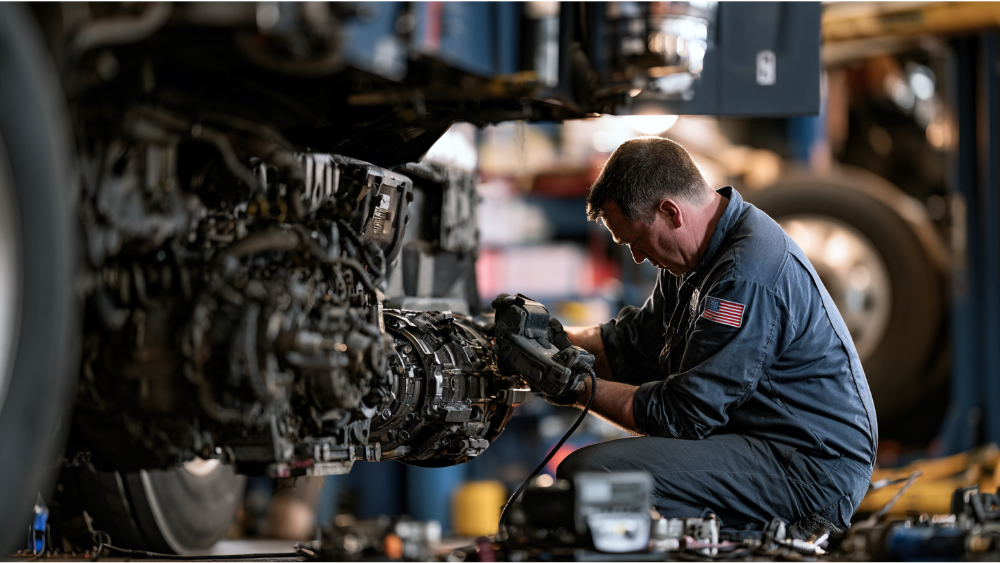
- Record the driver’s complaint precisely.
- Identify truck, engine, and transmission model.
- Review recent service and repair history.
- Inspect transmission fluid level, specification, condition, and leaks per the OEM procedure.
- Scan the applicable OEM modules and save active and inactive codes.
- Reproduce the noises under controlled conditions.
- Compare engine RPM, input speed, output speed, road speed, gear, clutch state, and load.
- Visual inspection of clutch, mounts, driveshaft, U-joints, carrier bearings, differential, and axle.
- Confirm the failed system before any teardown.
- Issue an itemized written estimate before work begins.
A code scan alone does not diagnose the source of a mechanical noise. Nobody should quote you a rebuild off a road test. Torpedo runs OEM diagnostic software and certified technicians through that verified workflow because skipped steps are what turn a clutch-brake adjustment into a gearbox invoice.
Preventing Repeat Noises: Transmission Fluid, PM, and Documentation
There is no universal transmission fluid change mileage. Verify the exact transmission model, use the OEM-specified lubrication, and follow the interval that matches actual duty cycle. The spread is real: one unit on approved extended-service lubricant lists 750,000 miles or 5 years for linehaul against 250,000 miles or 3 years for vocational work. Excessive load and constant grade work shorten that interval further. Check for leaks instead of assuming lubricant was consumed. Skip additives and generic “universal” transmission fluid, because inadequate lubrication is a direct path to excessive wear and eventual transmission failure. Build driveline, U-joint, mount, and carrier-bearing checks into PM service, where regular inspections flag potential issues before they strand a unit.
Federal rules require systematic inspection, repair, and maintenance, and drivers must report defects likely to affect safe operation or cause a breakdown. The 12-month periodic inspection does not replace condition-based maintenance. CVSA’s Level I inspection is a 37-step process that covers driveline components, and out-of-service status depends on the defect found, not the noise itself.
Frequently Asked Questions
What are the signs of a bad transmission?
Noises combined with slipping, a gear you can’t get, hard shifting, burnt-smelling transmission fluid, leaks, or a transmission warning light. Noise on its own is a clue. Noise plus any of those is a stop-driving signal.
Is it bad if I can hear my transmission?
Not necessarily. Some gear rollover noise is normal on heavy-duty manual transmissions. A noise that’s new, getting louder, or tied to one gear or one condition needs diagnosis.
How long will a whining transmission last?
There’s no mileage answer. Low lubricant level and advanced bearing wear run on completely different clocks. Guessing is how a repairable fault becomes replacing the gearbox.
Why do the noises stop when I press the clutch?
That points toward the input side, the clutch, or engine-driven components rather than output-side gears. It’s one of the most useful observations you can hand a technician.
Does grinding into first or reverse mean the transmission is failing?
Often not. Insufficient clutch clearance, a dragging clutch, a worn clutch brake, or shifting before rotating parts have stopped will all produce clash.
Get Expert Diagnostics Before You Pay for Transmission Repair
A noisy transmission does not automatically mean a rebuild. Transmission And Clutch Repair at Torpedo starts with OEM transmission diagnostics and verified diagnosis before any parts are ordered. You get a full itemized estimate before a single bolt is turned. No surprises, no upsell, same-day service focus when possible. Call (253) 449-0100 or request a service quote online, takes under 60 seconds, no obligation. Shop in Fife, WA, with 24/7 emergency dispatch.