Key Takeaway
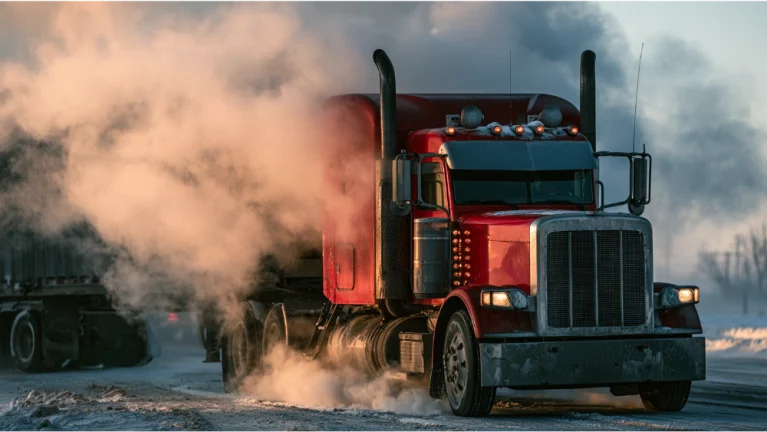
Diesel engine overheating happens when the cooling system cannot remove heat as fast as the engine produces it, making it a symptom that requires diagnosis, not a parts swap. Normal operating limits vary by platform: a Detroit DD15 tops out at 234°F while a Cummins maximum is 221°F. Stop immediately if you see steam, coolant loss, or a STOP ENGINE warning, and never open a pressurized cooling system on a hot engine.
A diesel engine overheats when the cooling system cannot dissipate heat into the air as fast as the engine makes it. That’s it. Which means an overheating engine is a symptom, not a diagnosis. A climbing temperature gauge tells you heat is winning. It does not tell you whether the problem is coolant level, coolant flow, airflow, or heat the engine shouldn’t be making in the first place.
You might be loaded on a grade right now, watching the needle climb. Or you might be on your third round of parts on a truck that keeps running hot. This guide covers when to stop, how the operating pattern narrows the cause, and what a verified diagnosis of an overheating diesel engine actually looks like. One rule before anything else: never open a pressurized cooling system on a hot engine.
What Should You Do Right Now If Your Diesel Engine Is Overheating?

- Get to a safe stop. Reduce throttle and load only as much as you need to position the truck off the travel lane.
- Follow your warning strategy. CHECK ENGINE means get it serviced promptly. STOP ENGINE means stop now. Your owner’s manual for that exact engine and chassis is the authority.
- Do not open the radiator cap or surge tank. Cummins warns that coolant in a warm engine is pressurized and can flash to steam, causing severe burns. Don’t crack it “just a little.”
- Don’t set a timer and open it anyway. Cooling time depends on engine size, load, and ambient temperature. Wait until the system is fully cool per the manual.
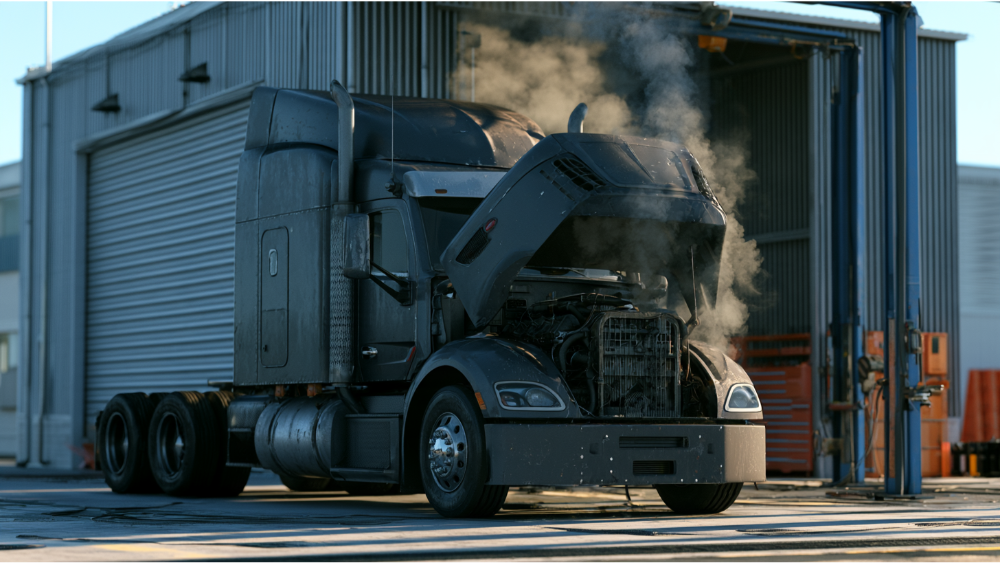
- Stop the run if you see real overheat evidence. Steam from under the hood, visible coolant discharge, a fast engine temperature spike, a derate, or loss of cabin heat all mean the route is over until the cause is known.
If you’re on the shoulder and need a technician dispatched, call (253) 449-0100. Our 24/7 emergency road service dispatch is always live.
What Engine Temperature Is Actually Too Hot For A Diesel Engine?
There is no universal overheating number. Many diesel owners run on the blanket advice that “anything over 220°F is overheating,” and that advice gets trucks misdiagnosed every week.
Here’s a real platform-specific example. A current New Cascadia driver’s publication lists a normal operating temperature range on the coolant gauge of 175 to 195°F, tells you to inspect the cooling system if the temperature stays below 160°F, puts Cummins fan engagement near 215°F, lists a Cummins maximum of 221°F, and lists a Detroit DD13/DD15/DD16 maximum of 234°F. Those are values from that publication for those configurations. They are not limits for every truck on the road. On one platform 220°F is knocking on the ceiling. On another it’s well inside range.
Use the manual for your engine and chassis. And remember that a failed coolant temperature sensor, a chafed wire, or a gauge fault can imitate diesel engine overheating perfectly. That’s why we read live ECM data and confirm actual engine temperature with an infrared reading instead of trusting the needle.
Warning Lights Tell You More Than The Temperature Gauge Does
| Warning | What it means | What to do |
|---|---|---|
| Coolant temperature warning | Coolant temp has reached the calibrated warning point | Reduce load, find a safe stop, get it diagnosed |
| Low coolant level warning | Level sensor sees engine coolant below minimum | Stop. Do not open the hot system. Topping off is not the repair |
| CHECK ENGINE | Fault logged, engine still running within protection limits | Prompt service, pull codes before the condition escalates |
| STOP ENGINE | Protection strategy has reached its limit | Safe stop and shut down now |
| Engine derate | ECM is cutting output to protect the engine | Stop operating. A derate is protection, not permission to finish the run |
| HEST / high exhaust temperature | Aftertreatment components are hot, often during regen | Keep the exhaust clear of people and combustibles. This is not a coolant warning |
Early Warning Signs Of Engine Overheating Most Drivers Miss
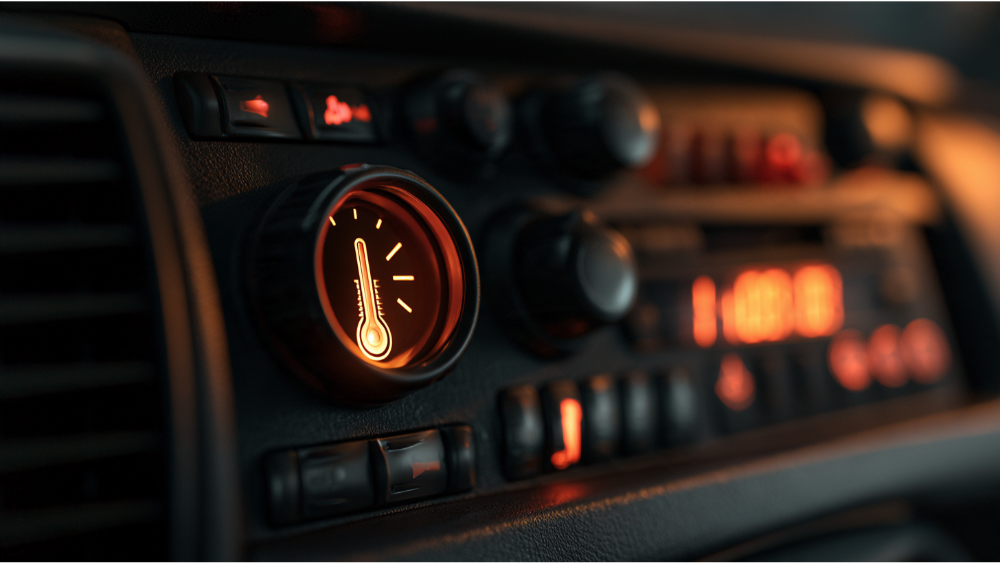
- The temperature gauge sits higher than normal on the same route with the same load, or rising temperatures show up earlier in the day than they used to.
- The cooling fan runs constantly or engages far more often than it used to.
- Cabin heat drops off or goes lukewarm.
- Coolant level falls between PM intervals. Low coolant levels that keep coming back are a leak you haven’t found yet.
- Bubbles in the coolant reservoir, or coolant getting pushed out of the surge tank.
- Sweet smell in the cab, or dried coolant residue on hoses, clamps, radiator seams, or around the water pump weep hole.
If you add coolant every week, that isn’t a fix. It’s a logged symptom, and it’s telling you something is leaking, boiling, or being pressurized by combustion gas.
What Causes Diesel Engine Overheating?
Causes of an overheating diesel engine group into four systems, and the same climbing temperature gauge can come from any one of them. That’s exactly why parts-swapping fails.
Low Coolant Levels, Coolant Leaks, And Trapped Air
Low coolant levels are the single most common cause. External coolant leaks show up at hose connections, clamps, radiator seams, and the water pump weep hole. Internal loss hides: a head gasket, a cracked cylinder head, an EGR (exhaust gas recirculation) cooler, or an oil cooler can dump coolant where you’ll never see a puddle. A weak pressure cap lowers the boiling point of the entire coolant system. And air trapped after a fill that was never bled to the OEM procedure will cook an engine that looks full.
Restricted Coolant Flow: Faulty Thermostat And Water Pump
The water pump circulates coolant through the engine block, the head, and the radiator. Impeller damage, a failing bearing, or a slipping belt kills that flow. Water pump failure is not always obvious either, because a pump that still turns can have a corroded or eroded impeller that no longer moves enough coolant under load. A malfunctioning thermostat stuck closed causes rapid overheating. Stuck open, you get a cold-running complaint and poor cab heat instead. Collapsed hoses and internal scale deposits restrict flow too. Check fan and accessory belts for cracking, glazing, and correct tension while you’re looking.
Airflow And Heat Dissipation: Clogged Radiator, Cooling Fan Clutch, And Air Filter
The cooling stack has to transfer heat into moving air. A clogged radiator packed with bugs and road film, a bent or blocked charge air cooler, a damaged shroud, or a cooling fan clutch that won’t lock up all cut cooling efficiency. Those faults hurt worst at idle and low road speed, when the cooling fan is doing all the work. A restricted air filter or an intake and exhaust restriction makes the engine work harder and produce more heat. A clogged radiator core can also hide behind a CAC that looks clean from the front, so inspect the radiator fins from both sides. Keeping the radiator clean is regular maintenance, not detailing.
Excess Heat From The Engine Itself
Put a diesel engine under a heavy load on a grade and any reduced ability to manage heat that looked fine empty shows up immediately. Low oil level or degraded engine oil raises internal friction and adds more heat. Fuel system faults and injection timing problems add combustion heat, and clogged diesel injectors produce incomplete combustion, which means inefficient combustion pushes energy into heat instead of work at the wheels. Combustion gases leaking past a head gasket pressurize the coolant and push it out. Wrong or contaminated coolant reduces the system’s ability to transfer heat and protect against corrosion. Sensor, wiring, and ECM data faults report more heat than the engine is actually making.
What Does It Mean If The Truck Only Overheats Under Load, At Idle, Or On Grades?

The operating condition narrows the system before anyone touches a wrench. Record exactly when it happens: road speed, load, grade, ambient temperature, and what the temperature gauge did.
| Pattern | What technicians investigate |
|---|---|
| Overheats at idle or low speed, cools on the road | Cooling fan clutch, fan control circuit, shroud damage, restricted airflow through the stack |
| Overheats on grades or pulling a heavy load | Reduced cooling capacity, clogged radiator or CAC restriction, low coolant levels, a failing thermostat, a failed water pump, fan engagement, combustion gas intrusion |
| Overheats at highway speed | Coolant flow restriction, radiator restriction, excessive heat production, internal engine problem |
| Temperature erratic or spikes fast | Low coolant, trapped air, intermittent sensor or wiring fault, thermostat, combustion gases in the coolant |
| Coolant disappears with no puddle | Pressurized leak that evaporates hot, EGR cooler, heater circuit, head gasket, cylinder head |
| Coolant pushed out of the coolant reservoir | Overfill, failed pressure cap, boiling, trapped air, combustion pressure entering the cooling system |
| Started right after cooling system work | Incorrect fill, air never bled, wrong coolant chemistry, thermostat installed backward or with the wrong rating |
This is diagnostic direction, not a parts list. Every row still gets verified before anything is replaced.
Can You Keep Driving With An Overheating Diesel Engine?
No. Not through a genuine overheat.
“Making it to the next exit” is how a cooling system repair becomes a major repair with the head off. When the ECM derates the engine, it’s protecting the hardware by cutting engine power. Driving through that removes the protection margin you have left. Repeatedly restarting to move the truck in short hops does the same thing, one heat cycle at a time.
The one exception is safety. Moving a short distance to reach a safe shoulder or off-ramp is about getting out of traffic, not about keeping your delivery window.
What Overheating Actually Does To A Diesel Engine
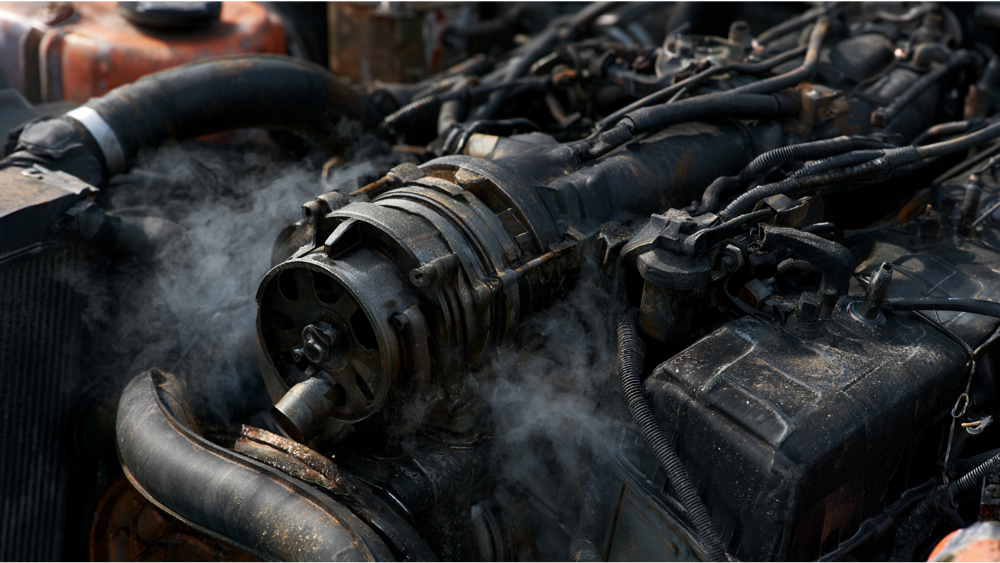
Heat takes out critical components in a predictable order:
- Cylinder head warps and the head gasket fails.
- Coolant enters the cylinders through the failed gasket.
- Pistons swell and score the cylinder walls.
- Bearings and the crankshaft take heat damage as oil film breaks down.
- Full engine rebuild.
Repair costs scale with how long the engine kept running hot. Severe cases end in cracked blocks and internal damage that no gasket set will fix, and major engine repairs are what follow. Every one of those critical components costs more than the cooling system repair that would have prevented it. The repair you can live with is the one you catch before the head comes off.
Checking Coolant Level And Oil Levels After The Engine Cools
Once the system is fully cool, visual checks only:
- Coolant level at the correct cold mark on the coolant reservoir, not the hot mark.
- Oil levels, and any sign of coolant in the oil or oil in the coolant. Oil levels reading high after an overheat can mean coolant is reaching the crankcase.
- Puddles or dried residue under the truck.
- Hoses that are split, swollen, soft, or collapsed. Look, don’t handle.
- Road debris packed into the front of the cooling stack.
- Active fault codes and dash messages.
- A written record of how much coolant you had to add, with the date.
Pressure testing, fan actuation tests, thermostat testing, and fill-and-bleed procedures are technician work. Pressurized systems and hazardous rotating fans are not a roadside project.
How Certified Technicians Verify The Real Cause
Replacing a thermostat because thermostats usually cause overheating is not a diagnosis. Diesel engine overheating is rarely one part. Here’s the workflow that finds the actual failure:
- Pull fault codes and live coolant data with OEM diagnostic software.
- Verify actual engine temperature against reported temperature using infrared and live data, ruling out a sensor or wiring fault.
- Inspect cold coolant level, condition, and chemistry.
- Pressure-test the cooling system and the pressure cap.
- Compare commanded cooling fan against actual fan response.
- Check radiator and CAC airflow and temperature distribution across the core.
- Verify thermostat operation and coolant circulation through the pump.
- Test for combustion gases in the coolant when the pattern points there.
- Refill and bleed to the exact OEM procedure for that platform.
- Verify the repair under the condition that caused the complaint, loaded or controlled, not idling in a bay.
That’s how our Cooling System Repair And Service, Diesel Engine Repair And Maintenance, and Electrical Diagnostics And Repair work is structured. Our certified technicians run OEM diagnostic software on Freightliner Cascadia, Kenworth T680, Peterbilt 579, Volvo D11 and D13, Mack MP7 and MP8, International A26 and MX-13, and Western Star platforms. You get a full itemized estimate before a single bolt is turned. No surprises, no upsell.
Is It Engine Overheating Or A Hot Exhaust System?
HEST means high exhaust system temperature. The exhaust system is hot, usually because a regen is active. That is not a coolant overheat warning, and shutting down mid-regen to “let it cool” solves nothing. Coolant temperature, CHECK ENGINE, and STOP ENGINE are separate indicators with separate responses. DPF, DEF, EGR, and SCR faults can absolutely coexist with a cooling system problem, and each still needs its own diagnosis. Know which lamp is actually lit before you report it.
How Regular Maintenance Keeps The Cooling System Ahead Of A Breakdown
Coolant chemistry first. Detroit guidance calls for concentrated coolant mixed 50 percent antifreeze and 50 percent water, with approved coolant meeting the engine maker’s specification (Detroit 93K217 is one example). ASTM D6210-25 is the current standard for fully formulated glycol-base heavy-duty coolant. Do not pick coolant by color. Si-OAT, OAT, and conventional chemistries shouldn’t be mixed even when the colors look identical, and topping off with plain water dilutes the additive package that protects against corrosion, scale, aeration, and liner cavitation. Test engine coolant. Don’t eyeball it.
Commonly quoted flush intervals in the 24,000 to 36,000 mile range are a starting point, not a rule. The engine specification and duty cycle control. Beyond that: driver reports that record the exact operating condition, coolant additions tracked per unit, repeat fault codes flagged instead of cleared, belt tension and water pump condition checked at PM, and cooling stack inspection on a set schedule. Keep the radiator clean seasonally, because bug season and harvest dust do more damage to heat rejection than most fleets account for. Tested coolant, a clean stack, and a verified pump do more to prevent overheating than anything you can do on the shoulder, and they are what keep a cooling fault from becoming expensive repairs later. Most diesel engine overheating we see traces back to something that was visible at a PM and skipped.
Documentation And DOT Compliance
49 CFR 396.3 requires systematic inspection, repair, and maintenance, with records kept one year while the vehicle is under your control plus six months after. 396.11 requires drivers to report defects, with defect DVIRs and repair certifications retained three months. 396.13 requires the driver to be satisfied the vehicle is in safe operating condition before driving it. FMCSA sets no universal PM interval. CVSA out-of-service criteria are published annually and take effect April 1, and no single gauge reading is automatically an out-of-service violation. Our Preventive Maintenance PM Service and DOT Inspection And Compliance support includes custom PM schedules by engine and duty cycle, priority fleet scheduling, and fleet account billing.
When To Call For Service
Call when your diesel engine shows a STOP ENGINE warning, steam or active coolant discharge, a derate, repeated coolant loss, overheating only under load, overheating right after cooling system work, coolant in the oil or oil in the coolant, engine temperature still abnormal after the truck cools, or no safe way to inspect or move it.
Call Now: (253) 449-0100. 24/7 emergency road service dispatch. For fleet PM and cooling system programs, Request Service Quote, takes under 60 seconds, no obligation. Shop hours are Mon through Fri, 8:00 AM to 5:30 PM, with 24/7 emergency dispatch always available. Itemized estimate before work begins, and same-day service when possible.
Frequently Asked Questions
What should you do when a diesel engine overheats?
Get to a safe stop, follow your CHECK ENGINE or STOP ENGINE instruction, and shut down. Don’t open the hot cooling system. Don’t continue the route if there’s steam, coolant loss, a fast temperature spike, or a derate.
How can you tell if a diesel engine has a blown head gasket?
Watch for bubbles or pressure in the coolant reservoir, coolant loss with no external puddle, white exhaust smoke, and coolant in the oil. Those point toward combustion gas entering the cooling system. Confirm it with a combustion gas test, not symptom guessing.
Why shouldn’t you let a diesel engine idle for long periods?
Extended idling makes more heat with minimal airflow through the radiator, so heat builds exactly when a weak fan clutch or a packed cooling stack shows up. It also loads the aftertreatment and drives regen behavior.
Is an engine ruined if it overheats?
Not automatically. A diesel engine that got hot once and was shut down early often needs nothing more than a cooling system repair. The outcome depends on how hot it got, how long it stayed there, and whether it kept running. Driving through a derate is what turns it into a cylinder head job, major engine damage, or a rebuild.