Key Takeaway
A Jake Brake is a compression release engine brake made by Jacobs Vehicle Systems that opens exhaust valves near the top of the compression stroke, forcing the engine to absorb momentum instead of producing power. Engine brake is the broader category covering exhaust brakes and natural engine braking too. Compression brakes are the strongest retarding option for Class 7 and 8 trucks on steep grades, keeping service brakes cool and reducing lining wear.
A Jake Brake is a specific type of compression release engine brake used on heavy-duty diesel engines. When you lift off the throttle, it opens the exhaust valves near the top of the compression stroke so the compressed air escapes instead of pushing the piston back down. The engine absorbs the truck’s momentum instead of producing power, and that retarding force reaches the drive wheels. “Engine brake” is the broader category. A Jake Brake is one kind of it.
This is written for truck drivers and fleet operators who need to know how the system works, how to use it without putting the truck sideways, and what weak engine braking is telling you about a repair you have not scheduled yet. Most drivers hear that bark on their first truck and never get a straight explanation of what is happening inside the head.
Engine Brake, Jake Brake: Are They the Same Thing?

Every Jake Brake is an engine brake. Not every engine brake is a Jake Brake. Around a yard, engine brake, Jake Brake, and compression brake all get used for the same hardware. “Jake Brake” is a brand name owned by Jacobs Vehicle Systems, and that one company’s product name became shop shorthand for compression brakes in general.
Three things get confused constantly, so define them once:
- Natural engine braking: the slowing you get from internal friction and pumping losses with no fuel being delivered.
- Compression release engine brake: a system that alters exhaust valve timing to dump compressed cylinder air, turning the motor into a power absorber.
- Exhaust brake: a valve in the exhaust stream that restricts flow and builds back pressure as exhaust gases stack up behind it. Exhaust brakes are standard equipment on plenty of medium-duty trucks and diesel pickups.
Where the Name Came From: Jacobs Manufacturing Company to Jacobs Vehicle Systems
Clessie Cummins, founder of the Cummins engine company, patented compression release braking in 1957 after decades of watching loaded trucks cook their service brakes on descents. Cummins Engine Company passed on the design. The Jacobs Manufacturing Company did not, and that company put it into production. The operation is Jacobs Vehicle Systems today, and the Jacobs brake name stuck to the whole category. Millions of units later, drivers still say “Jake” whether the truck has one or not.
How Does a Compression Release Engine Brake Work?
The sequence is short:
- You lift off the accelerator and the fuel control system cuts delivery. No fuel, no combustion stroke.
- The piston reaches the top of the compression stroke with a cylinder full of compressed intake air.
- The engine brake mechanism trips and the exhaust valve opens right near the top of that stroke.
- The compressed air escapes into the exhaust system instead of expanding against the piston and returning that energy.
- The engine absorbs energy rather than making it, and the retarding force transfers through the drivetrain to the drive wheels.
All the power the cylinder would have handed back on the expansion stroke leaves through the exhaust instead. The load keeps driving the crankshaft and the engine fights it, which is why a compression release engine brake can produce retarding force in the same neighborhood as the engine’s power output. You are running the motor as an air compressor that the truck has to turn. Note what it does not do: it does not simply add backpressure. That is how an exhaust brake works, and it is a different mechanism.
How an Exhaust Brake Works
An exhaust brake works by closing a butterfly valve in the exhaust stream. Pressure builds ahead of the valve, the exhaust gases have nowhere to go, the engine has to work against it, and the vehicle slows. There is no valvetrain change and no hard bark, which is why exhaust brakes draw far fewer complaints in noise-restricted towns. They are also weaker. Exhaust brakes hold speed well on a medium-duty box truck or a diesel pickup pulling weight. Put a fully loaded tractor trailer on a long grade and compression brakes do work that exhaust brakes cannot.
Why Heavy-Duty Trucks Rely on Engine Brakes to Prevent Brake Fade

Heat is what kills service brakes on a grade. Friction brakes convert the kinetic energy of the load into heat, and once linings and drums get hot enough, stopping power falls off. That is brake fade, and it is how a runaway accident starts on a long descent in mountainous terrain with 80,000 pounds of gross vehicle weight pushing from behind.
Every mile the engine brake holds your speed is heat the wheel brakes never take. Energy absorbed by the engine is energy the linings never have to convert. Holding speed with the engine is a more efficient use of the truck than riding the pedal down a grade, though it does not improve fuel economy on its own, since fueling is already cut the moment you come off the throttle. The payoff is practical:
- Controlled speed on long or steep grades
- Cooler service brakes with capacity held in reserve for actual stopping
- Slower lining wear and fewer unplanned brake jobs
- Less downtime tied to heat-damaged foundation brake components
It is a slowing device, not a stopping system. Use it to reduce speed and hold it. Your service brakes still stop the truck, and they still need to be in spec.
Compression Brakes vs Exhaust Brakes vs Normal Engine Braking
| System | How it creates resistance | Typical application | Noise character |
|---|---|---|---|
| Natural engine braking | Internal friction and pumping losses with fueling cut | All diesel engines, any time you are off throttle | Quiet |
| Exhaust brakes | Restrict exhaust flow to build backpressure against the engine | Medium-duty trucks, diesel pickups, some Class 7 | Quieter, deeper tone |
| Compression brakes | Open the exhaust valves near top of compression to release compressed air | Class 7 and 8 on grades and loaded operation | Loud, distinctive staccato bark |
| Driveline retarder | Creates resistance directly in the driveline, commonly hydraulic | Vocational and transit vehicles, some heavy haul | Quiet |
The Federal Motor Carrier Safety Administration groups retarders on commercial vehicles into these same categories, and all of them reduce how hard the service brakes have to work. Compression brakes are generally the stronger choice in heavy-duty applications, but skip the fixed percentages you see quoted online. Relative retarding strength depends on the engine, the configuration, load, gearing, and vehicle weight.
What Do the Low, Medium, and High Engine Brake Settings Do?

The switch selects retarding intensity. That part is simple. The part the internet gets wrong is assuming every higher setting just adds cylinders.
The generic Jacobs operator manual describes one common strategy for an inline six: low is roughly one-third braking power, medium roughly two-thirds, high is full power. Current Detroit Gen 5 documentation uses different logic entirely. Low activates three cylinders. Medium activates all six. High activates all six plus varied EGR control.
Same three-position switch, different control technology underneath. Behavior is engine- and calibration-specific, so read the manual for the engine you are actually driving, whether that is a Cummins, a Detroit, a Volvo D13, or a Mack MP8.
How RPM, Gear, and Load Affect Engine Brake Performance
Retarding power generally climbs with engine speed. How much, and within what limits, is model-specific. Two examples from two manuals make the point:
- The generic Jacobs manual cites best retarding performance from roughly 1,800 RPM to high idle, with significantly reduced performance below about 1,700 RPM.
- Current Detroit Gen 5 documentation lists a 900 RPM minimum operating speed, advises operation at 1,900 RPM or less, and warns not to exceed 2,000 RPM.
There is no universal “correct Jake Brake RPM.” Cummins, Detroit, Volvo, and Mack each publish their own operating range. A loaded semi truck gains speed faster than most drivers expect once the grade steepens, so pick your gear and your safe speed before you start down. And drop the old rule about descending in the gear you climbed in. FMCSA’s own model CDL material says that guidance may not suit modern aerodynamic, low-friction trucks, and that some require a lower gear going down than they used coming up.
How to Use a Jake Brake Safely

The system applies retarding force through the drive axle. That single fact drives most of the safe-use rules, and most engine brake accidents trace back to ignoring them.
Wet, Icy, and Low-Traction Roads
FMCSA guidance is conservative: do not use a retarder on wet, icy, or slippery roads, because retarding force applied through the drive axle can make the drive wheels lose traction. FMCSA also advises switching retarders off approaching bridge decks and ramps in cold weather, where ice forms first. Some OEM manuals give more nuanced procedures for ABS-equipped trucks. Your truck’s manual controls, and a public road is not the place to test theories.
Bobtail and Empty Trailer Operation
Manufacturer manuals specifically warn against engine brake use when bobtailing or pulling an empty trailer on slippery pavement. Drive-axle weight is light, weight transfer works against you, and a jackknife accident can develop in a couple of seconds.
Automatic Transmissions, Cruise Control, and ABS
Yes, Jake Brakes work with automated and automatic transmissions, just with different control logic. On some automatics, engine braking drops out in roughly the 10 to 25 mph range as the transmission leaves lockup, which is transmission-dependent. ABS can temporarily cut the engine brake when it detects wheel slip. Cruise control integration varies by platform.
Why Your Jake Brake Turns Itself On or Off
On a modern truck, “the switch is on and nothing happens” does not automatically mean a failed brake housing. Activation depends on conditions the ECM is watching:
- Accelerator position and clutch or transmission status
- Programmed minimum road speed and engine speed
- ABS wheel-slip response
- Cruise control state
- ECM and TCM calibration logic
- DPF regeneration strategy
That last one surprises drivers. Detroit documents a “Thermo Coast” function in which engine braking can activate during active DPF regeneration for thermal management, even with the driver’s engine brake selection switched off. Unexpected activation is not always a fault. Emissions technology and brake control share the same ECM, and they are not always working toward the same goal.
Why Do Some Towns Post “No Engine Brake” Signs?
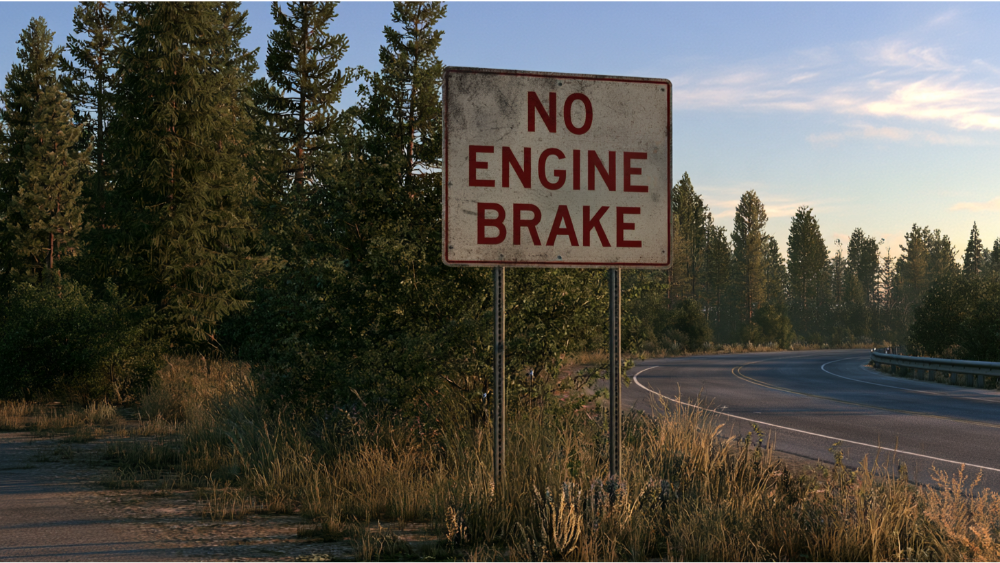
Compression release dumps high-pressure air into the exhaust on every cycle, which produces that hard, repeating bark you hear from a block away. Exhaust system condition changes how loud it gets, which is why a worn or modified exhaust draws attention fast. The signs are a reaction to compression brakes, not exhaust brakes.
FMCSA acknowledges that compression engine-brake use can be restricted under federal, state, or local noise standards. FHWA describes engine compression brake restrictions as a tool local and state authorities use, often near residential areas. Some ordinances target engine brake use broadly. Others target unmuffled exhaust specifically. Obey posted signs and verify the rules on your route.
Signs Your Jake Brake Needs Diagnostics
- No engagement at all when the switch is on
- Engagement only after the engine is fully warm
- Noticeably weak retarding force on a grade the driver knows well
- Only one of the three levels does anything
- Intermittent operation with no clear pattern
- Uneven or “missing cylinder” sound under braking
- A dash warning lamp or a stored fault code
- Activation you did not ask for, outside of regen behavior
An unresolved fault ends up pushing all that retarding work onto the friction brakes. Faster lining wear, more heat on every grade, and a larger brake repair later.
What a Proper Jake Brake Diagnostic Covers

What you can check from the seat: dash switch position, the fuse or breaker, whether the engine is at operating temperature, and whether your RPM and gear were in the range the manual calls for. Hydraulic compression brakes need warm, pressurized oil for full engagement, so a cold motor that brakes weakly may be behaving normally.
What the shop verifies: OEM software fault codes and live data, switch and activation inputs, wiring and connectors, solenoid circuits, oil pressure and supply, internal or external oil leakage, valve lash and engine brake adjustment, control valves, pistons and springs, and ECM, transmission, and ABS interaction. Service brake condition gets checked too, because the Jake Brake is supplemental.
Engine brake technology moved into the ECM years ago, which is why a scan tool matters more than a wrench on the first pass. Incomplete diagnosis is the root cause of most repeat repairs. Installing a new solenoid because it is the easiest part to reach is not a diagnostic.
Engine Brake Preventive Maintenance
Inspect and service the engine brake during scheduled engine maintenance, not as a separate event. The generic Jacobs guide lists inspection points around 100,000, 300,000, and 500,000 miles (roughly 3,000, 9,000, and 15,000 hours), then defers to the engine manufacturer’s schedule. Treat those as a general reference. Duty cycle, severe service, engine family, and OEM requirements all move the interval. Valve lash drifts with hours, and out-of-spec valves cost you retarding power before they cost you anything else.
For fleets: log driver complaints about weak engine braking in your company’s PM documentation, on every vehicle in the fleet. A trend shows up in the records long before it shows up as lining wear.
Frequently Asked Questions
Is an engine brake the same as a Jake Brake?
No. Jake Brake is a Jacobs Vehicle Systems brand of compression release engine brake. “Engine brake” is the broader category, which also covers exhaust brakes and plain natural engine braking.
What is engine braking, and why is it restricted in some places?
Engine braking is using the engine itself to absorb the truck’s momentum and control speed without the service brakes. Restrictions on commercial vehicle engine braking are about noise, not safety, and they come from state or local authorities rather than one national rule. Follow posted signs.
Is it okay to use the Jake Brake all the time?
Routine use on dry pavement, within the manual’s RPM and gear guidance, does not damage a properly maintained engine. That is what the technology is built for. Back off on low-traction surfaces, bobtail or empty on slick pavement, on a cold engine before oil is up to temperature, and in posted restriction zones.
Does a Jake Brake replace the service brakes?
No. It slows the truck, it does not stop it. Federal rules still require adequate service, parking, and emergency brake systems, and your friction brakes still need inspection and repair.
Get the Jake Brake Diagnosed Right the First Time
Weak or dead engine braking is a diagnostic problem before it is a parts problem: electrical, hydraulic, mechanical, or control-system. Torpedo Truck Repair’s certified technicians run OEM diagnostic software and verified workflows across Freightliner, Kenworth, Peterbilt, Volvo, Mack, International, and Western Star platforms, Class 6 through 8. You get an itemized estimate before work starts. No surprises, no upsell, with a same-day service focus when possible.
Call (253) 449-0100 or request a service quote.