Key Takeaway
A DPF, or diesel particulate filter, is an exhaust aftertreatment device in diesel engines that traps soot particles before they exit the tailpipe, reducing particulate emissions by 85 to 90 percent or more. Regeneration burns off collected soot, but non-combustible ash builds permanently and eventually requires professional cleaning or filter replacement. Ash service intervals vary widely, from 250,000 to over 800,000 miles, depending on duty cycle and engine oil consumption.
A DPF is a diesel particulate filter. It is an exhaust aftertreatment device that traps soot particles and other particulate matter before the exhaust gases leave the tailpipe. Diesel engines periodically burn off that accumulated soot through a process called DPF regeneration, which restores exhaust flow through the particulate filter. What regeneration cannot remove is ash, and that is why every diesel particulate filter eventually needs service regardless of how well it regenerates.
If you are reading this, you probably saw “DPF” on a repair estimate, got a dash warning mid-route, or your truck keeps asking for a parked regen and nobody has told you why. That last one matters most. A DPF warning is often not a filter problem at all. Here is what the particulate filter does, what the regeneration process can and cannot fix, and how to decide your next move.
What Is DPF in Diesel Engine Systems?
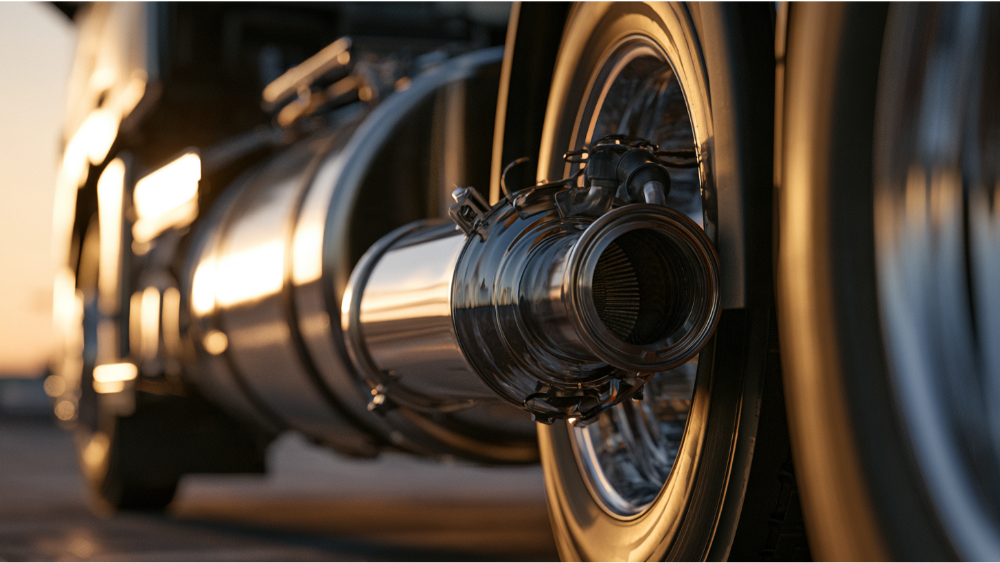
When drivers ask what is DPF in diesel engine terms, the answer is filtration. A diesel particulate filter is a filtration device in the exhaust stream that captures the solid particulate matter produced by combustion in diesel engines. The core is a fine pore ceramic structure, usually cordierite or silicon carbide, engineered to trap particulate matter, including soot particles well under 100 nanometers, with high filtration efficiency. It controls soot. It does not control NOx, and no amount of DPF work will fix a NOx-related fault.
Diesel particulate filters became standard equipment because of one regulatory change. The federal particulate matter standard for new heavy-duty highway diesel engines dropped from 0.1 to 0.01 grams per brake horsepower-hour for engines certified to model-year 2007 standards. That tenfold cut required widespread use of the diesel particulate filter to reduce particulate matter at the tailpipe. It also required cleaner fuel: ultra-low-sulfur diesel at a 15 ppm sulfur specification, phased into highway use between 2006 and 2010, because sulfur poisons this kind of emission control hardware.
One thing to understand before you read another estimate: in a service context, “the DPF” means the entire DPF system. Filter, housing, differential-pressure sensors and tubes, exhaust temperature sensors, dosing injectors, wiring and controls. Any one of those can trigger a diesel particulate filter complaint.
Where the Diesel Particulate Filter Sits in the Exhaust System
On a modern on-highway truck, the diesel particulate filter (DPF) is one stage in a chain of emission control components. Exhaust gases move through them in sequence, and each stage handles a different pollutant. Unlike the single catalytic converter under a gasoline vehicle, this is a multi-stage system with its own sensors, its own dosing hardware and its own failure modes.
| Stage | Component | What it handles |
|---|---|---|
| 1 | Engine out | Raw exhaust gases: soot, NOx, CO, hydrocarbons |
| 2 | Diesel oxidation catalyst (DOC) | An oxidation catalytic converter for hydrocarbons and CO; raises exhaust temperature for active regeneration |
| 3 | Diesel particulate filter (DPF) | Traps soot particles and particulate matter |
| 4 | DEF doser | Injects diesel exhaust fluid into the exhaust gases |
| 5 | SCR catalyst | Selective catalytic reduction of NOx |
| 6 | Tailpipe | Treated exhaust gases out |
Packaging and arrangement vary by engine manufacturer and model year. Some platforms combine the catalytic converter and the particulate filter into a single canister, some split them. The functional order above holds for most current heavy-duty systems.
What Soot Particles Does a Diesel Particulate Filter Remove From Exhaust Gases?

Diesel particulate matter is the solid material that survives combustion: unburned carbon, plus trace metals and other solids. Regulators went after it because fine soot particles smaller than 10 micrometers reach deep into the lungs, and some of the smallest can pass into the bloodstream. Soot emissions are linked to respiratory and cardiovascular effects, which is why the standards tightened as hard as they did.
EPA has stated that EPA-verified DPF systems are typically effective at reducing particulate emissions by 85 to 90 percent or more. That applies to verified systems, not to every particulate filter in every condition, and a filter with a cracked or damaged substrate is not delivering anything close to it.
How Does a Diesel Particulate Filter Work?
Most heavy-duty diesel particulate filters are wall flow filters. The substrate is a block of parallel channels plugged at alternating ends, so exhaust gases entering a channel have nowhere to go but sideways through the porous walls. Exhaust gases pass through the filter material. Soot particles stay behind, collecting on and inside the wall. That is the entire mechanism, and it is why a particulate filter restricts exhaust gas flow more as it loads.
The truck knows how loaded the filter is through a combination of differential-pressure sensing across the DPF, exhaust gas temperature sensors positioned through the aftertreatment, and a soot-load model running in the engine control unit. When the calculated soot load crosses a threshold, the engine management software commands a regeneration.
Pay attention to that word: model. The ECU is working from an estimate plus sensor inputs, not from a direct measurement of how much soot is in there. A failed pressure sensor, a plugged or cracked pressure tube, or a drifting temperature sensor can produce a “filter full” indication on a diesel particulate filter that is nowhere near full. That single fact is the reason so many filters get replaced when they did not need to be.
What Is DPF Regeneration?

DPF regeneration is the process of raising the temperature of the exhaust gases high enough to oxidize the collected soot in the particulate filter, converting the accumulated particulate mostly to carbon dioxide and clearing the channels. Soot begins oxidizing somewhere above roughly 350°C, and an active regeneration event runs considerably hotter than that. There are three ways the regeneration cycle happens, and OEM terminology for them varies.
Passive DPF Regeneration
Passive regeneration occurs naturally under sustained load at highway speed. During normal engine operation at that load, exhaust gases are hot enough to burn soot continuously with no added fuel and no driver involvement. Some manufacturers call passive regeneration continuous regeneration. A truck running loaded on long hauls may spend most of its life in passive regeneration and rarely see anything else.
Active Regeneration
When soot load crosses the threshold and passive conditions are not sufficient, the engine management system raises the temperature of the exhaust gases deliberately, typically through additional fuel injection or a dosing strategy. Active regeneration usually runs while the truck is driving, often without any driver action beyond keeping the truck moving. Passive and active regeneration together handle nearly all soot on a healthy truck.
Parked or Forced Regeneration
A forced regeneration is a stationary procedure initiated by the driver or a technician following the manufacturer’s sequence. Operating conditions, switch sequence, dash prompts and duration are specific to the truck and engine. Do not assume the forced regeneration procedure on one platform matches another.
Why Advice Written for Modern Diesel Cars Does Not Transfer to Class 8
Here is the most repeated bad advice on the internet: “just drive 50 to 60 mph for 30 to 45 minutes and it will clear.” That guidance comes from diesel cars and light diesel vehicles, where the particle filter is small and the regeneration cycle is short. Modern diesel cars and light pickups behave nothing like a loaded tractor with a 15-liter engine, and published intervals for diesel passenger cars have no bearing on your truck. On Class 6 through 8 platforms there is no universal speed, duration or mileage rule. Follow the operator manual and the truck’s own prompts.
One safety item that gets skipped: active regeneration and forced regeneration both produce very high exhaust system temperatures. Never initiate a parked regeneration near dry vegetation, spilled fuel, loading materials or low overhead clearance, and let the exhaust cool before anyone works near it.
Soot vs. Ash: Why Filter Regeneration Is Not a Full Cleaning
Regeneration does not empty the filter. It burns the carbon. Everything non-combustible stays exactly where it is.
Soot is combustible carbon, and that is what the regeneration process oxidizes. Ash is non-combustible, comes largely from engine oil consumption and the additive packages in engine oil, and accumulates permanently inside the substrate. A diesel particulate filter that regenerates flawlessly for years is still slowly filling with ash, and eventually it has to come off the truck for professional cleaning or replacement per the engine manufacturer’s specification.
How long that takes depends almost entirely on duty cycle and engine oil consumption. Engine manufacturers publish ash service ranges for their own platforms, and the spreads are wide. As one OEM example, Cummins publishes an ash service range for the 2024 X15 of 250,000 to 400,000 miles in severe operation and 600,000 to 800,000 miles in light operation. That is a single engine family, not a universal interval, and the spread tells you everything: the same particulate filter can need service at a quarter million miles or three times that.
So if someone quotes you a flat mileage number for ash service without asking about your duty cycle, your idle hours and your engine oil consumption, they are guessing.
What Does a DPF Warning Light Mean?
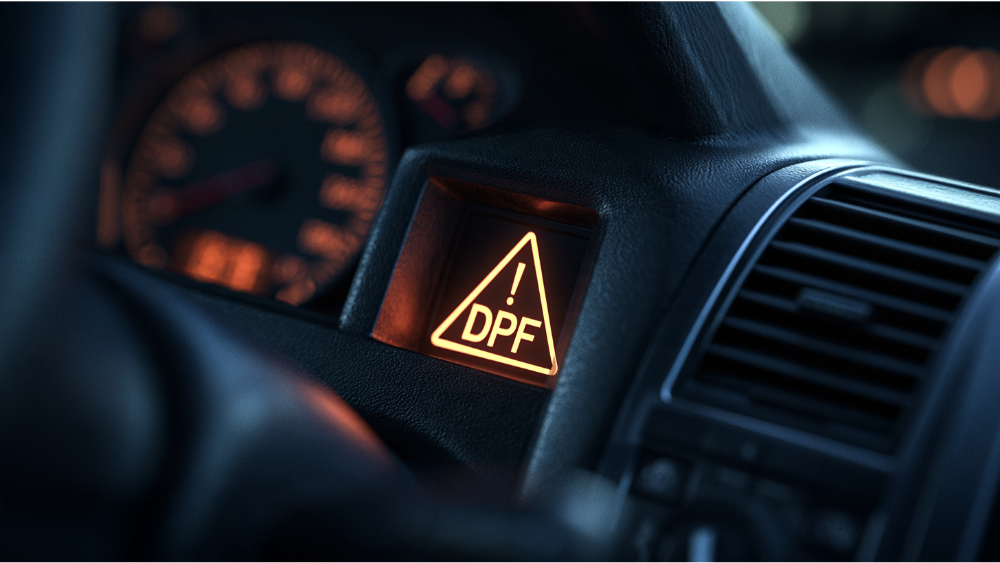
There is no universal DPF lamp language across Freightliner, Kenworth, Peterbilt, Volvo, Mack, International and Western Star. Solid, flashing and combined lamp behavior means different things by manufacturer and model year. Some platforms pair a flashing regeneration icon with a text message telling you a parked regen is needed. Your operator manual is the authority, not a forum post about a different truck.
Generally, escalating indications follow a pattern:
- Soot accumulating, or regeneration in progress or requested: the DPF system is managing itself, or wants driving conditions that let it.
- Parked regeneration required: the automatic strategy could not keep up. Driver action needed.
- Derate or stop-engine warning: the system has escalated to preventing engine damage.
Here is the misread that costs real money: the DPF warning light reports a condition, not a root cause. It tells you the ECU believes flow through the particulate filter is restricted or that regeneration is not completing. A pressure sensor, a damaged pressure tube, a failed doser or an engine fault producing excessive soot can all light it up with a perfectly serviceable filter in the pipe.
Can You Keep Driving With the DPF Light On?
It depends on what the truck is telling you, and the operator manual governs. Use this framework:
- Normal automatic regeneration indication: keep running per the manual and let the regeneration cycle finish.
- Parked regen requested: stop somewhere safe and run the OEM forced regeneration procedure.
- Regen will not start or keeps aborting: stop and get it diagnosed.
- Warning returns immediately after a completed regen: stop and get it diagnosed. Nothing was fixed.
- Derate or stop-engine warning: do not push it.
Increased Fuel Consumption, Power Loss, and Turbo Damage
The cost logic is simple. A genuinely blocked diesel particulate filter creates excessive exhaust backpressure, and that is how you get reduced engine power and acceleration, increased fuel consumption, hard-start or no-start conditions, and turbocharger damage. Fuel efficiency usually slips before the power does. Pushing a plugged filter one more load turns a diagnostic call into an engine repair.
Why DPF Problems Keep Coming Back

A regeneration is a process, not a diagnosis. If your truck keeps asking for one, nothing has been corrected. Repeat regens almost always trace back to one of four buckets.
- Duty cycle. Low engine load work, stop-and-go running at low speeds and heavy idling produce low exhaust temperatures that never get the filter hot enough. Soot keeps building, and every interrupted regeneration cycle leaves it behind.
- Engine-out soot sources. Worn or leaking injectors, a failing turbocharger, exhaust gas recirculation faults and air intake restrictions or leaks all push more soot particles into the filter than the system was designed to handle.
- Engine oil consumption and oil spec. Engine oil entering the combustion process raises ash loading directly. Use the exact OEM-specified oil category and viscosity. API CK-4 oils are formulated to protect aftertreatment durability, and FA-4 is not universally interchangeable or backward compatible, so follow the engine manufacturer’s specification rather than a generic “low-ash engine oil” recommendation.
- Aftertreatment hardware. Dosing injectors, exhaust temperature sensors, differential pressure sensors, the pressure tubes themselves, wiring and control modules. Any of these can block active regeneration or falsify the soot estimate.
How Should a DPF Problem Actually Be Diagnosed?
Structured, in this order, with data behind each step:
- 1. Pull OEM fault codes using manufacturer diagnostic software, not a generic code reader. Emission control logic lives in OEM-level data.
- 2. Review soot and ash load estimates against the truck’s duty cycle and service history. Ash near the end of its service life is a different problem than soot loading at 200,000 miles.
- 3. Verify differential pressure readings and physically inspect the pressure tubes for plugging, cracks and routing damage.
- 4. Validate exhaust gas temperature sensor data across the aftertreatment. A drifting sensor can prevent active regeneration from ever initiating.
- 5. Confirm the conditions for regeneration are being met in live data: temperature, load, doser function, inhibit conditions.
- 6. Inspect upstream causes. Injectors, turbocharger, EGR, air intake leaks, engine oil consumption, doser operation, exhaust leaks.
- 7. Run a controlled regeneration only when appropriate, then verify the repair under operating conditions before the truck leaves.
Replacing a particulate filter without finding what loaded it buys you the same breakdown a few thousand miles later, with a second invoice attached. At Torpedo Truck Repair, you get a full itemized estimate before a single bolt is turned. No surprises, no upsell.
Can a Blocked DPF Be Cleaned, or Do You Need a New Diesel Particulate Filter?
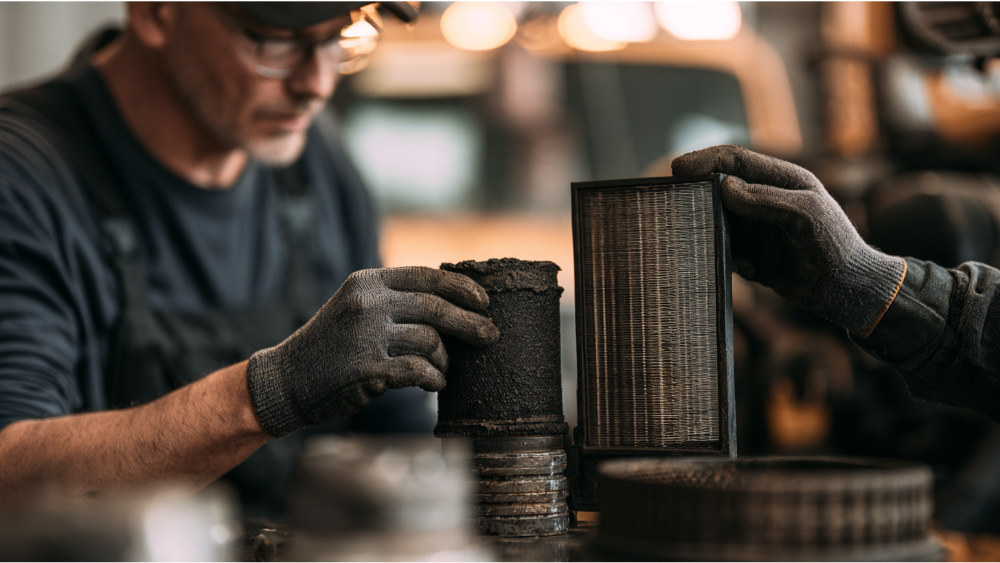
Often cleaned, sometimes replaced. Inspection decides, not the warning light.
- Soot-loaded: recoverable through a completed filter regeneration or a service regen once the underlying condition is corrected.
- Ash-loaded: the filter comes off the truck for professional cleaning per OEM specification. No on-truck procedure removes ash.
- Damaged or contaminated: replacement. A substrate that has been melted, cracked or soaked with engine oil, coolant or raw fuel cannot be cleaned back to spec, and once substrate integrity is gone, so is filtration efficiency.
A Word on Partial Filters
You will occasionally hear about partial filters. Partial-flow designs exist, but partial filters do not deliver the filtration efficiency of a wall-flow diesel particulate filter, and they are not what a modern on-highway truck runs.
DPF vs. DEF, SCR, DOC, and EGR: What’s the Difference?
First, the correction: DEF is not sprayed into the diesel particulate filter to burn soot. DEF feeds the SCR system and targets NOx. It has nothing to do with clearing your filter.
| System | What it targets | Where it sits | What failure looks like |
|---|---|---|---|
| DPF | Particulate matter and soot particles | After the DOC | Restricted flow, regen faults, derate, power loss |
| DEF / SCR | NOx | After the DPF | NOx conversion faults, DEF quality and dosing codes, derate |
| DOC | CO and hydrocarbons; supports regeneration temperature | Ahead of the DPF | Regenerations that will not reach or hold temperature |
| EGR | Engine-out NOx | On the engine, before the exhaust gases exit | Excess soot production, cooler leaks, repeat DPF loading |
How Do You Reduce DPF-Related Downtime?

Most DPF downtime is preventable, and it comes down to habits rather than hardware.
- Complete regeneration prompts when they appear instead of deferring them to the end of the week.
- Run the OEM-specified engine oil category and viscosity, and the specified fuel.
- Fix injector, EGR, turbo and engine oil consumption faults early, while they are still small and before they load the particulate filter.
- Track repeat regens per unit. Frequency trending upward is a fault developing, not a quirk.
- Watch fuel burn. Increased fuel consumption on a route you run every week is often the earliest signal of restriction.
- Build aftertreatment inspection and soot and ash data review into PM service intervals.
For fleet operators, the value compounds. When PM scheduling and documentation are consistent across units, regeneration frequency becomes a metric you review instead of a call you take from a stranded driver.
Is a DPF Delete Legal?
No. Federal Clean Air Act provisions prohibit knowingly removing or rendering an emission control device inoperative, and they also prohibit manufacturing, selling or installing defeat devices. EPA specifically identifies diesel particulate filter hardware and the associated software tuning as covered. DPF removal or disabling can expose owners, shops, sellers and installers to enforcement and penalties.
Beyond the legal exposure, a deleted truck creates inspection scrutiny and resale problems, and it does nothing about the injector, turbo or EGR fault that loaded the filter in the first place. We repair emission control systems. We do not delete them.
Frequently Asked Questions
How much does it cost to replace a DPF?
Too variable to publish a number. It depends on the engine platform, the filter type, whether the existing diesel particulate filter can be cleaned instead of replaced, and what upstream repair is required to stop it from happening again. You get an itemized estimate before any work begins.
Can I clean my DPF filter myself?
A regeneration is not a cleaning, and it will not touch ash. Ash removal requires the particulate filter off the truck and OEM-spec cleaning equipment. Improvised methods, including pressure washing or chemical soaking, can damage the substrate and destroy filtration efficiency.
What happens if a DPF is removed?
Removal or disabling is prohibited under federal law, with enforcement exposure for both the owner and whoever performed the work. It also creates DOT inspection and resale problems, and it leaves the original fault uncorrected.
Why does my truck keep asking for a parked regeneration?
Repeat requests point to duty cycle, excess engine-out soot, or a sensor or doser fault preventing the regeneration process from completing. The regen request is the symptom. Until the cause is identified with live data, you will keep running the same procedure.
Get the Cause Diagnosed, Not Just the Filter Replaced
Our Exhaust And DPF Repair service starts with OEM diagnostic software and a structured, verified workflow: fault codes, soot and ash data, pressure and temperature verification, upstream inspection, then post-repair confirmation under operating conditions. Certified technicians, Class 6 through 8 platforms, including Freightliner, Kenworth, Peterbilt, Volvo, Mack, International and Western Star. You get an itemized estimate before a single bolt is turned, and a same-day service focus when the repair allows it.
Call (253) 449-0100. 24/7 emergency dispatch is always available; shop hours are Mon-Fri 8:00 AM to 5:30 PM. Or Request Service Quote online. Takes under 60 seconds. No obligation.