Key Takeaway
Diesel engines have two batteries because their high compression ratios demand a massive burst of cranking current that a single battery cannot reliably supply, especially in cold weather when oil thickens and glow plugs or intake heaters add extra load. In most diesel pickups, two 12V batteries are wired in parallel, keeping the system at 12V while doubling available capacity. Neither battery is a backup: both work as one bank simultaneously. Class 6 through 8 trucks often run three or four batteries for the same reason.
Most diesel engines in trucks run two batteries because cranking high compression demands a large burst of current, and glow plugs or intake-air heaters pile on more load during a cold start. In most diesel pickups, those two 12V batteries are wired in parallel. The system stays 12V, but available cranking capacity goes up. Not every diesel has exactly two. Class 6 through 8 tractors often run three or four.
If your truck is cranking slow, clicking, or you are about to buy batteries, the configuration matters more than the count. Parallel adds capacity. Series adds voltage. In a factory starting setup, both batteries work as one bank, not as a spare.
Why Do Diesel Engines Need That Much Power To Start?
A diesel is a compression-ignition engine. It compresses air until it reaches a temperature hot enough to ignite the fuel injected into it. There is no spark plug doing the work, so the engine runs much higher compression ratios than a gasoline engine, per the U.S. Department of Energy and EPA.
The starter has to spin the engine against far more resistance than a gas engine ever puts up, and it has to do it in a few seconds. On common-rail diesel engines, the high-pressure fuel pump is driven off the engine, so the starter is turning that pump too. Current demand spikes hard into a short window.
Cold makes the problem worse. Oil thickens, and the starter has to shear that oil while it turns the crank, the oil pump, and the injection pump. Fuel can wax in the lines, and a restricted fuel filter makes the engine harder to catch. The battery itself loses some of its punch at low temperature. Cold-start aids add their own draw on top of all of it. Some engines use glow plugs, others use intake-air or grid heaters, depending on the engine family. If you wanted one universal amperage number that covers every diesel, it does not exist.
Two batteries exist to cover that kind of peak without the bank collapsing under it.
How Two Diesel Batteries Work Together: Parallel vs. Series
Parallel means positive to positive, negative to negative. Voltage stays the same, capacity adds. Series chains the batteries so voltage adds and capacity does not.
| Configuration | System Voltage | Capacity | Typical Purpose |
|---|---|---|---|
| Two 12V batteries in parallel | 12V | Adds (two 50Ah = 100Ah) | More cranking and reserve capacity |
| Two 12V batteries in series | 24V | Does not add (stays 50Ah) | Higher-voltage equipment systems |
One correction worth making: a parallel pair does not automatically double the current your starter draws. It increases available current, CCA, and reserve capacity. What actually gets pulled is set by the starter, the cables, engine resistance, and temperature.
Battery Council International defines cold cranking amps as the current a new, fully charged battery delivers at 0°F for 30 seconds while holding at least 1.20V per cell, or 7.2V on a 12V battery.
Two batteries sharing the load means each one sees a shallower discharge, which supports service life. Modern diesels carry loads that did not exist twenty years ago. DPF regens, DEF pumps and heaters, exhaust temperature sensors, telematics, and reefer or liftgate loads all draw power from the same bank.
Do All Diesel Engines Have Two Batteries?
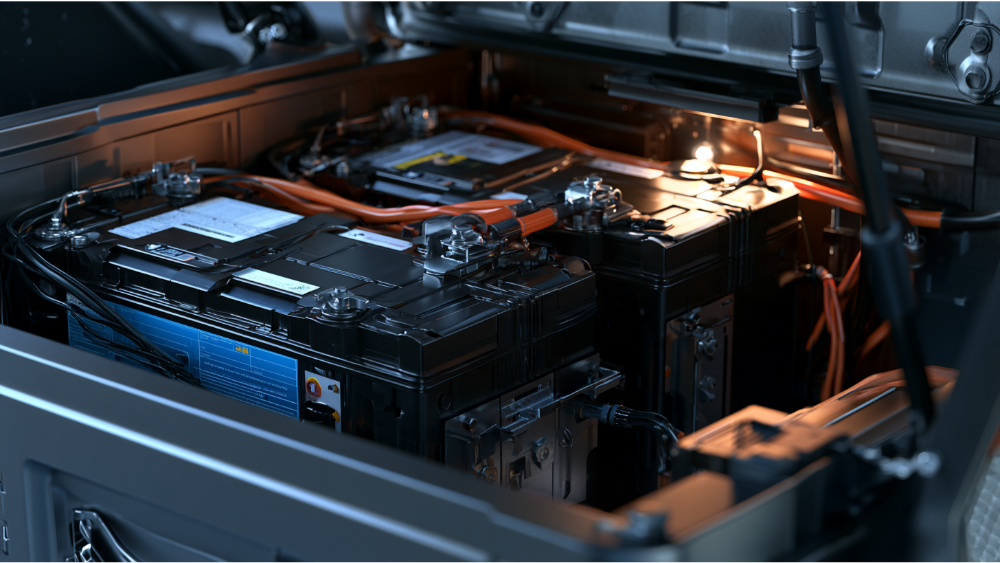
No. The count is an OEM engineering decision, and it moves with the platform.
| Platform | Typical Battery Count | Typical Setup |
|---|---|---|
| Smaller diesel engines | One | Single 12V with a sufficient rating |
| Diesel pickups (F-450, Ram 3500 and up) | Two | 12V parallel |
| Medium-duty trucks | Two | 12V parallel |
| Class 6 through 8 tractors | Three to four | 12V parallel, starter plus hotel loads |
| Heavy equipment | Varies | 24V series or series-parallel banks |
Displacement, starter draw, climate, accessories, and system voltage all factor in. A Freightliner Cascadia, Kenworth T680, Peterbilt 579, Volvo VNL, Mack MP8, International A26, and Western Star do not all land on the same answer. Follow the configuration on the truck, not a rule of thumb you read somewhere.
Is One Battery A Backup? What Happens When One Goes Bad
Neither one is a backup. Plenty of drivers treat the second battery as insurance against the first. That is wrong. In a factory parallel starting bank, both batteries operate as a single source, and nothing is held in reserve.
When one battery develops a shorted cell or high internal resistance, it drags the entire bank down. The good battery feeds current into the bad one and discharges itself doing it. You will see slow or uneven cranking, a single click, battery voltage collapsing under load, or lights dimming hard mid-crank.
The problem hides at rest. A truck can look fine sitting still. Most people stop at resting voltage, and resting voltage proves nothing about whether a battery carries a cranking load. With the batteries connected, the stronger one masks the weaker one during testing. Midtronics and GM service guidance both call for isolating batteries before testing for exactly that reason.
An isolated auxiliary or sleeper battery is different, deliberately separated so accessories run without touching starting capacity. Do not confuse it with a parallel starting pair.
Should You Replace Both Diesel Batteries At The Same Time?
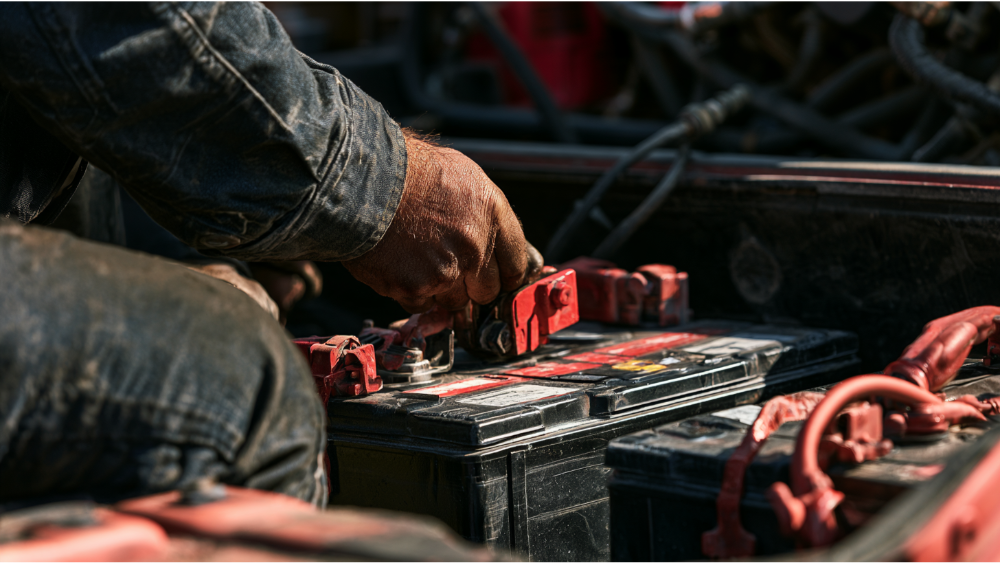
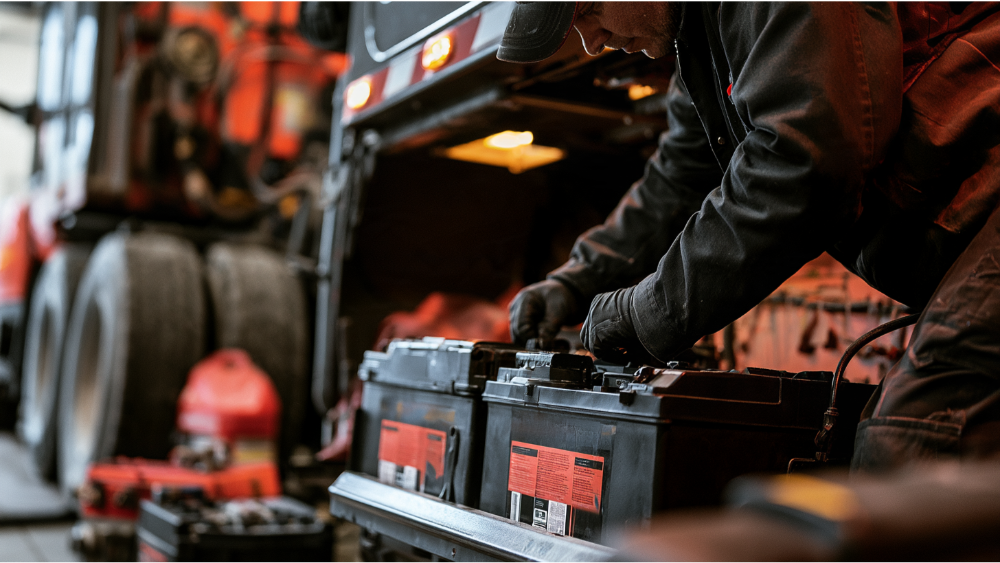
In a paired starting bank, yes. Replacing them as a set is the correct move, and manufacturers generally recommend it.
Batteries in one bank should be matched on age, rating, chemistry, and charge level. Pair a new battery with a degraded one and the new unit carries more load and ages faster. Do not mix AGM and flooded in the same bank. The same is true for mixing ratings. East Penn and Interstate agree on that.
Interstate puts typical service life around three to five years, depending on heat, cold, vibration, deep discharge, and duty cycle. A truck running long miles in steady service can outlast one that sits and short-cycles. Treat it as a range, not a schedule.
Before you buy anything, the full bank, cables, starter, and charging system get tested. A new set of batteries does not fix a bad ground or corroded posts. A lot of batteries get replaced that were never the fault, and buying twice is pretty common when that step gets skipped. On larger Class 6 through 8 banks, follow OEM and fleet replacement procedure rather than a two-battery rule that was never written for your truck.
How A Dual-Battery Diesel No-Start Should Be Diagnosed
- Confirm the configuration first: 12V or 24V, parallel, series, or isolated auxiliary.
- Inspect posts, terminals, crossover cables, and ground straps for corrosion and loose clamps. A bit of corrosion on a ground strap drops enough voltage to mimic a dead battery.
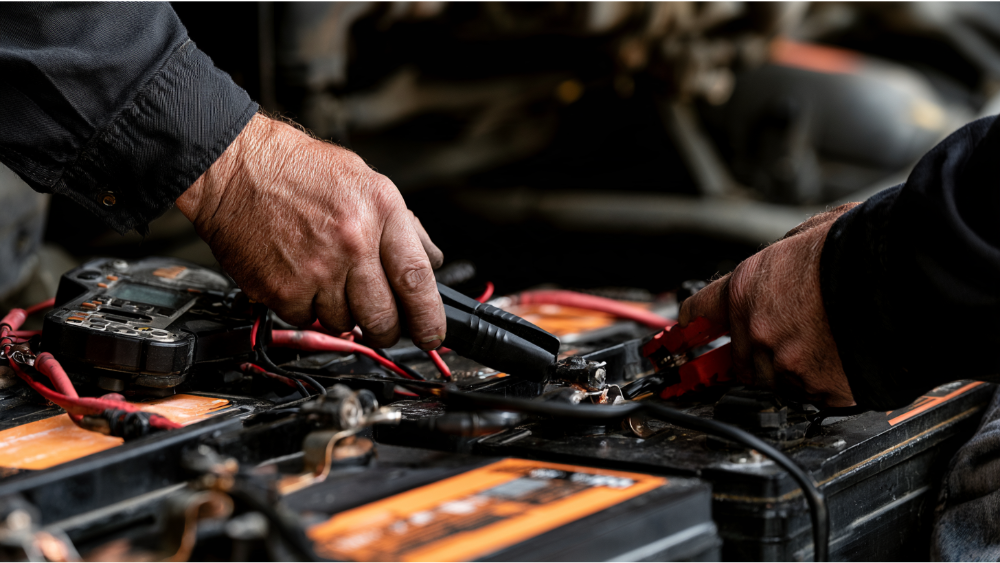
- Electrically isolate each battery and test it individually against its labeled rating. Never test the bank connected.
- Charge as required before load testing. A discharged battery fails a test it would otherwise pass.
- Run voltage-drop testing on the cables and grounds.
- Check starter draw and cranking speed.
- Verify alternator output so you have a full view of whether the bank actually recharges.
- If the engine cranks at normal speed and still will not fire, move to the fuel side: supply pressure, rail pressure, injectors, and intake air.
- Match any replacement to OEM specification and to the rest of the bank.
Troubleshoot the bank in that order and you find the fault once. Guessing which battery looks bad is how a truck comes back down a week later. In our view, that is the whole argument for Electrical Diagnostics And Repair run in sequence instead of by parts swap.
OEM procedure varies more than most shops admit. A 2025 Ford Super Duty manual allows cranking up to 15 seconds. The 2026 F-650/F-750 limits a crank attempt to 10 seconds with a 30-second wait between tries. Same brand, different rules. Applying the wrong one makes a marginal bank look worse than it is.
Torpedo Truck Repair handles diesel electrical diagnostics on Class 6 through 8 trucks and trailers. Our experience comes from inside trucking operations, not just a service bay. Certified technicians, OEM diagnostic software, itemized estimate before work starts, no surprises. Chicago shop: 2940 W 36th St Unit A, Chicago, IL 60632. Call Now: (331) 299-1322. 24/7 emergency road service dispatch.
Frequently Asked Questions
Can you start a diesel truck with only one battery?
Sometimes, in mild conditions, if that battery is healthy and the bank is parallel. It is not a repair, and it will leave you stranded on the first cold morning. Cranking capacity is reduced, and a heavy starter load exposes it fast.
Can weak batteries cause running problems after the engine starts?
Yes. Low system voltage can leave control modules, fuel pumps, and exhaust aftertreatment components working out of spec. An aborted regen or a fault code with no obvious source sometimes traces back to the bank or the charging circuit, so check the electrical side before buying parts.
How do you jump-start a diesel truck with two batteries?
Use the OEM-designated jump point (many pickup manuals specify the driver-side battery), never exceed the truck’s rated system voltage, and ground away from the posts. Procedures are model-specific, so read the manual first.
Why does a 6.7 Power Stroke have two batteries?
Ford specs dual 12V batteries in parallel to supply cranking current for the high-compression engine plus the glow plug system and the truck’s electrical loads. The system stays 12V.
Does a Duramax need two batteries?
It comes factory-equipped with two wired in parallel for cranking capacity and reserve. Running one is below OEM specification and shortens the remaining battery’s life.