Key Takeaway
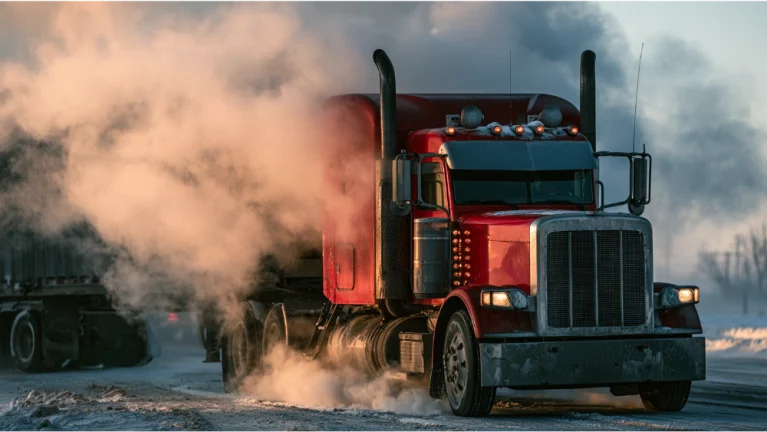
Diesel engines blow black smoke when fuel does not burn completely, producing carbon soot from oxygen-starved zones inside the combustion chamber. The root cause is almost always too much fuel for the available air, poor fuel atomization, or a failed aftertreatment system. On any 2007-or-newer DPF-equipped truck, where filters cut particulate matter by 85 to 90 percent, visible black smoke means something is broken and needs a verified diagnosis before any parts are replaced.
A diesel engine blows black smoke when fuel does not burn completely and leaves the stack as carbon soot. That happens when the cylinders get too much fuel for the air actually reaching them, when the fuel injectors are not atomizing properly, or when soot escapes past damaged aftertreatment. The color of the exhaust smoke tells you which system to look at. It does not tell you which part failed.
If you are watching a diesel truck smoke right now, here is what this covers: what black smoke means, whether the unit should keep moving, and what a real diagnosis includes before anyone quotes you a turbo or a set of fuel injectors. Black smoke is a symptom, not a diagnosis. Anyone who tells you otherwise is guessing with your money.
Is Black Smoke From a Diesel Engine Ever Normal?
There are three tiers here, and the rest of this article depends on knowing which one you are in.
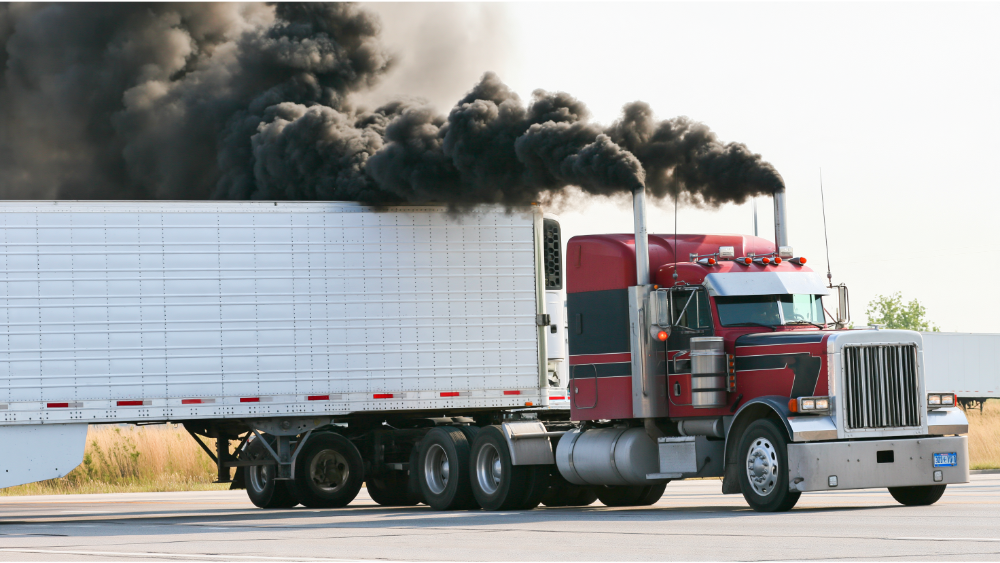
- A brief puff on an older mechanically injected or pre-DPF diesel engine. Under sudden load, fuel delivery can get ahead of turbo airflow for a second. That happens, and it is not automatically a fault.
- Persistent or dense black smoke on any platform. Not normal. Ever. Something is wrong with air, fuel, or combustion quality.
- Visible black smoke from a 2007-and-newer DPF-equipped Class 6 through 8 truck. Red flag. EPA-verified diesel particulate filters typically cut particulate matter by 85% to 90% or more. If soot is reaching daylight in visible quantities, the filter is not doing its job.
“That’s just what diesel engines do” is not an acceptable answer on a modern truck. It was a reasonable shrug in 1998. On a Cascadia or a T680 with functioning emissions hardware, black smoke means something is broken or something has been removed.
What Diesel Black Smoke Actually Is
Most articles call it unburned diesel. That is close enough to be misleading. Diesel black smoke is carbon soot formed in locally fuel-rich zones inside the combustion chamber, places where fuel and air did not mix well enough to burn cleanly. OSHA describes diesel particulate as soot made primarily of carbon, along with ash, metallic abrasion particles, sulfates, and silicates.
Unlike gasoline engines, which throttle incoming air to control engine speed, diesel engines draw a full charge of air on every intake stroke and set engine speed with fuel volume instead. Proper combustion turns that fuel into carbon dioxide and water vapor. When there is not enough air for the fuel being commanded, the combustion process leaves unburnt fuel behind as carbon.
Here is the part that matters diagnostically: your overall air fuel mixture can look fine on paper and the diesel engine can still make soot. Diesel fuel enters the combustion chamber as a high-pressure spray and has milliseconds to mix with whatever air is in there. Oxygen-starved pockets around the fuel spray produce carbon even when the engine is running lean overall. That is why boost leaks and a bad injector can produce the same visible black smoke through completely different mechanisms.
Soot does not all leave through the stack, either. What does not exit ends up in the engine oil and on internal components, which is why heavy sooting shortens oil life and accelerates wear on bearings, rings, and valvetrain.
The Five Main Causes of Black Smoke in a Diesel Engine
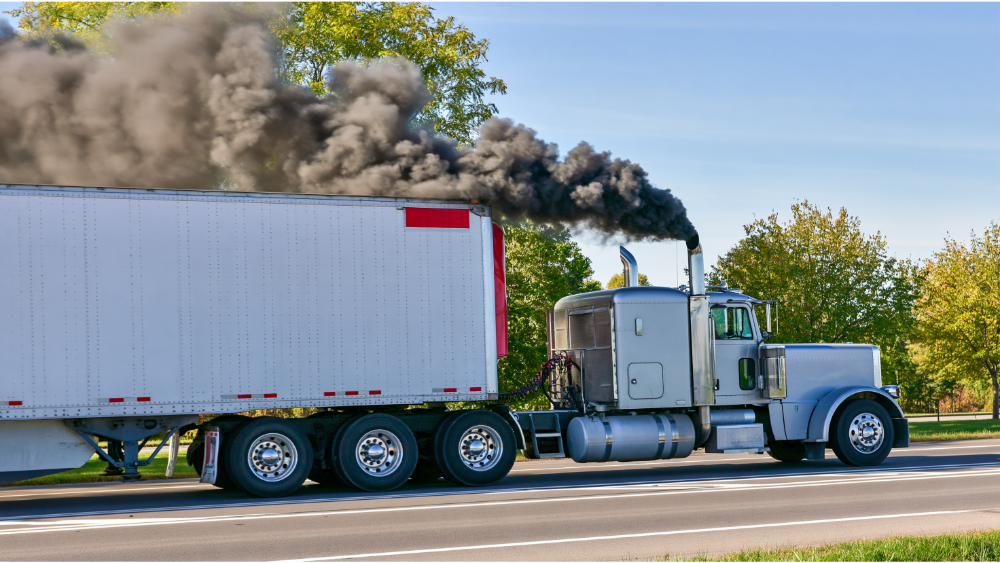
Every cause of black smoke lands in one of five buckets: air supply, charge air, fuel delivery, controls, or mechanical and aftertreatment condition. A competent shop uses that hierarchy to narrow the field before touching a wrench. Skipping it is how a truck comes back twice.
Restricted Airflow (Clogged Air Filter, Intake Restriction, Carbon Buildup)
The cheapest cause of black smoke to rule out, and the first thing that should get checked. A clogged air filter starves the diesel engine of air while the ECM keeps commanding the same fuel quantity. The result is a rich mixture and soot out the stack. A restriction gauge on the housing tells you in ten seconds whether the air filter is the suspect, and a clogged filter on a linehaul unit running gravel yards or agricultural routes can load up long before the mileage interval says it should.
Beyond the filter itself, look at collapsed or crushed intake piping, a loose clamp pulling unfiltered air, and carbon buildup in the intake manifold and on the intake valves. Intake manifold deposits are common on high-idle and short-haul duty cycles that never get the diesel engine hot enough for long. Less air, same fuel, black smoke. That is the whole mechanism.
Boost Leaks and Turbocharger Faults
Pressurized air that escapes before it reaches the cylinders never gets to burn fuel. Split boots and hoses, loose or shifted clamps, a leaking charge-air cooler, and pre-turbo exhaust leaks all cost you boost. So do VGT actuator faults, a stuck wastegate, and bearing or compressor wheel damage.
The symptom pairing is distinctive. Black smoke plus power loss plus a hiss under load usually means charge air is going somewhere other than the intake manifold. Boost leaks weight heavily toward black smoke under hard acceleration and grade pulling, when boost demand is highest and a marginal leak becomes an obvious one. Expect more smoke at high rpm under a full load than at cruise. Small boost leaks also hide at idle and only show themselves on a pressurized test, which is why guessing at this system wastes days.
Fuel Injectors, Diesel Fuel Quality, and Fuel Delivery Problems
Too much fuel injected, or fuel injected badly, makes soot. That covers an over-fueling injector, clogged fuel injectors with a degraded spray pattern that dumps liquid diesel fuel instead of atomized mist into the combustion chamber, incorrect fuel pressure, and injection timing that is off. A failing fuel pump that cannot hold commanded rail pressure belongs here too. So does fuel quality: contaminated, waxed, or off-spec diesel fuel burns poorly and shows up as exhaust smoke and rough running. Water or debris in the tank will chew nozzles and put you right back here in a month. Excess fuel that never finds oxygen leaves the exhaust pipe as thick black smoke.
Faulty fuel injectors are a genuinely common cause. But black smoke alone does not prove it. Injector condition gets tested with OEM diagnostics and cylinder contribution data, not assumed because a truck smoked on a hill. A set of fuel injectors is a serious invoice to write off a visual symptom.
EGR System Faults, a Dirty MAF Sensor, and ECM Calibration
The EGR system exists to lower combustion temperatures and cut NOx emissions. When an EGR valve sticks open, or the system flows more than conditions warrant, recirculated exhaust displaces fresh intake air. Less oxygen, same fuel, soot. Sensor faults do the same thing indirectly. A dirty MAF sensor reports less airflow than the diesel engine is actually getting, and MAP, boost, and intake-air-temperature sensors reporting values that do not match reality cause the engine computer to command the wrong fuel quantity with perfect confidence. A dirty MAF sensor is a cheap part telling an expensive lie.
Then there is tuning. Aggressive aftermarket calibration and rolling coal deletes over fuel the cylinders on purpose, commanding more diesel fuel than the available air can burn. That is the point of them. Federal law prohibits tampering with hardware designed to reduce emissions and prohibits installing devices that defeat it. Beyond the compliance exposure, a deleted or retuned truck is a diagnostic blind spot. Deletes are not repairs.
Engine Condition, Catalytic Converters, and Aftertreatment Failures
Low compression, worn piston rings, and valve or cam timing problems all degrade what happens inside the combustion chamber and can produce smoke. Worn rings can also mean the diesel engine is burning oil, which changes the exhaust smoke color and the diagnosis with it.
Now the DPF distinction most articles get wrong. A loaded DPF creates restriction, frequent regens, warning lights, power loss, and eventually a derate. It does not typically produce a black plume at the stack. Visible soot downstream of a DPF usually means the filter is cracked, broken, removed, or bypassed. The diesel oxidation catalyst ahead of it matters too, since failed or gutted catalytic converters change light-off temperature and regen behavior, and gutted catalytic converters on a used truck are something you find during inspection, not from the driver’s seat.
EPA guidance is direct: find out why soot production increased instead of just cleaning or swapping the filter. Excessive engine-out soot from an upstream fault can load a filter rapidly, and OEM field bulletins document exactly that.
What the Timing of the Black Smoke Tells You
When the smoke appears does not prove which part failed. It tells a technician what to test first, and that shortens the diagnosis.
| When you see the smoke | What gets checked first |
|---|---|
| Under acceleration or pulling a grade | Charge-air leaks, low boost, VGT control, intake restriction, over-fueling |
| Constant at idle and under load | Injector fault, EGR system stuck open, dirty MAF sensor or calibration issue, severe airflow restriction |
| With power loss or hissing | Boost hoses, charge-air cooler, clamps, turbo, pre-turbo exhaust leak |
| With rough idle or misfire | Injector contribution test, fuel delivery, EGR, compression and valve concerns |
| Black smoke at the stack on a DPF truck | DPF integrity, tampering, excessive engine-out soot |
| Frequent regens or rapid soot loading | Air, fuel, EGR, sensors, temperature, duty cycle, before any DPF cleaning |
| Started right after service work | Disconnected sensors, charge-air connections, injector setup, ECM calibration, installed parts |
Record which pattern you are seeing before you call the shop. It cuts diagnostic time and it sharpens the estimate.
Reading Diesel Exhaust: Black Smoke vs. White Smoke vs. Blue Smoke
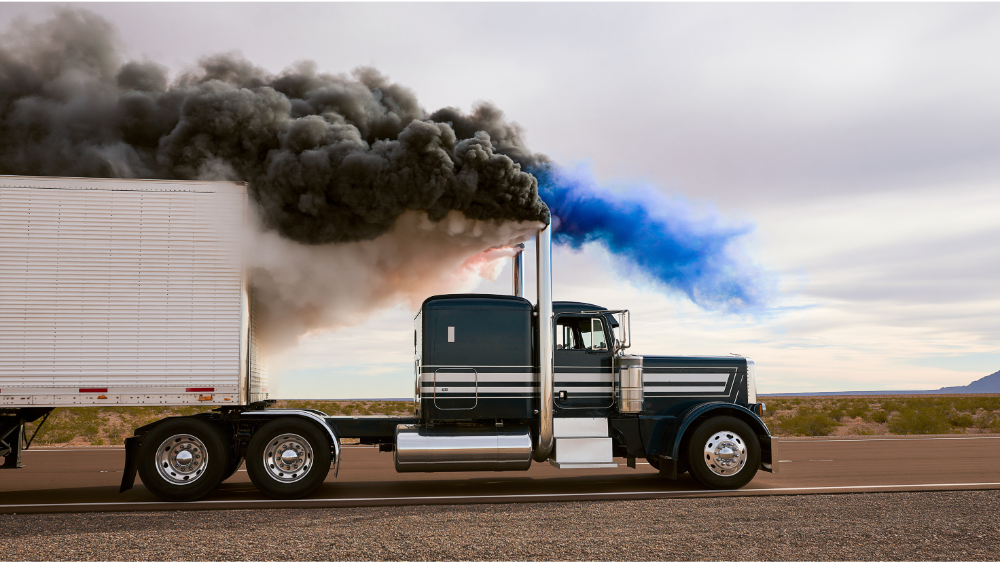
Black smoke: carbon soot from incomplete combustion. An air, fuel, or aftertreatment problem, every time.
White smoke: raw or vaporized unburned fuel, or coolant. White smoke on a cold start that clears as the engine warms is usually incomplete ignition, and on smaller diesel platforms weak glow plugs are a common contributor. White smoke that persists after warm-up points toward injection timing, low compression, or an injector that is dribbling instead of atomizing. Sweet-smelling white smoke means coolant is finding its way into a cylinder, and that gets shut down, not driven.
Blue smoke: burning oil. Typically worn piston rings, valve guides, or turbo seals. A bluish smoke haze that shows up at startup or on decel narrows the list further.
Exhaust smoke color narrows the system. It does not identify the part. Two trucks with identical black plumes can need completely different work, and a truck that makes both black smoke and white smoke is telling you the fuel is landing in the combustion chamber wrong.
Can You Keep Driving a Diesel Truck That Is Blowing Black Smoke?
Diesel owners ask this constantly, and the honest answer depends on severity. A brief puff with no warning lights is a different call than a continuous plume. Persistent black smoke means the diesel truck gets diagnosed promptly, not at the next PM. Every mile you run it, you are burning diesel fuel you are not converting to power and loading soot into the DPF and the oil.
Shut down safely and call for roadside service if the smoke comes with any of these:
- Stop-engine warning or active derate
- Overheating or a coolant temperature alarm
- Low oil pressure warning
- Sharp, sudden power loss
- Engine overspeed or runaway behavior
- Grinding, whining, or other abnormal turbo noise
Diesel Exhaust Is Not Something to Stand In
One safety note that gets ignored: do not run a smoking truck inside a closed shop, dock, or warehouse without working exhaust extraction. Diesel exhaust was classified a Group 1 human carcinogen in 2012, and short-term exposure to high concentrations of diesel exhaust causes headache, dizziness, and eye, nose, and throat irritation. A unit making heavy black smoke is putting out far more particulate than a healthy one.
No article can clear your truck to keep running. That takes an inspection. If you are on the shoulder on I-5 with a loaded trailer, call (253) 449-0100 for 24/7 emergency roadside dispatch.
How a Diesel Technician Should Diagnose Black Smoke
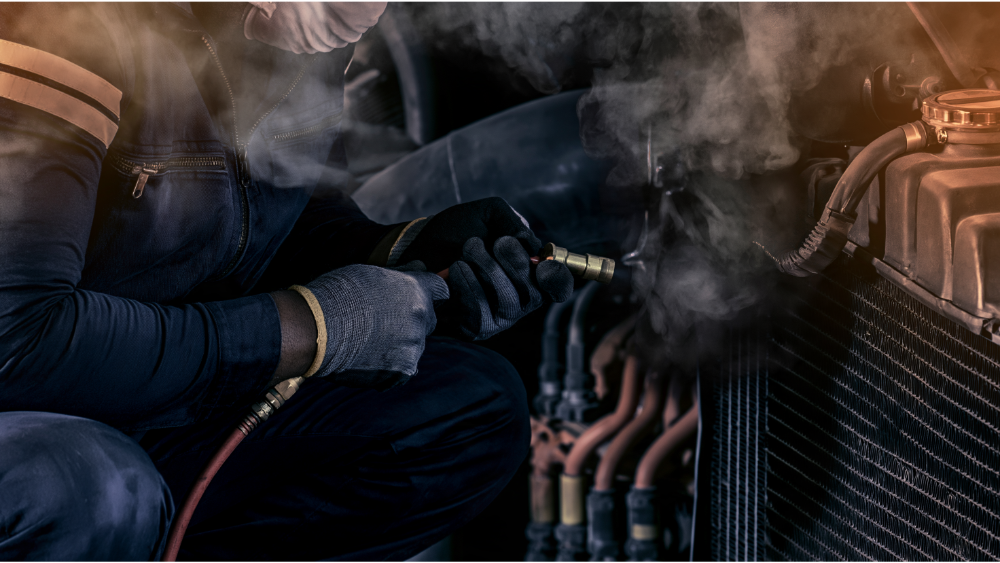
Nobody should replace a turbo, clean an EGR valve, or order fuel injectors because a diesel engine made smoke. Parts swapping is how one repair becomes three, and how a two-day job becomes two weeks of downtime spread across three visits. Here is the sequence that finds the actual cause of black smoke:
- Document operating conditions, load, duty cycle, and exactly when the smoke appears
- Pull fault codes and freeze-frame data with OEM diagnostic software
- Inspect the air filter, intake tract, charge-air system, and exhaust path
- Run a boost leak test by pressurizing or smoke-testing the charge-air system
- Compare commanded versus actual boost, airflow, EGR position, and sensor values
- Run OEM injector and fuel system tests, including cylinder contribution
- Check compression, valve operation, or mechanical timing when the evidence points there
- Review DPF soot load, differential pressure, regen history, temperatures, and outlet soot
- Verify factory emissions hardware and calibration are intact
- Present findings and an itemized estimate before any work starts
That last step is the one that protects your wallet. You get a full itemized estimate before a single bolt is turned. No surprises, no upsell, and a same-day service focus when the parts and the fault allow it. Our certified technicians run OEM diagnostic software across Class 6 through Class 8 platforms: Freightliner Cascadia, Kenworth T680, Peterbilt 579, Volvo D13, Mack MP8, International A26, and Western Star.
What Ignoring Black Smoke Actually Costs You
Start with fuel economy. Soot is fuel you paid for and did not convert to torque, on every mile, which means visible smoke reduces fuel economy load after load. Add reduced engine performance, because whatever is choking combustion is also costing you power output on grades.
Then the aftertreatment bill. Excess engine-out soot loads the DPF faster, which means more frequent regens, more diesel fuel burned in regen, and eventually a derate on the shoulder instead of a scheduled bay. Soot in the oil accelerates component wear. Carbon buildup in the intake manifold compounds the original airflow problem, so the truck gets worse the longer you run it that way. A cheap airflow fix ignored long enough turns into costly repairs.
There is a compliance angle too. Washington’s vehicle emissions inspection program ended January 1, 2020, so there is no testing requirement at registration renewal. But the Washington Department of Ecology is clear that driving a smoking vehicle or one with modified emissions equipment is still illegal. Under RCW 46.37.390, a vehicle first sold and registered new on or after January 1, 1971 may not emit smoke as dark as or darker than Ringelmann No. 1 for more than 10 seconds at elevations below 3,000 feet. A visibly smoking diesel truck on the Seattle-Tacoma corridor is an invitation for attention you do not need.
How Fleets Prevent Repeat Black Smoke Problems

One smoking unit is a repair. Three smoking units is a process problem. What actually prevents repeats:
- Air filter and charge-air inspections on a real interval tied to duty cycle, not a guess, since a clogged air filter is the most preventable item on the list
- Regen frequency and soot-load trending tracked unit by unit, so a rising trend gets caught before a derate
- Fuel and oil consumption tracking, which flags combustion problems before they are visible
- Driver reporting standards, so the black smoke pattern gets recorded the first time it appears instead of the third
- Documentation of recent repairs and any calibration change, since post-service smoke has a short and specific suspect list
- A consistent diagnostic process across every unit, so what you learn on one truck means something for the next one
Torpedo builds custom PM schedules around your routes and duty cycles, with priority fleet scheduling, DOT compliance documentation, fleet account billing, and the same diagnostic standard applied to every unit. Request a service quote and we will build the schedule around how your trucks actually run.
Black Smoke From a Diesel Engine: FAQ
How do you stop black smoke from a diesel engine?
Find the cause instead of masking it. Test in order: airflow and air filter, charge air and boost leaks, fuel delivery and fuel injectors, controls and sensors, then aftertreatment. Additives and injector cleaners will not fix a split charge-air boot or a failed injector, and they will not repair a cracked DPF.
Is it good for a diesel engine to blow black smoke?
No. It is wasted diesel fuel, lost power, and soot loading both the DPF and the engine oil. Heavy black smoke is a fuel economy failure, not a sign of a strong engine.
What are 5 causes of black smoke in diesel engines?
A clogged air filter or intake restriction, boost leaks or a turbocharger fault, faulty fuel injectors or incorrect injection timing, an EGR system or dirty MAF sensor and calibration fault, and a damaged or bypassed DPF. Each of these causes of black smoke gets confirmed by testing, not by symptom alone.
Is it normal for a 7.3L to emit black smoke under hard acceleration?
Older mechanically injected and pre-DPF platforms can show a brief puff when fuel delivery leads turbo airflow. A persistent or heavy plume still points to air, fuel, or turbo problems. On any DPF-equipped truck, it is not normal at all.
Get a Verified Diagnosis Before Anyone Sells You Parts
Torpedo Truck Repair runs heavy-duty diesel engine diagnostics for Class 6 through Class 8 trucks and trailers out of our shop at 7495 26th St E Ste B, Fife, WA 98424, near I-5 and Hwy 167. We serve the Seattle-Tacoma freight corridor: Fife, Tacoma, Auburn, Puyallup, Sumner, Milton, Pacific, and Algona. Mobile dispatch covers 50 miles from the shop along I-5, Hwy 167, and SR-512.
OEM diagnostic software. Certified technicians. An itemized estimate before work begins, and a same-day service focus when possible. Licensed and insured, DOT certified, est. 2017, 4.9 stars across 146 Google Reviews.
Call now: (253) 449-0100 for 24/7 emergency roadside dispatch. Shop hours are Mon through Fri, 8:00 AM to 5:30 PM.