Key Takeaway
Diesel turbo failure symptoms include loss of power under load, slow or unstable boost pressure, black or blue-gray exhaust smoke, excessive oil consumption, new grinding or whining noises, and check engine lights with underboost faults. These symptoms prove a boost-system problem exists but do not confirm the turbocharger itself has failed. BorgWarner reports 90% of turbo failures trace to four causes: foreign-object entry, oil contamination, inadequate oil supply, or excessive heat. Testing the full system before replacing the turbo is the only way to avoid paying twice.
The most common diesel turbo failure symptoms are loss of power under load, slow or unstable boost pressure, black or blue-gray exhaust smoke, rising oil consumption, a new whining or grinding noise, a boost-related check engine light or derate, and oil showing up in the charge-air piping. Those are the signs. They tell you the boost system is not performing.
They do not tell you the turbocharger is the failed part. If you are running a loaded Class 6 through 8 truck and trying to decide whether to keep rolling, that distinction is the whole game. Symptoms prove there is a boost-system problem. Testing proves the turbo is bad.
What Are the Most Common Diesel Engine Turbo Failure Symptoms?
- Loss of engine power under load, especially on grades
- Slow, low, or unstable boost pressure
- Black exhaust smoke
- Blue or gray exhaust smoke
- Excessive oil consumption between services
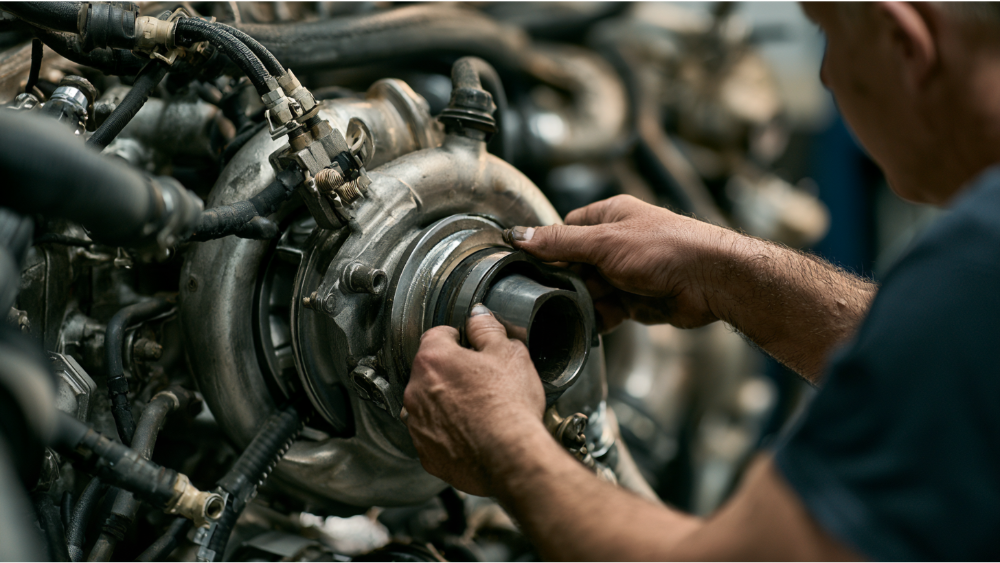
- A new siren, scraping, or grinding noise from the turbo
- Check engine light, underboost or overboost fault, or engine derate
- Oil film in the charge-air piping or intercooler
- Poor fuel economy for the same load and route
Every one of these can appear while the turbocharger is mechanically intact. A boost leak, a restricted DPF, a stuck VGT actuator, an exhaust leak, a fuel fault, or excessive crankcase pressure can produce nearly identical behavior.
Turbo System Symptom vs. Confirmed Diesel Turbo Failure
A turbo-system symptom means the air and boost path is not doing its job. The fault can sit in the intake or exhaust system, the charge-air piping, the DPF, the fuel system, crankcase ventilation, or the VGT control circuit. Modern diesel engine control units monitor boost with sensors, so the ECU flags the shortfall without knowing what caused it.
A confirmed turbo failure means verified mechanical damage: bearing, shaft, compressor wheel, turbine wheel, or seal. Cummins warns directly that defects in other engine components are frequently blamed on the turbocharger. BorgWarner notes turbo wheels can spin up to 300,000 rpm, which is why damage escalates toward complete turbo failure quickly once contact starts.
Can You Keep Driving With a Failing Turbo, or Should You Shut It Down?

| Decision | What you are seeing |
|---|---|
| Schedule diagnosis promptly | Gradual loss of power, mild boost inconsistency, check engine light with no severe smoke or noise |
| Do not load it again | Significant underboost, repeated derate, excessive exhaust smoke, oil consumption climbing fast |
| Shut down now | Grinding or metal-contact noise, severe vibration, rapid oil loss, heavy blue smoke, engine revving without throttle input |
Cummins and MAHLE both direct operators to stop the engine when a turbo is noisy, starts to leak oil, or vibrates. Continued operation can take the engine with it. There is also an overspeed risk worth understanding: MAHLE’s 2024 damage guide notes that oil pooling in the charge-air cooler or intake can be drawn in and burned as fuel, which is why an engine that starts revving on its own is a park-it-immediately condition.
The Seven Warning Signs of Diesel Turbo Failure, Explained
The signs of turbo trouble a driver notices, what they may mean, what else causes them, and how fast you need to act.
Loss of Power Under Load
Weak pull on grades. Slow recovery after a shift. Higher fuel consumption for the same run. Airflow loss through a failing turbocharger will do this, but so will a restricted air filter, a split charge-air boot, a loose clamp, a charge-air cooler leak, a pre-turbine exhaust leak, a DPF restriction, or a fuel-injection fault. Urgency depends on how far below normal you are running.
Slow, Low, or Unstable Boost Pressure
Lag when the load changes. Boost that builds, then falls off. That pattern can point to worn bearings, wheel damage, or a vane pack that is sticking. It can just as easily be a leak in the charge-air system, a failed boost pressure sensor, or a VGT actuator out of calibration. Unstable boost paired with repeated derates means stop hauling loaded.
Black Smoke and Other Excessive Exhaust Smoke
Black smoke means too much fuel for the air available. A turbo that is not moving enough air causes it. So does an intake restriction, a boost leak upstream of the intake, a restricted exhaust or DPF, or an injection fault dumping fuel. Smoke color narrows the search. It is not a diagnosis, and no shop should quote a turbo off it.
Blue or Gray Exhaust Smoke
Blue or gray smoke means oil burning inside the engine after reaching the intake, combustion chamber, or exhaust gas path. Turbo seal failure is one possibility. Excessive blow-by, a restricted oil return, blocked crankcase ventilation, overfilled engine oil, and general engine wear all produce the same color. Heavy blue smoke combined with rapid oil loss is a shutdown condition, not something to run out to the next terminal.
Increased Oil Consumption and Engine Oil Leaks Around the Turbo
You are topping off between PM services. There is oil residue in the charge piping or sitting in the intercooler. Before anyone condemns the cartridge, understand what the manufacturers see: BorgWarner reports that more than 95% of the turbo oil leakage cases it addresses trace back to oil-drain sizing or restriction and excessive blow-by. That is manufacturer-reported data in a specific context, and it makes the point. Oil around the turbo usually reflects oil flow or crankcase pressure, not a failed seal.
Whining, Siren, Scraping, or Grinding Noise
A new hiss or whistle from the engine bay most often traces to a charge-air leak or an exhaust leak. Not all turbo noise means the cartridge is finished, and a healthy turbo produces a consistent, even whine that rises and falls with load. A siren-like cycling sound, scraping, or grinding is different. Those noises mean the compressor wheel or the turbine wheel on the exhaust side may be contacting its housing. That is a stop-driving sound. Do not finish the run to see if it gets worse.
Check Engine Light, Underboost Codes, or Engine Derate
For 2010-and-later heavy-duty highway engines in vehicles over 14,000 pounds, EPA OBD requirements cover turbo-related monitoring: underboost, overboost, VGT slow response, and electronic boost-control components. A noticeable drop in boost pressure will set a light and can trigger a derate. Here is the position that matters: a fault code is a lead, not authorization to replace a turbocharger. Code interpretation, enabling conditions, and commanded boost are engine- and calibration-specific.
Bad Turbo, Boost Leak, or DPF Restriction?

| Symptom | Possible turbo failure | Common alternative causes |
|---|---|---|
| Low or unstable boost | Bearing or wheel damage, stuck VGT vanes | Split boot, CAC leak, boost sensor, exhaust leak, actuator calibration |
| Black smoke | Insufficient air supply from the turbo | Air intake restriction, fuel fault, DPF or exhaust restriction |
| Blue smoke | Worn seals allowing oil past the shaft | Blow-by, breather restriction, engine wear, overfilled oil |
| Whistle or hiss | Compressor or bearing problem | Charge-air leak, pre-turbine exhaust leak |
| Derate | VGT or boost-control fault | DPF, EGR, sensor, wiring, fuel system |
| High oil consumption | Turbo seal or bearing damage | Restricted oil drain, crankcase pressure, engine wear |
The DPF deserves its own place in this list. A restricted filter raises exhaust backpressure, cuts engine performance, disrupts expected turbocharger performance, and can contribute to premature turbocharger failure. Testing exhaust restriction before ordering a turbo is not optional. One more note on that whistle: 49 CFR 393.83 prohibits an exhaust system leak or discharge forward of or directly below the driver or sleeper compartment, so an exhaust leak is a compliance problem as well as a diagnostic one.
How Technicians Confirm Diesel Turbocharger Failure
- Pull fault codes and freeze-frame operating data.
- Compare commanded boost pressure against actual boost with the engine warm and under controlled conditions.
- Inspect the air filter and the full intake tract.
- Pressure-test or smoke-test the charge-air cooler, boots, clamps, and piping with compressed air to find boost leaks.
- Check for pre-turbine exhaust leaks.
- Test exhaust and DPF restriction.
- Command the VGT actuator and verify actual movement.
- Inspect oil feed, oil drain, crankcase ventilation, and crankcase pressure.
- Inspect turbo components including compressor and turbine wheels and shaft movement against the OEM clearance specifications for that engine.
- Identify the initiating failure before quoting a turbocharger.
Garrett’s published diagnostic sequence follows the same logic: intake, fuel, exhaust, DPF, intercooler, crankcase ventilation, and lubrication all get checked before the turbo is condemned. Most turbo problems start somewhere else. Replacing a turbo based on smoke, a whistle, and one underboost code is guesswork, and the customer pays for it twice. We run diagnostics with OEM software and give you a full itemized estimate before a bolt is turned.
What Causes Diesel Turbo Failure?

BorgWarner’s technical guidance reports that 90% of turbocharger failures fall into four categories: foreign-object entry into the compressor or turbine, oil contamination, inadequate oil supply, and excessive exhaust gas temperatures. Treat that as manufacturer guidance rather than an independent fleet study, but it lines up with what comes through the bay.
Air Filter Condition and Intake Contamination
A plugged element chokes off fresh air and leaves the engine short on charge. A damaged element or duct does worse: it lets grit reach the compressor wheel at full speed. Filter condition is the cheapest turbo protection on the truck.
Carbon Buildup, Oil Starvation, and Heat
Carbon deposits lock up the vane pack and choke the drain passage. Oil starvation from a blocked oil feed or a sludged return line kills bearings fast. The rest of the list:
- Restricted or sludged oil return line
- Excessive crankcase pressure from blow-by
- Turbo overspeed
- DPF or exhaust restriction driving backpressure up
- Hot shutdown after a hard pull
- VGT actuator faults, vane position sensor failures, and calibration drift
What Must Be Corrected Before a Replacement Turbo Goes In
- Oil feed and return lines cleaned or replaced
- Air filter and full intake tract inspected for debris
- Charge-air cooler and piping cleaned of oil and metal
- Exhaust and DPF restriction verified within spec
- Crankcase ventilation and blow-by tested
- VGT actuator calibrated where applicable
- Root cause documented on the invoice
A new turbo does not fix what killed the old one. Install one without correcting the cause and you have bought a repeat failure with a second invoice attached.
How Owner-Operators and Fleets Reduce Turbo-Related Downtime
- Regular oil changes using the high quality oil grade the engine manufacturer specifies
- Engine-specific air and oil filter intervals, not generic ones
- Cool-down before shutdown after a hard pull
- No full throttle on a cold start
- Inspect charge-air boots, clamps, and piping at every PM
- Track oil consumption and fuel efficiency between services
- Address boost, DPF, and exhaust faults before the derates start repeating
- Document recurring faults across fleet units so patterns surface early
None of this is optional housekeeping. It is what keeps turbo life and fuel economy where the spec sheet says they should be, it is what keeps small leaks from turning into higher fuel costs on every run, and it is why our Preventive Maintenance PM Service tracks oil use and charge-air condition unit by unit.
Frequently Asked Questions
Can you drive a diesel with a bad turbo?
Sometimes, briefly, at reduced load. Not when there is grinding, vibration, rapid oil loss, heavy blue smoke, or an engine revving without throttle input. Manufacturers direct operators to shut the engine down in those conditions because engine damage or overspeed can follow.
Can turbo failure be fixed?
Yes, by repair or replacement depending on the verified damage and the OEM procedure for that engine and turbo configuration. The fix only holds if the initiating cause (oil supply, contamination, restriction, foreign object, or heat) is corrected at the same time.
What is the average lifespan of a diesel turbocharger?
There is no universal number, and any shop quoting one is guessing. Turbo life depends on engine platform, duty cycle, oil quality and change intervals, air filtration, exhaust gas temperatures, and aftertreatment condition. A mileage figure would tell you nothing useful about your unit.
Will a bad turbo throw a code?
Usually. On 2010-and-later heavy-duty highway engines over 14,000 pounds, the ECU monitors boost pressure and will set underboost, overboost, or VGT response faults, often with a derate. But codes point to the boost system, not to a specific part, and mechanical damage can exist with no stored code.
Get a Verified Diagnosis Before You Buy a Turbo
Before you authorize turbo service, get the actual cause in writing. Our Diesel Engine Repair And Maintenance and Electrical Diagnostics And Repair work runs on OEM diagnostic software with certified technicians, and you see a full itemized estimate before a bolt is turned. No upsell. No surprises.
Call (253) 449-0100 or Request Service Quote. Takes under 60 seconds, no obligation.