Key Takeaway
A transmission shifting hard on a Class 6-8 truck is a symptom caused by factors including clutch drag, binding linkage, low or wrong fluid, low air pressure in shift circuits, sensor or solenoid faults, or worn internal components. The correct diagnosis depends on whether the truck runs a manual, automated manual, or fully automatic transmission. Stop driving immediately if you cannot hold a gear, experience slipping, or notice burning smell or fluid loss. Schedule diagnosis soon if shift quality has changed but the truck remains controllable.
A hard shift is a symptom, not a diagnosis. On a heavy-duty truck it can come from a clutch that isn’t releasing, a binding shift linkage, low or wrong lubricant, low air pressure in the range or shift circuits, an electronic or calibration fault, or wear on internal components. The correct first check depends on whether you’re running a manual, an automated manual, or a fully automatic transmission. This article is for the driver deciding whether to roll or shut down, and for the fleet manager who needs a repeatable process behind that call. You’ll get a stop-or-schedule decision, causes broken out by transmission type, and what a real diagnosis looks like.
If the truck is already down, call (253) 449-0100. 24/7 emergency road service dispatch.
What Does “Shifting Hard” Actually Feel Like?
Two completely different complaints share the same words. One is a gear lever that takes excessive force, hangs up, or grinds. The other is a transmission that bangs, jerks, or slams itself into gear with no input from you. Those are not the same problem and they do not follow the same diagnostic path.
- Lever requires excessive effort in one gear or in every gear
- Gear clash or grinding during the shift
- Range or splitter engagement that is slow or never completes
- A jolt or bang on upshift
- Harsh downshift, especially under load
- Delayed engagement into Drive or Reverse followed by a slam
- Slipping gears or engine-speed flare before the gear catches
Which one you have narrows the list before a technician touches the truck. Be specific about how the unit shifts gears when it acts up: the timing, the load, and any noise that comes with it.
Can You Continue Driving, or Should You Stop Now?
Hard shifting that gets ignored does not stay a shift-quality complaint. It escalates toward lost gears and complete transmission failure. Driving on it invites further damage and turns a contained repair into expensive repairs. Use this to make the call.
| Stop and call for roadside help | Keep moving, but schedule diagnosis now |
|---|---|
| Can’t engage or hold a gear | Shift is consistently harder than it used to be |
| Unexpected neutral or loss of drive | The symptom is getting more frequent |
| Grinding or repeated gear clash | It repeats in the same gear or range |
| Slipping or engine-speed flare | It started right after recent service |
| Delayed engagement followed by a violent application | No warning light, but shift quality clearly changed |
| Transmission overheat or low transmission-air warning | |
| Burning smell, smoke, or a major fluid leak | |
| Restricted or limp operation | |
| Any shift severe enough to affect vehicle control |
Hard shifting is not automatically an out-of-service condition. But under 49 CFR §396.13 the driver has to be satisfied the vehicle is in safe operating condition before driving it, and under §396.11 a defect likely to affect safe operation has to be reported and corrected before the unit runs again. If the shift quality is bad enough that you’re questioning control of the truck, you already have your answer.
Down on the shoulder right now? Call (253) 449-0100.
Identify the Transmission Before You Diagnose It

Three architectures, three failure paths. Most generic hard-shift articles publish one undifferentiated causes list, and that is exactly how trucks get misdiagnosed and owners get quoted a rebuild they don’t need.
Manual Transmissions
Driver-operated clutch and lever, with air-assisted range and splitter circuits on most heavy-duty units. Important distinction: many heavy-duty manuals are non-synchronized in the main box. Advice written for a car, where worn synchronizers get blamed for every gear, does not transfer to these transmissions.
Automated Manual Transmissions (AMT)
No clutch pedal, but there’s still a real clutch in there doing the work of changing gears automatically, plus pneumatic shift controls and learned calibration values. Detroit DT12 in the Freightliner Cascadia, Volvo I-Shift behind the D11 and D13, Mack mDRIVE on MP7 and MP8, Eaton-equipped Kenworth T680 and Peterbilt 579. An AMT that shifts hard is not automatically “a bad automatic transmission.”
Fully Automatic Transmissions
Torque converter, hydraulic control, a solenoid-controlled valve body, and adaptive shift values that learn over time. Common on medium-duty box trucks, vocational rigs, and heavier diesel pickups (F-450, Ram 3500 and up). Approved fluid specification directly affects shift consistency and clutch application here.
Why a Manual Heavy-Duty Transmission Shifts Hard
Work external to internal. That order matters.
- Clutch not releasing fully. Clutch drag keeps engine power flowing into the box when it should be disengaged. The result is poor shifting and extra stress on parts that were fine yesterday.
- Clutch brake fault showing up when you try to get into gear from a stop.
- Improper clutch installation or components that prevent clean release, often after recent clutch work.
- Binding, worn, or misadjusted shift linkage. Worn bushings, dry joints, an obstruction in the travel. Eaton’s guidance is to inspect the linkage before concluding the transmission itself is causing excessive shift effort.
- Low lubricant level or the wrong grade. Being able to touch oil through the fill opening does not prove the level is correct.
- Air leak or low regulated pressure in the range or splitter circuit. Eaton Fuller Advantage range-system troubleshooting specifies 57 to 63 psi regulated pressure. That figure applies to that system, not to every heavy-duty transmission on the road.
- Internal causes: binding sliding-clutch splines, bent shift components, shift rails binding in the housing.
Linkage and clutch release get verified first. Always.
Why an Automated Manual Shifts Hard
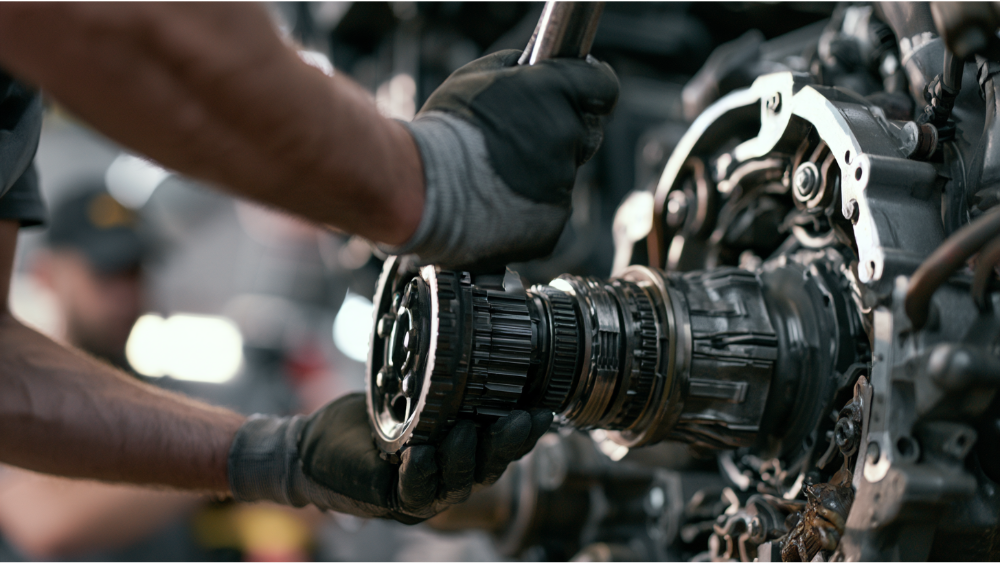
Pneumatic controls shift these units. Lose air, lose shift quality. Most AMT shifting problems start in the air system or in learned values, not inside the gearbox.
- Low transmission air pressure or a leak in the shift air circuit
- Clutch wear or a clutch actuator fault
- Clutch calibration out of range, or never performed after service
- Active or stored fault codes with occurrence counts worth reading
- Sensor, connector, or wiring faults
- Datalink problems between engine and transmission
- Control software or calibration level
- Elevated clutch temperature from extended creep in stop and go traffic, slipping the clutch, or holding the truck on a grade with throttle, which can trigger protective restrictions
Eaton ServiceRanger supports fault retrieval, data monitoring, software and calibration updates, and clutch-calibration routines, with limited clutch-calibration and fault-code coverage on DT12, I-Shift, and mDRIVE applications. Air supply, clutch actuation, learned values, and engine-transmission communication all get checked before internal repair enters the conversation.
Hard Shifting in Automatic Transmissions: Fluid, Faulty Sensors, Solenoids, and the Control Module
Automatic transmissions depend on hydraulic pressure for every gear change. Walk the system in order.
Fluid level and specification. Low transmission fluid drops hydraulic pressure, and the valves can’t operate smoothly during shifts without it. Low fluid levels are the most common problem behind a hard shift on an automatic, and the condition usually produces hard shifting and slipping together. Allison specifies TES 668 for its 1000, 2000, 3000 and 4000 Series, and warns that unapproved fluids create seal and friction problems. Check for leaks at the pan, cooler lines, and seals while you’re under there.
Fluid condition and contamination. Degraded fluid loses the ability to carry pressure and lubricate, and a clean shift depends on both.
Filter restriction. A clogged filter chokes fluid flow and makes transitions harsh.
Solenoids and valve body. Electronic solenoids control fluid flow and pressure through the valve body. A failed shift solenoid produces harsh or delayed engagement, and a valve-body fault does the same thing from a different direction.
Faulty sensors and control module. Vehicle speed sensors and the throttle position sensor feed the ECM and TCM. Bad input produces bad shift timing even when everything inside the transmission is working correctly. A failing control module or a software issue can mismanage shift commands outright.
Internal wear. Worn clutches or bands show up as lag followed by a heavy thunk, and that slipping feels different from a flat hard shift. Torque converter issues read differently again: shudder under light acceleration or a soft slip at highway speed.
Check the mounts too. Degraded engine or transmission mounts let the driveline move more than it should, a normal shift starts feeling like a hard one, and you often get added vibrations with it. On older medium-duty automatics and pickups with a vacuum-operated modulator, a leaking vacuum line will also change shift feel. That does not apply to modern electronically controlled units.
Cold Weather, Dark Fluid, and Low Fluid Levels
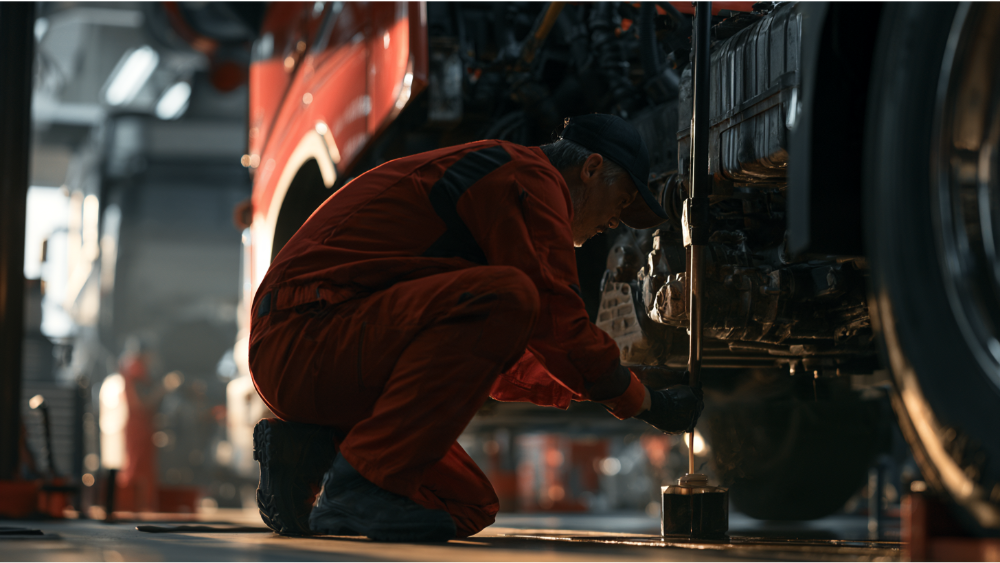
Cold-only hard shifting usually points at viscosity. Cold temperatures thicken the fluid, it moves slowly through the valve body, and shift feel sharpens until the transmission comes up to temperature. Trucks that only drive short distances never get the fluid fully up to temperature, so hard shifting issues show up more often in cold weather on local routes. Most automatic fluid works best in roughly the 175 to 225°F range, and synthetic holds viscosity better across temperature swings. If it’s still shifting hard after warm-up, stop blaming the weather.
Dark or burnt-smelling fluid means heat and wear, not just mileage. A fluid service puts fresh fluid in, but it does not remove the heat source that cooked the old charge. For the families covered in Eaton’s heavy-duty troubleshooting guide, the guidance is not to run consistently above 250°F/120°C, with intermittent operation to 300°F/149°C not harming those transmissions. That scope is specific to those families.
As previously mentioned, specification is model specific. There is no single correct fluid, change interval, or “normal” operating temperature across every truck. It’s duty-cycle specific, and anyone telling you otherwise is guessing.
What the Shift Pattern Tells the Technician
When the symptom happens is evidence. Note exactly when the transmission shifts hard. A driver who can describe the pattern precisely has already eliminated half the list.
| Symptom pattern | First systems to verify |
|---|---|
| Lever hard to move in every gear | Linkage, clutch release, lubricant level and grade |
| Only the range or split shift is slow or incomplete | Air supply, regulator, valves, range cylinder, O-rings |
| AMT shifts hard with a low-air warning | Transmission air system |
| Hard only when cold | Fluid viscosity, specification, level |
| Hard only when hot or loaded | Fluid condition, pressure control, clutch temperature |
| Hard right after clutch work | Clutch setup, actuator calibration, installation |
| Hard after battery disconnect or software work | Codes, calibration, learned values |
| Bang into Drive or Reverse | Fluid level and spec, control pressure, mounts, clutch application |
| One specific gear only | Gear-specific controls, range components, internal wear |
| Hard shift plus slipping or flare | Hydraulic pressure control, internal clutch integrity |
What to Record Before You Call a Shop

The driver’s complaint is one of the most important diagnostic inputs there is. Symptoms you can reproduce for the technician save shop hours and cut your downtime.
- Year, make, model
- Transmission make, model, and serial number if you have it
- Mileage and engine hours
- Exact gear or range where it happens
- Upshift or downshift
- Cold or hot
- Empty or loaded
- Road grade and throttle position
- Dash warnings, gear-display messages, fault codes
- Current air pressure reading
- Recent repairs, battery disconnects, or software updates
- Any leak, burning smell, grinding, or slipping
Fleet maintenance files want the same information. Record it once, use it twice.
How Professional Diagnosis of a Hard Shifting Transmission Works
This is the structured workflow. Skipped steps are the root cause of most shop failures.
- Verify the complaint and reproduce it.
- Identify transmission model and configuration.
- Scan with OEM diagnostic software. Read active and inactive codes, occurrence counts, and timestamps before clearing anything.
- Verify fluid level using the correct procedure and confirm the exact approved specification.
- Test air supply and pneumatic actuation where the transmission uses them.
- Check clutch release, actuation, and calibration.
- Inspect linkage, wiring, connectors, and mounts.
- Road test with live data under the conditions the driver reported.
- Confirm root cause and explain it to you in plain terms.
- Itemized estimate before a single bolt is turned.
A generic code reader does not rule a transmission in or out. And a complaint can be reproduced with no active code present, which is why inactive history and timestamps still carry weight. Certified technicians, OEM diagnostic software, and a same-day service focus when possible.
Why Throwing Parts at a Hard Shifting Problem Creates More Downtime

What not to do, in order of how much it costs you:
- Assume it needs a rebuild
- Change the fluid without verifying level and specification
- Clear codes before recording them
- Repeatedly reset adaptive values to mask a fault
- Pour in additives
- Keep forcing a manual shifter that’s fighting back
- Authorize internal repair before the external, pneumatic, and control checks are finished
A hard shift alone does not prove the truck needs a transmission. A fluid change alone is not a diagnosis. No active code does not prove there’s no fault. Every one of those shortcuts buys a second repair visit and sometimes additional damage, and the second visit is the one that really hurts.
Fleet Prevention and Documentation
Shift-quality complaints are a pattern problem. Log intermittent driver reports by unit, capture codes before clearing them, and track repeat complaints so a developing fault shows up in the file before it shows up on the shoulder. Regular maintenance catches shift-quality drift early. Build PM schedules around the specific transmission model, document every transmission service with the approved fluid, and keep repair and calibration records with the unit. Add a shift-quality check to road tests.
On the compliance side: §396.3 maintenance records are retained where the vehicle is housed or maintained for one year, and for six months after the vehicle leaves the carrier’s control. Applicable DVIRs, repair certifications, and driver-review certifications are retained three months. §396.3 prescribes no single maintenance interval, because it’s fleet and vehicle specific.
For automatics in lighter and medium-duty service, fluid changes in the 30,000 to 60,000 mile range are a common general guideline. Heavy-duty intervals follow the OEM schedule for that transmission and duty cycle, not a rule of thumb.
Transmission And Clutch Repair Without Guesswork
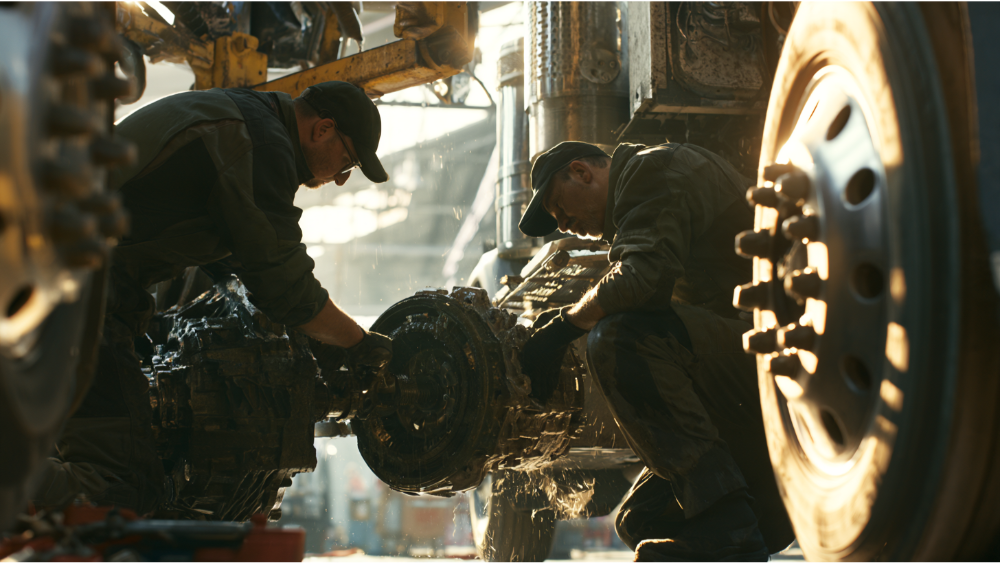
Torpedo Truck Repair did not begin as a traditional repair shop. It was built inside real trucking operations, which is why downtime drives every repair decision we make. We diagnose manual, automated manual, and fully automatic transmissions on Class 6 through 8 platforms and trailers: Freightliner, Kenworth, Peterbilt, Volvo, Mack, International, Western Star. OEM diagnostic software. Certified technicians. A full itemized estimate before work starts, no upsell, and a same-day service focus when possible. Licensed and insured, DOT certified, 4.9 stars across 146 Google Reviews.
Call (253) 449-0100 for 24/7 emergency road service dispatch. Shop hours are Mon–Fri, 8:00 AM to 5:30 PM. Not an emergency? Request a Service Quote. Takes under 60 seconds, no obligation.
Frequently Asked Questions
Can you fix a hard shifting transmission?
Usually, and often without opening the transmission. The fix depends entirely on root cause: linkage adjustment, clutch release, an air leak, fluid level or specification, a sensor, a solenoid, or a calibration. Diagnosis determines the repair. Never the other way around.
What are the common causes of hard shifting in a transmission?
Low or contaminated fluid, wrong fluid specification, clutch drag or a release fault, binding shift linkage, low air pressure in range or AMT circuits, failed speed or throttle position sensors, shift solenoid and valve-body faults, control module or calibration issues, worn mounts, and internal clutch or band wear.
How much does it cost to fix a hard-shifting transmission?
Cost tracks the root cause, and the spread between a linkage adjustment, an air leak, a clutch calibration, and internal repair is wide. We don’t quote blind. You get a full itemized estimate before a single bolt is turned. No surprises. Call (253) 449-0100.
What are the first signs of a transmission going out?
Most transmission problems announce themselves in shift quality first. Harder or slower engagement, slipping or engine-speed flare, delayed engagement into gear, gear clash, repeat faults in one gear or range, dark or burnt-smelling fluid, and overheat or low-air warnings. Ignoring these escalates toward complete transmission failure.