Key Takeaway
Diesel engines sound different than gasoline engines because compression ignition causes a steep, abrupt cylinder pressure rise that vibrates the entire engine block, producing a characteristic clatter. Diesel engines compress air at ratios above 20:1, nearly double the 8:1 to 12:1 range of gasoline engines, forcing all prepared fuel to ignite at once. Modern common-rail systems with multiple injection pulses have made this sound noticeably quieter, but the core physics has not changed.
Diesel engines sound different because they ignite fuel with the heat of highly compressed air instead of a spark. Diesel fuel is injected near the top of the compression stroke, there is a brief pause while it atomizes and mixes, and then the prepared fuel lights off at once. That sudden, steep rise in cylinder pressure shakes the block and everything bolted to it. What you hear is clatter.
Most drivers asking this question want to know one more thing: is that characteristic diesel sound normal, or is the engine telling me something? Both answers are here. First the physics of combustion, then the practical part most explainers skip, which is how to tell a healthy diesel engine from one that needs a scan tool on it.
Compression Ignition vs. Spark Ignition: Why Diesel and Gasoline Engines Sound Different

Two engines, two ways of starting a fire.
A gasoline engine is a spark-ignition engine. Gasoline engines use a spark plug to light an air fuel mixture that was blended before the compression stroke ever started. The spark plug ignites the charge and a flame front spreads out from it. A diesel is a compression-ignition engine. Diesel engines use air alone during compression, and near the end of that stroke, fuel is injected into air already hot enough to ignite it on contact. No spark plug involved. Both run the same four-stroke cycle: intake, compression, combustion/power, and exhaust, as the U.S. Department of Energy lays it out.
To get air hot enough for autoignition, diesel engines squeeze harder. Compression ratios commonly exceed 20:1 on heavy-duty platforms, while most gasoline engines live in the 8:1 to 12:1 range because a higher compression ratio would cause pre-ignition, lighting the fuel air mixture before the spark ever fired. That single constraint shapes the entire engine design. Traditional diesel engines operate without a throttle plate, so they pull a full charge of air on every intake stroke regardless of load.
Here is where most explanations go wrong. They stop at “diesel engines use higher compression ratios, so they’re louder.” Compression is what makes autoignition possible. It is not the whole acoustic story. The distinctive sound comes from what happens in the microseconds after the fuel lights.
Compression Ratios and Fuel Injection: How Combustion Occurs Inside a Diesel Cylinder
Walk through one power stroke:
- The piston compresses air alone, driving temperature and pressure up. Higher compression ratios mean more heat available at top dead center.
- Near the top of the stroke, the fuel injector sprays diesel at extreme pressure. Cummins cites high pressure fuel injection up to 37,000 psi on modern systems. Treat that as an OEM example, not a universal spec.
- Ignition delay follows: the short interval between the start of injection and the start of autoignition. During it, fuel atomizes and vaporizes, and the fuel mixes with air sitting at high temperature.
- All of that prepared fuel begins burning at once to produce power.
- Cylinder pressure climbs fast. Pressure-rise rate is how quickly it climbs, measured per crank degree.
- That pressure input excites the combustion chamber, the block, the head, the mounts, and the covers. The structure rings.
That last step is the one to hold onto. The clatter is not the fuel being loud. It is a steep combustion pressure input hitting a large iron structure and turning into vibration you can hear from the cab. SAE research on ignition delay and on the effects of rapid pressure rise on engine vibration and noise traces the whole chain, from fuel injection timing to what reaches your ear.
A gasoline engine’s flame front spreads out from the spark plug across a premixed air fuel charge. The pressure curve is smoother. Fewer sharp edges, less structural excitement, quieter result.
Diesel vs. Gasoline Engines: Side-by-Side Sound Comparison

Same four strokes, different sound at nearly every step. This table covers what actually differs between a diesel and a gas or petrol engine when you are standing next to one.
| Characteristic | Diesel engine | Gasoline engine |
|---|---|---|
| Ignition source | Heat of compressed air | Spark plug |
| Compression ratios | High, often above 20:1 | Lower, commonly 8:1 to 12:1 |
| Charge preparation | Air compressed alone, fuel injected late | Air and fuel mixed before compression |
| Fuel injection pressure | Very high, tens of thousands of psi | Substantially lower |
| Pressure-rise character | Steep and abrupt after ignition delay | Progressive flame front, smoother curve |
| Primary sound | Low clattering knock | Smoother hum |
| Typical secondary noises | Injector tick, high pressure pump, turbo, cooling fan | Valvetrain, intake, exhaust note |
| Typical operating RPM | Lower, with more torque per revolution | Higher |
The distinct sound of a diesel comes from that whole column stacking up, not one item on it. There is an economic side to the same physics: diesel fuel carries more energy per gallon, and high compression extracts more of it, so diesel engines run on less fuel to produce the same power output. Fuel economy is the payoff. A petrol car engine burning the same amount of fuel makes less usable torque where a working truck lives.
What Creates the Diesel Sound You Actually Hear
Most articles lump every diesel noise into one bucket. They are separate sources, and knowing which is which is what lets you tell normal from developing.
Combustion pressure rise and block vibration
The dominant source. Fuel prepared during ignition delay burns almost simultaneously, cylinder pressure spikes, and the structure responds. Heavy castings ring at lower frequencies than a light aluminum four-cylinder, which is why the diesel engine sound reads as clatter rather than a buzz. Everything else on this list is secondary to combustion.
Injector and high pressure pump tick
Injectors actuate hard and fast. High pressure fuel pumps work against enormous load, building rail pressure that the ECM meters out in fractions of a millisecond. Both produce a rhythmic tick. A manufacturer service bulletin hosted by NHTSA confirms that rhythmic injector ticking is normal operation on some diesel engines. Worth knowing: gasoline direct-injection engines tick too. A fuel injection system is not what makes a diesel a diesel, acoustically.
Heavier engine parts
Diesel combustion pressures demand stronger castings, thicker cylinder walls, heavier connecting rods, and a heavier rotating assembly. Gas engines build lower pressures, so their internals can be lighter. More mass moving at lower speeds produces a lower-pitched, heavier mechanical sound. Diesel fuel burns at a rate suited to lower operating RPM, so the firing rhythm itself is slower and more distinct than a gas engine turning twice the revs.
Turbo, intake, exhaust, and cooling system fan
Turbo whistle and the rush of intake air are separate from combustion clatter entirely. A turbocharger uses exhaust-gas energy to spin a turbine that drives an intake compressor, per Cummins. It does not recycle exhaust gases back into the cylinder. That is EGR, a different system, and the two get confused constantly. The cooling system adds its own layer: when the fan clutch locks up on a hot engine, the roar that follows startles plenty of drivers who assume something in the engine just let go. It is the fan, and it should cycle back off as coolant temperature drops.
A diesel’s sound is a combustion pressure signature with several mechanical sounds layered on top of it.
Is Diesel Knock Normal, or a Sign of Engine Trouble?
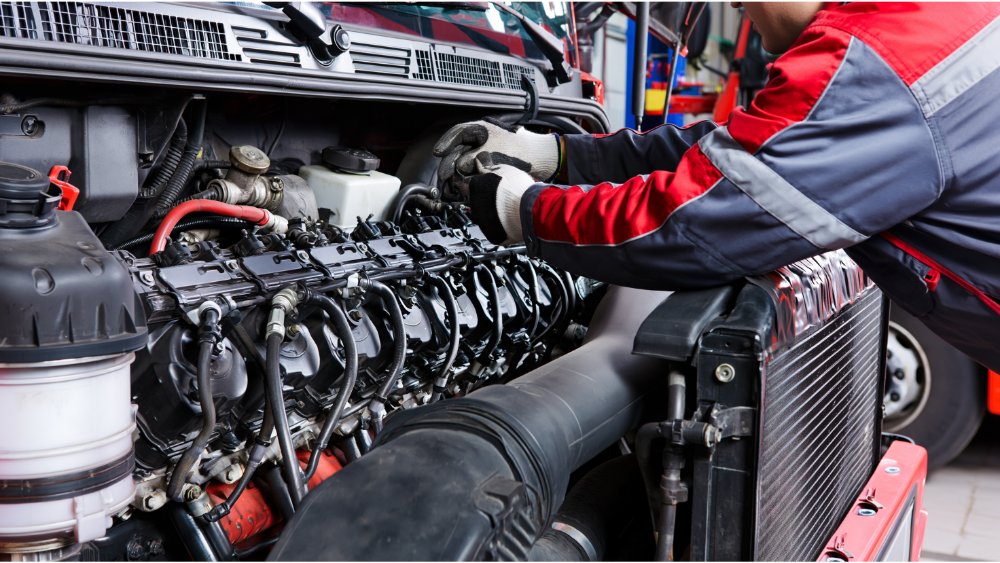
“Diesel knock” is an overloaded term, and that causes real confusion in the bay.
It describes the normal sharp combustion sound every compression-ignition engine makes. It also describes abnormally harsh combustion caused by incorrect injection timing, excessive ignition delay, or a developing fault. Same two words, two very different situations.
It is also not the same thing as destructive detonation in a gasoline engine. A NASA technical review notes that diesel combustion produces faster pressure-rise rates than normal spark ignition combustion, and that this by itself does not mean audible or damaging knock is happening. Your engine is built for those pressures, and combustion at those rates is not engine damage in progress.
Here is our position: sound alone does not establish a cause. Nobody should be quoting a repair off a noise description over the phone, and nobody should be replacing injectors because a truck sounds rough. That guessing is how a one-day job turns into a week of downtime and two invoices.
Why Modern Diesels Sound Quieter Than Older Diesel Engines
Park a current Cascadia, T680, or VNL next to a twenty-year-old truck at idle. The difference is engineering, not fuel. Modern technology did not change the physics. It changed how and when the fuel arrives.
Modern diesel engines run common-rail fuel injection, which decouples fuel pressure from engine speed and lets the ECM split fueling into multiple events per power stroke. A small pilot injection fires first, warming and preparing the chamber so the main charge does not arrive as one abrupt spike. Softer pressure rise, less structural excitement, less diesel noise. Cummins identifies multiple injection pulses as a tool for both noise and emissions control. Bosch lists its CRS3-27 piezo system at up to 2,700 bar with as many as ten injections per cycle. That is one specific system, not every truck on the road.
Better mounts, acoustic covers, and structural damping handle what is left on modern engines after combustion is optimized.
Why the Distinctive Sound Changes With Cold, Idle, and Load

The same engine does not sound the same all day.
Cold starts. A cold combustion chamber slows fuel vaporization and lengthens ignition delay. More fuel is sitting there prepared when ignition finally happens, so more of it burns at once and the pressure rise gets steeper. That is why a diesel is harshest in the first few minutes, and why a cold morning in the yard exaggerates every bit of clatter the engine has. SAE cold-start noise research ties colder starts to longer ignition delay, combustion instability, and more noise.
Idle, acceleration, and load. At idle, diesel clatter dominates because nothing else is masking it. Under acceleration and loaded pulls, turbo and exhaust sound climb and the character shifts.
Diesel fuel ignition quality. Current federal ULSD standards under 40 CFR §1090.305 require 15 ppm maximum sulfur, plus either a minimum cetane index of 40 or maximum 35% aromatic content. Cetane index relates to ignition quality, and lower ignition quality can lengthen ignition delay. That does not mean a loud diesel has bad fuel, and a cetane additive is not a repair.
When a Diesel Engine Noise Needs Real Diagnostics
The rule: judge the sound against your truck’s own baseline, not against diesel engines in general. You know what your unit sounds like at a cold start in the yard and what it sounds like pulling a grade loaded. A change from that is data.
Get it looked at when the noise is:
- New, or clearly louder than the truck’s established baseline
- Uneven, or isolated to one cylinder
- Paired with a fault code or a warning lamp
- Paired with rough running, hard starting, smoke, power loss, cooling system overheating, or abnormal oil pressure
- Noticeably changing with acceleration, deceleration, or load
A correct diagnosis follows a workflow, not a hunch. A Cummins service bulletin for an engine noise complaint directs technicians to verify fault codes, connect electronic service tools, run cylinder cutout and injector performance tests, and work published troubleshooting to a conclusion rather than replacing parts based on sound. That is the same standard we hold: OEM diagnostic software, verified codes, structured testing.
Incomplete diagnosis is the root cause of most shop failures. Depending on what the testing shows, the path runs through Diesel Engine Repair And Maintenance, Fuel System Repair And Diagnostics, or Electrical Diagnostics And Repair. A noise you ignore becomes downtime on someone else’s schedule.
Frequently Asked Questions About Diesel Engine Sound
Why are diesel engines noisier than gas engines?
Compression ignition produces a steeper cylinder pressure rise than a spark-lit flame front, and that pressure input vibrates the block. Add heavier castings, a heavier rotating assembly, and high pressure fuel injection hardware, and you get a louder sound at a lower pitch than any comparable petrol engine makes.
Do diesel engines sound better?
Subjective. What people respond to is the low-pitched rumble, which comes from low operating RPM, long stroke, and heavy rotating mass. Fewer combustion events per second at higher torque produces a slower, deeper rhythm than a high-revving gas engine.
Why are Cummins engines so loud?
Inline-six firing rhythm, direct fuel injection, and heavy-duty construction give them a pronounced signature. Older mechanically injected units are louder than the common-rail engines used in modern diesels, where pilot injection and precise timing soften the pressure rise.
What are the downsides of a diesel engine?
More noise and vibration, heavier and costlier components, and emissions hardware (DPF, DEF, EGR, SCR) that requires real maintenance. Weigh that against the torque, thermal efficiency, and fuel efficiency that higher compression ratios and low-RPM operation deliver.
Hearing Something New? Get It Diagnosed Before It Becomes Downtime
Torpedo Truck Repair runs diesel engine diagnostics with OEM diagnostic software out of our Fife, WA shop for trucks working the Seattle-Tacoma freight corridor. Class 6 through 8. Freightliner, Kenworth, Peterbilt, Volvo, Mack, International, Western Star. You get an itemized estimate before work starts. No surprises, no upsell, same-day service focus when possible.
Call (253) 449-0100. Shop hours are Mon-Fri, 8:00 AM to 5:30 PM. 24/7 emergency dispatch covers a 50-mile radius on I-5, Hwy 167, and SR-512. Or request a service quote: under 60 seconds, no obligation.