Key Takeaway
A diesel truck maintenance checklist runs on three layers: a driver pre-trip inspection before every dispatch, scheduled preventive maintenance by a certified technician on OEM intervals, and a documented annual DOT inspection retained per federal rules. Brake violations account for 39.1% of vehicle out-of-service citations, making daily checks non-negotiable. Skip any layer and you are managing breakdowns instead of preventing them.
A working maintenance checklist for diesel trucks has three layers. The driver runs a daily inspection before dispatch. A certified technician performs scheduled preventive maintenance on intervals set by your OEM and your actual duty cycle. The truck and every trailer behind it pass a documented annual DOT inspection, with records retained the way federal rules require. Skip a layer and you are managing breakdowns instead of preventing them.
Written for owner operators, independent drivers, fleet managers, and safety directors running Class 6 through 8 trucks and trailers. Diesel truck maintenance only prevents unexpected downtime when every item has a responsible person, a pass standard, and a repair that gets closed out and verified.
What Belongs On A Diesel Truck Maintenance Checklist?
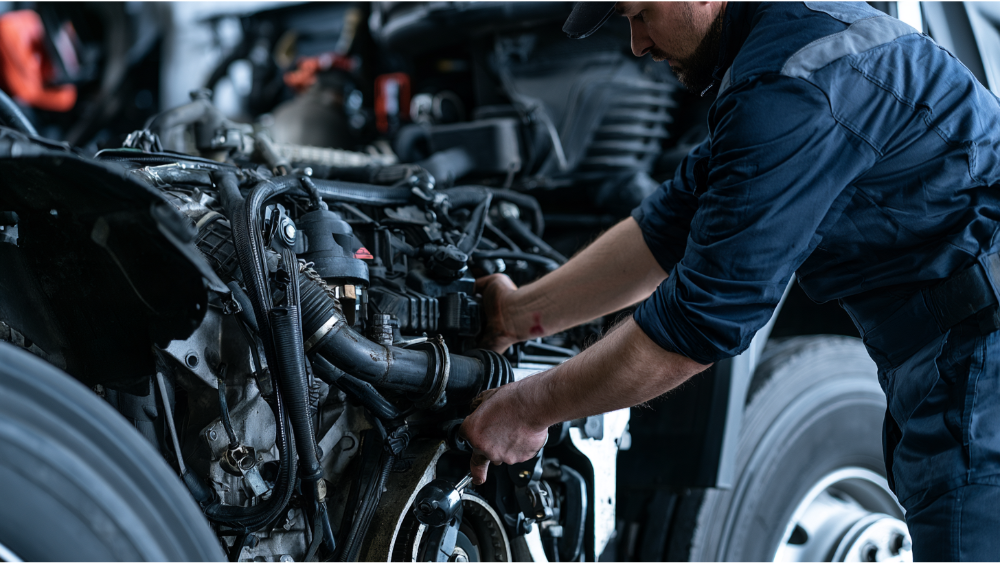
Most published checklists blur three different things into one list. Keep them separate and the program gets easier to run, one truck or forty. Driver eyes catch what changed. Professional service catches what is measurable, and together they prevent unexpected breakdowns.
| Layer | Who performs it | What it covers | How often |
|---|---|---|---|
| Daily inspection | Driver | Tires, brakes, lights, fluid levels, leaks, coupling, warning lights | Before every dispatch |
| Preventive maintenance | Certified technician | Diesel engines, aftertreatment, brakes, steering and suspension, cooling, electrical, driveline | Per OEM and duty cycle |
| Annual compliance | Qualified inspector | Periodic inspection of each vehicle in the combination, plus records | At least every 12 months |
A pre-trip is not PM service. An annual DOT inspection is a compliance floor, not proper maintenance. Treat the “complete system inspection every 30,000 miles” figure quoted across the industry as a generic benchmark, not a rule that applies to your engine.
How To Use This Truck Maintenance Checklist
Your OEM engine, transmission, chassis, and trailer manuals control every interval, including overriding this list. Heavy-duty diesel engines run compression ratios and thermal loads that make engine-specific instructions non-negotiable. Two trucks with identical odometers can need very different service.
Intervals trigger on whichever comes first: mileage, engine hours, calendar time, idle and PTO percentage, or duty classification. Short haul stop-and-go shortens intervals in ways steady long hauls do not, and so do heavy loads, dust, and repeat fault codes. Nothing lengthens an interval except documented OEM permission.
Daily Pre-Trip Checklist For Diesel Trucks

Brakes, tires, and lights lead this list for a reason. In the May 2026 International Roadcheck, CVSA reported 23.5% of vehicles placed out of service, with brake violations at 39.1% of vehicle out-of-service violations, tires 20.9%, lights 11.9%.
Under The Truck And Engine Compartment
- Ground under the truck: fuel, oil, coolant, and air leaks show up here first
- Fluid levels: engine oil, coolant, and power steering
- Belts, hoses, battery hold-downs, terminals, and cable condition
Tires, Wheels, Brakes, And Air System
“Check the tires” is not an instruction. Measure cold pressure against the load you are hauling, not a number you remember. Underinflated tires run hot under heavy workloads and cost fuel every mile. Federal tread minimums are 4/32 inch on steer tires, 2/32 elsewhere. Uneven wear is a signal, not a tire problem, and usually points to alignment, steering components, suspension, or a wheel end.
- Exposed ply or belt material, separation, sidewall damage, cuts, and audible leaks
- Wheels, lugs, indicators, valve stems, and hub seals
- Air buildup, governor cutout, low-air warning, slack adjusters, chambers, and visible lining
Cab, Lights, Coupling, And Trailer Connection
- All required lamps and reflectors, tractor and trailer, including brake lights and turn signals
- Fifth wheel locked on the kingpin, jaws closed, no gap at the upper coupler
- Glad hands seated, air lines clear of chafe points, gauges, mirrors, and emergency equipment
Do Not Dispatch: Defects That Have To Be Fixed First
Under 49 CFR §396.13, the driver has to be satisfied the vehicle is in safe operating condition before moving it. Every finding lands in one of three buckets: pass, monitor and schedule, or repair before dispatch.
- Active fuel leak
- Low oil pressure or rising coolant temperature
- Audible air leak or any brake defect affecting stopping
- Tread below the federal minimum, exposed ply, sidewall separation, or an audible leak
- Steering or suspension damage affecting control
- Coupling not fully locked, or required lamps out
- Emissions fault, active derate, or an uncorrected safety defect from the prior DVIR
Not an exhaustive out-of-service list. Just the short list that stops a truck in the yard.
Early Warning Signs And Warning Lights On Diesel Trucks

Diesel trucks telegraph their failures. Warning signs show up as a smell, unusual sounds, a gauge reading, or a code well before the tow bill. Treat them as diagnostic starting points, not annoyances to reset:
- Warning lights: check engine, low coolant, low air, ABS, or active derate
- Falling fuel efficiency on the same lane with the same freight
- Oil or coolant consumption climbing week over week
- Hard starts, extended cranking, or white smoke at idle
- Vibration, wander, feathered steer tires, or regens firing closer together
Early warning signs are cheap to chase in a bay. The same failure on the shoulder at 2 a.m. is not. Catching developing issues early keeps them from becoming major problems and costly repairs.
Post-Trip Defect Reporting And Repair Verification
For property-carrying CMVs, a written DVIR is generally not required when the driver found no defect and was not informed of one (49 CFR §396.11). Defects that could affect safe operation must be reported, then repaired or certified as unnecessary, and the next driver reviews that certification before driving. Required DVIRs and certifications are retained three months.
Write symptoms a technician can act on. “Runs rough” closes nothing. Conditions, codes, load, and mileage close something. Timely repairs keep a reported defect from rolling into the next shift.
Weekly Checks For Owner Operators And Fleet Managers

Weekly work is trend tracking, not topping off. Coolant levels that drop every week mean a leak with a location. Monthly maintenance adds the slower-moving items: air dryer function, frame and mounting hardware, wheel-end seals.
- Fluid and consumption trends: oil, coolant, DEF, any visible seep
- Belts, hoses, battery terminals, grounds, and corrosion
- Measured tire pressures across positions, plus wear patterns
- Fuel filters and the water separator, drained per OEM instructions
- Grease points, fifth wheel lubrication, trailer cord, and connector pins
Scheduled Preventive Maintenance PM Service Checklist By System
This is the technician layer. Regular service here keeps trucks out of the breakdown lane, because key systems get measured against spec instead of eyeballed. Work done to spec extends vehicle life. Deferred work shortens vehicle lifespan one skipped item at a time.
Engine Oil, Oil Filter, And Air Filter Replacements On Diesel Engines
Regular oil changes and filter replacements on the OEM interval protect bearings, turbo, and aftertreatment. Clean oil carries heat and soot away from parts that tolerate neither, so oil levels get checked daily. Contaminated fuel takes out injectors, so fuel filters go on schedule, not after power loss shows up. Clogged filters affect performance and push exhaust temperatures the wrong way.
Cooling System Repair And Service
Pressure test the system, then check coolant condition and additive levels, radiator and charge air cooler, water pump, fan clutch, and hoses. Catching a slow seep and a marginal fan clutch is cheap and helps prevent overheating. An overheat event that warps a head is not. Trucks climbing grades all day need this looked at more often than the book interval suggests.
Truck And Trailer Brake Inspections
Lining and pad thickness, drums and rotors, pushrod stroke, chambers, valves, and hose routing. Federal minimums vary by brake and axle type under §393.47, from 3/16 and 1/4 inch on air drum brakes to 1/8 inch on air disc and 1/16 on hydraulic or electric. Brake inspections at this level are qualified inspector measurements, not a walkaround item.
Suspension Components And Steering Repair
Kingpins, ball joints, tie rods, drag link, shocks, airbags, hangers, bushings, and U-bolts. Wandering, vibration, or feathered steer tires mean suspension components are worn. Precision alignment after suspension work keeps new tires from wearing out in a quarter of their life and gives back the fuel a misaligned truck was burning.
Electrical Diagnostics And Repair
Charging output, starter draw, grounds, harness chafe, and connector corrosion. Intermittent faults are wiring problems until proven otherwise. Diagnostic testing on the circuit produces accurate diagnostics; replacing a sensor that a bad ground was reporting on is how a truck comes back twice.
Transmission And Clutch Repair
Transmission fluid condition and level on the specified interval, clutch adjustment and travel, shift quality, driveline U-joints, and differential service. Hard shifts and shudder on takeoff are the cheap stage of expensive repairs.
How Often Should Diesel Trucks Get Preventive Maintenance?

Mileage alone is not a maintenance program. The “oil changes every 5,000 to 7,500 miles” and “PM every 10,000 to 25,000 miles” figures circulating online are light-duty rules of thumb. They do not transfer to Class 8 line haul.
Cummins publishes X15 oil drain intervals from 4,500 miles, 500 hours, or 12 months in extreme-severe duty up to 75,000 miles in light duty, and drops operators above 40% combined idle and PTO to the next-lower interval. PACCAR lists MX oil and filter intervals of 30,000, 50,000, or 75,000 miles by duty and idle percentage. Those are OEM examples, not our recommendation for your trucks.
DPF, DEF, EGR, And SCR: Maintaining Diesel Exhaust Systems
Diesel exhaust systems fail upstream more often than they fail themselves, so another forced regen is not a diagnosis. Regeneration burns soot and converts most of it to gases and ash, but the ash stays in the filter and eventually requires DPF cleaning or replacement per the engine manufacturer’s specification (EPA). Frequent regens, rising backpressure, reduced power, or a derate point upstream into other systems: injectors, turbo, EGR carbon buildup, sensors, oil consumption, or a duty cycle that never gets exhaust temperature high enough.
DEF quality matters just as much. Industry-standard DEF is a 32.5% urea solution meeting ISO 22241-1, and SCR systems are calibrated around that concentration. Diluted or contaminated fluid produces faults and higher NOx. OEM diagnostic software resolves this without throwing parts at it.
Trailer Maintenance Checklist

The annual inspection requirement applies separately to the tractor, semitrailer, full trailer, and converter dolly (§396.17). Unattended units still need consistent attention, and thorough inspections at PM time catch what a walkaround misses.
- Air lines, glad hands, seals, and protection valves
- Brakes, slack adjusters, chambers, and ABS function
- Lights, wiring, connectors, and reflective tape
- Tires, wheels, hubs, wheel ends, and seals
- Suspension springs, airbags, hangers, and bushings
- Landing gear, kingpin, upper coupler, and frame condition
- Doors, floor, cargo-control points, and reefer unit operation
DOT Inspection Requirements And Maintenance Records
Under 49 CFR §396.3, carriers must systematically inspect, repair, and maintain all trucks and trailers under their control. There is no universal federal PM mileage. For vehicles controlled 30 consecutive days or more, records are retained one year where the vehicle is housed, plus six months after it leaves your control. Periodic inspection at least every 12 months, with that report retained 14 months. Roadside violations must be certified corrected within 15 days, report retained 12 months.
Regular inspections only count in an audit when they are documented. Detailed service records should capture unit number and VIN, make, model, and engine, date, mileage and engine hours, driver complaint, inspection result, diagnostic codes, work authorized, parts and labor performed, technician or inspector, repair verification, and next due mileage, hours, and date.
Owner Operators Versus Fleet Managers

Owner operators: one master schedule, a written estimate before work starts, an itemized invoice after, and a clear next-due date on every line. There is no fleet manager behind you to catch a bad invoice.
Fleets: custom PM schedules by truck and duty cycle, priority scheduling, standardized inspection levels, repeat-repair tracking, DOT compliance documentation, and fleet account billing with the same repair quality across every unit.
Frequently Asked Questions
What routine maintenance is required for diesel trucks?
Daily driver inspections before dispatch, scheduled PM on OEM intervals covering oil and filters, brakes, steering and suspension, cooling, electrical, and aftertreatment, plus a documented periodic inspection at least every 12 months on each vehicle.
Is it still illegal to delete DEF?
Yes. Tampering with or disabling emissions control systems, including SCR and DEF, remains prohibited under federal law. Deleted trucks also fail inspections and lose OEM diagnostic support.
What is the worst thing for a diesel engine?
Deferred oil changes and filter service combined with ignored warning lights. That pairing is how contaminated oil takes out a turbo, loads the DPF with ash, and turns a service item into an engine repair.
Put The Checklist To Work: Call Torpedo Truck Repair
You get an itemized estimate before a bolt is turned. No surprises, no upsell, and a same-day service focus wherever the job allows. Certified technicians, OEM diagnostic software, and an alignment machine on site across 15+ service categories for Class 6 through 8 trucks and trailers. Licensed and insured, DOT certified, est. 2017, 4.9 stars across 146 Google Reviews.
Call (253) 449-0100. 24/7 emergency dispatch; shop hours Monday through Friday, 8:00 AM to 5:30 PM. Or request a service quote: takes under 60 seconds, no obligation.