Key Takeaway
A diesel engine works by compressing air in the cylinder to roughly 1,000°F, then injecting atomized fuel that ignites from heat alone, with no spark plug required. Expanding combustion gases push the piston down, the connecting rod turns the crankshaft, and that rotation delivers torque to the drivetrain. This four-stroke cycle repeats thousands of times per minute across every cylinder, controlled precisely by the engine’s electronic control module.
A diesel engine pulls air into the cylinder, compresses that air until it is hot enough to ignite fuel on contact, then injects a metered spray of diesel directly into it. The fuel lights off without a spark plug. Expanding combustion gases drive the piston down, the connecting rod turns the crankshaft, and that rotation becomes torque at the drivetrain. That cycle repeats across four strokes, thousands of times per minute.
It is still an internal combustion engine. The fuel burns inside the cylinder, not outside it. What separates diesel and gasoline engines is the ignition source and the degree of control over when and how the fuel is injected.
This is written for owner operators, independent drivers, and fleet managers running Class 6 through 8 equipment. You get the full path from air intake to torque at the wheels, plus what a driver actually sees in the cab when one stage of that path starts to fail.
Diesel Engine Components and the Complete Process at a Glance
Before the detail, here is the whole path. Air and diesel fuel move one direction. Exhaust moves the other.
Intake and power path:
- Air filter
- Intake piping and clamps
- Turbocharger compressor
- Charge-air cooler
- Intake manifold
- Intake valve
- Compression
- Fuel injection
- Combustion
- Piston
- Connecting rod
- Crankshaft
- Flywheel
- Transmission and drivetrain
Exhaust path:
- Exhaust valve
- Exhaust manifold
- Turbocharger turbine
- EGR, where equipped
- DOC
- DPF
- DEF dosing
- SCR catalyst
- Tailpipe
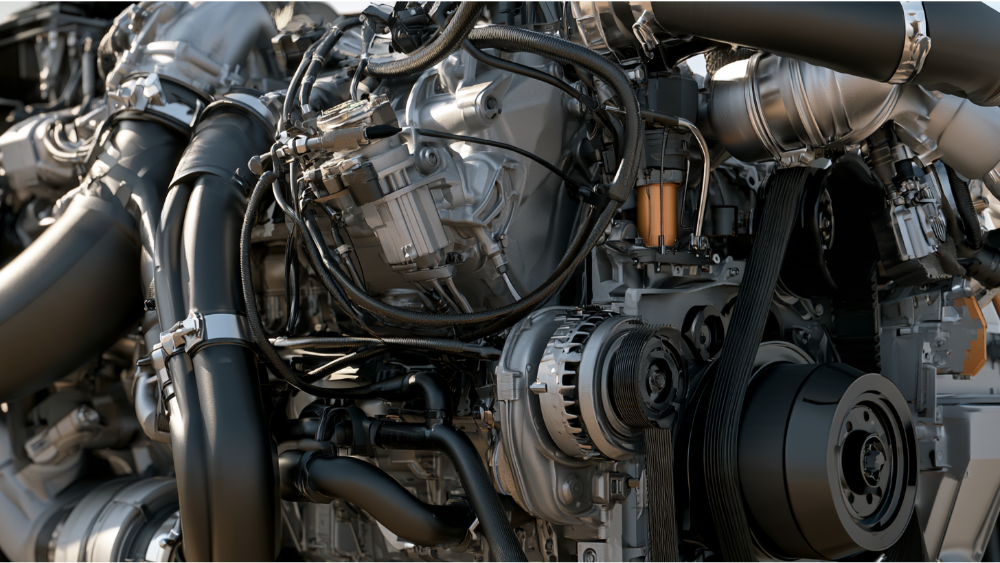
It helps to think of a modern truck engine as four layers. There is the core mechanical engine, whose key components are the block, cylinder head, pistons, rods, crank, cam, and valves. There is air and diesel fuel delivery. There are the support systems, meaning cooling, lubrication, electrical, and the electronic control module. And there is exhaust aftertreatment.
The cylinder head deserves a mention on its own, because it carries more load on a heavy-duty engine than most drivers realize. It seals the combustion chamber against cylinder pressures no gasoline engine ever sees, houses the valves and the injector bores, and routes coolant directly past the hottest metal in the engine. When a cylinder head gasket starts to fail, the first evidence is often coolant consumption with no visible external leak, or pressurization in the cooling system that pushes coolant out the overflow under load.
Aftertreatment is not technically “the engine.” But on modern diesel engines the ECM manages all of it as one system, which is why a plugged filter or a dosing fault downstream can show up on your dash as an engine power problem. Understanding that relationship is the difference between chasing symptoms and finding causes.
What Is Compression Ignition, and Why Don’t Diesel Engines Use Spark Plugs?
Compression ignition means the heat of compressed air is the ignition source. There is no electrical spark involved in normal running.
A gasoline engine prepares an air-fuel mixture, draws it into the cylinder, compresses it moderately, and fires a spark plug at a precise moment to light it. A diesel does something different. On the intake stroke it takes in air only. The piston then compresses that air hard, typically somewhere in the 15:1 to 23:1 range depending on the engine family, compared with roughly 8:1 to 12:1 for most gasoline engines. Squeezing air that far raises its temperature dramatically, commonly cited around 1,000°F near the end of the compression stroke.
Diesel fuel injected into air that hot ignites on contact. No spark required. There is no ignition timing to set, because nothing fires. That is the entire principle, and everything else in the engine exists to control it: how much air gets in, how clean and how dense it is, exactly when the diesel fuel arrives, at what pressure, in how many events, and what happens to the gases afterward.
Because ignition depends on the state of the compressed air rather than on a timed spark, power in a diesel is controlled almost entirely by fuel metering. Gas engines throttle air to control load. Diesel engines run essentially unthrottled and meter fuel instead. That difference explains a lot of diesel behavior, including why a diesel can lug down under heavy load without stalling and why fuel system faults hit power delivery so directly.
One practical consequence for anyone running a truck: because the ignition source is heat generated by compression, anything that bleeds off compression or cranking speed attacks starting directly. Worn rings, a valve that is not sealing, a tired battery bank, or cold ambient temperatures all work against you at the same moment.
What Is the Difference Between a Glow Plug and a Spark Plug?
A spark plug fires every combustion cycle. It is the ignition event in a gasoline engine, and it never stops working while the engine runs. Glow plugs are heating elements. They warm the combustion chamber or the incoming air so a cold engine can reach ignition temperature during startup, and once the engine is warm, they stop being part of the combustion process.
That is also why cold weather makes diesels harder to start. The block, the oil, and the intake air are all pulling heat out of the compressed charge before it can reach ignition temperature. Not every diesel uses glow plugs, either. Plenty of heavy-duty on-highway engines use an intake air heater or grid heater instead of individual glow plugs, which does the same job on a larger scale by warming the whole intake charge rather than each chamber.
The maintenance implication is straightforward. There are no spark plugs to replace on a diesel, no ignition coils, and no plug wires. What replaces that work is fuel filtration, aftertreatment service, and the diagnostic attention that high-pressure fuel injection demands.
The Four-Stroke Diesel Cycle: How a Diesel Engine Works, Stroke by Stroke
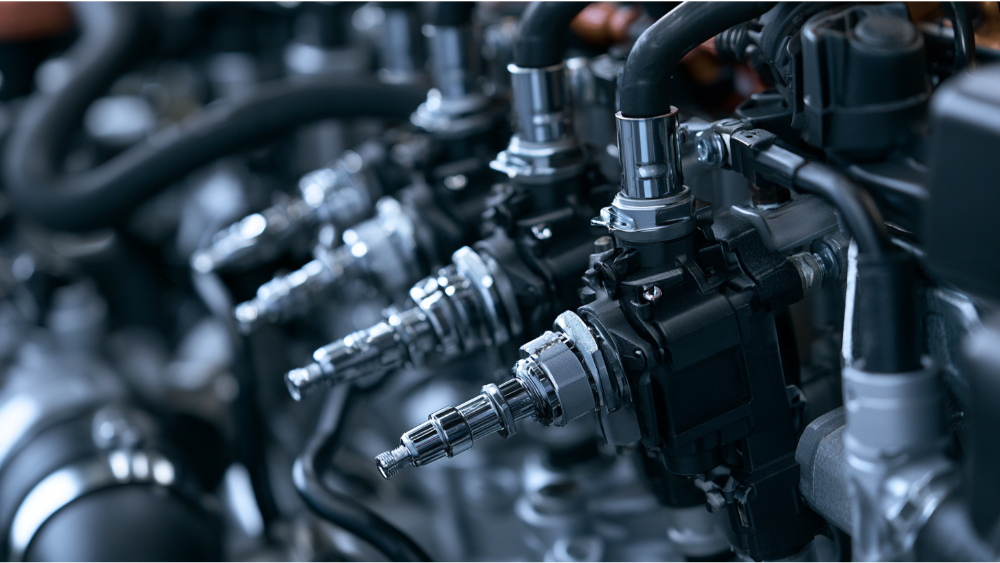
Nearly every on-highway diesel is a four stroke diesel engine. One complete cycle takes two full crankshaft revolutions, and each cylinder produces one power stroke during that cycle, according to the U.S. Department of Energy. The valves, the fuel injectors, and the piston all have to be in agreement on timing for any of it to work.
Two-stroke diesel engines do exist, mostly in marine service and legacy equipment, where a power stroke happens on every crank revolution. You will not find one under the hood of a modern Class 8 truck. When someone asks how a diesel engine works on a highway tractor, the answer is four-stroke operation with electronic direct injection.
Worth saying once: this is controlled combustion, not an explosion. Injection timing, pressure, spray pattern, and quantity are all shaped to produce a specific pressure rise. When that shaping goes wrong, you hear it and you feel it.
Intake Stroke: Air Only, No Fuel
The piston travels down the bore. The intake valve opens and the cylinder fills with filtered air. On virtually every modern heavy-duty truck, that air has already been compressed by the turbocharger and cooled by the charge-air cooler before it arrives.
This is the first real departure from a gasoline engine. Nothing combustible enters the cylinder on this stroke. Fuel has not entered the picture yet, which is why a diesel can compress air far harder than gas engines can without detonating anything prematurely.
Compression Stroke: Heating the Air Inside the Cylinder
Both valves close and the piston rises. The air has nowhere to go, so volume collapses and temperature climbs fast. By the top of this stroke, the compressed air inside the cylinder is hot enough to ignite fuel on its own.
This stroke is also where mechanical wear shows itself. If the rings are worn, a valve is not seating, or a cylinder head gasket is leaking, the cylinder cannot hold what it is trying to compress. The result is extended cranking, uneven cylinder contribution, and blow-by. Those are compression symptoms, and no amount of fuel system work fixes them.
Power Stroke: Fuel Is Injected and Combustion Drives the Piston
Near the top of compression, diesel fuel is injected directly into the combustion chamber as an atomized spray. It ignites in the hot compressed air, pressure rises, and the expanding gases force the piston down. The connecting rod converts that push into rotation at the crankshaft.
The ECM controls when injection starts, how long it lasts, and how much fuel goes in. Many modern engines split that into multiple events within a single combustion cycle, injecting fuel more than once to shape the pressure rise for noise, emissions, and fuel efficiency rather than dumping everything in at once.
Exhaust Stroke: Clearing the Cylinder
The exhaust valve opens and the rising piston pushes spent gases out into the exhaust manifold. Those gases are still hot and still moving with real energy, which is exactly what the turbocharger turbine is there to capture. Then the intake valve opens again and the whole thing repeats.
How Air Gets Into a Heavy-Duty Diesel Engine
More air in the cylinder means you can burn more fuel, and burning more fuel makes more power from the same displacement. That is the whole reason the intake side of a truck engine looks the way it does.
The path starts at the air cleaner, which has to pass enough volume while keeping abrasive dirt out of the turbo and the cylinders. From there air moves through intake piping and clamped boots to the turbocharger compressor. Exhaust energy spins the turbine on one side of the turbo, the shaft drives the compressor wheel on the other side, and that compressor pushes pressurized air toward the engine. Variable-geometry designs adjust turbine flow so the turbo responds usefully across a wider range of engine speed and load rather than only at the top of the tach.
Compressing air heats it, and hot air is less dense. So the charge-air cooler sits between the turbo and the engine to drop that temperature back down before the air reaches the intake manifold and the intake valves. Denser charge, more oxygen per cylinder, better combustion.
One correction worth making, because competing explanations get it wrong: not every diesel engine is turbocharged. Naturally aspirated diesel engines exist. But virtually every modern on-highway heavy-duty engine is turbocharged and charge-air cooled, and that is the configuration you are working with on a Class 6 through 8 truck.
There is a second air system on every heavy truck that gets confused with the first one. The engine drives an air compressor that supplies compressed air to the brake system, the suspension, and the accessories. That compressed air has nothing to do with combustion, but it does run off the engine, and a failing compressor or a leaking governor puts load and oil consumption where you do not want it. When a driver reports slow air build, the engine is part of that conversation.
The operational payoff is this. A cracked charge-air cooler, a loose boot, a collapsed hose, or a restricted air filter rarely announces itself as a hard failure. It shows up as low power under load, smoke, and fuel economy that quietly gets worse. Drivers often live with it for weeks, blaming the fuel or the truck’s age, when the actual problem is boost pressure leaking out before it ever reaches a cylinder.
How the Fuel System Delivers Diesel Fuel: Direct Injection to the Combustion Chamber
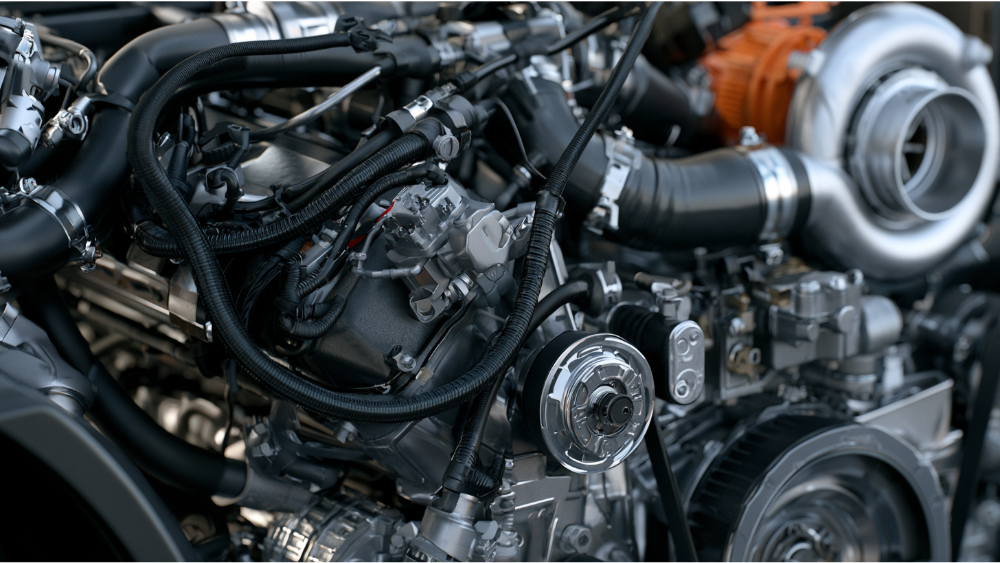
The fuel system has one job: put an exact quantity of clean, atomized diesel fuel into the cylinder at an exact moment. Everything in the path exists to protect that precision.
Fuel leaves the fuel tank and moves through a supply pump. It passes through a water separator and then primary and secondary filtration. From there it reaches the high-pressure fuel pump, sometimes called the injection pump, which raises it to injection pressure. On common-rail systems it enters the rail, a pressurized reservoir that feeds all injectors. The fuel injectors deliver diesel into the combustion chamber, and a return circuit carries unused fuel back to the tank.
A heavy truck engine is a direct injection engine, which means the injector sprays into the main combustion chamber above the piston rather than into a separate prechamber. Direct injection on a modern truck also means the ECM commands injection timing, duration, quantity, rail pressure, and the number of injection events per cycle, adjusting all of it continuously based on load, speed, temperature, and emissions strategy. That is not a mechanical system with a fixed schedule. It is a closed loop making decisions every combustion event.
The pressures involved are worth understanding. Published specifications on specific heavy-duty platforms list injection pressures in the range of 32,000 to 35,000 psi, or roughly 2,400 bar. Those are model-specific published figures, not a universal number. Actual pressure depends on engine family, model year, and operating condition.
At those pressures, small problems become combustion problems immediately. Water contamination, a restricted filter, a worn high-pressure pump, injector return flow outside spec, or a wiring fault at an injector connector all change what happens in the cylinder. That is why filtration intervals on modern fuel systems are not suggestions, and why fuel pressure and return flow get tested rather than assumed.
Injector condition also shapes the combustion process in ways a code will not describe. A worn nozzle that drips instead of atomizing produces fuel that burns late and incompletely, which shows up as soot loading in the DPF, a light knock, and fuel efficiency that falls off a few tenths at a time. Cylinder cutout testing and injector return flow measurement separate a mechanical injector problem from an electrical one before anyone starts pulling a valve cover.
Fuel quality is not optional either. Federal highway diesel fuel is ultra-low sulfur diesel, capped at 15 parts per million sulfur, phased in between 2006 and 2010 per EPA. The catalysts and filters downstream are designed around that fuel. Running anything else on a modern highway truck damages the aftertreatment.
For deeper coverage, see our Fuel System Repair And Diagnostics service page.
How Combustion Becomes Torque at the Wheels
Diesel fuel carries chemical energy. Combustion converts it to heat and pressure. Pressure acts on the piston crown and pushes it down the bore. The connecting rod turns that linear push into rotation at the crankshaft. The flywheel smooths out the individual pulses into steady rotation, and the transmission and driveline carry it to the wheels.
Diesel engines produce strong torque low in the RPM band, which is exactly what a loaded truck needs. That characteristic comes from the whole package working together: high cylinder pressure, stroke geometry, boost from the turbo, and precise control over how and when fuel enters the chamber. It is not created by compression ratio alone, and more compression does not automatically mean more power. Anyone telling you otherwise is oversimplifying a design problem that engine manufacturers spend decades on.
Fuel energy density helps too. EIA’s current estimate puts distillate fuel at 15 ppm sulfur or less at about 137,381 Btu per gallon, compared with roughly 120,166 Btu per gallon for finished motor gasoline. More energy per gallon, combined with higher thermal efficiency, is a large part of why freight runs on diesel and not on something else.
What the Cooling and Lubrication Systems Actually Do
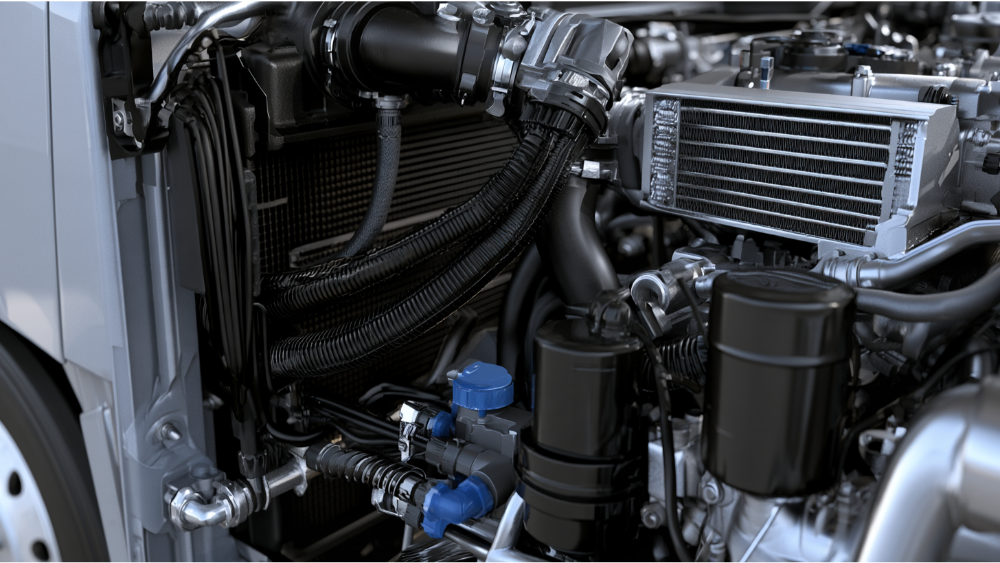
Combustion happens thousands of times per minute in every cylinder. Without temperature control and an oil film on every loaded surface, the components doing that work would not survive a shift.
The cooling system moves heat out. Water pump, radiator, thermostat, fan, coolant passages through the block and cylinder head, and on modern trucks an EGR cooler as well. The ECM watches coolant temperature and reacts. When temperature climbs past thresholds, the engine derates to protect itself. That derate is not the failure. It is the protection strategy doing its job while something upstream, often a restricted radiator, a failed fan clutch, air in the system, or a weak water pump, goes unaddressed. Most diesels in this class are liquid cooled, though that is a design choice rather than a universal rule.
The lubrication system does more than reduce friction. Oil pump, pickup, filter, and galleries deliver oil to bearings, rings, cam lobes, and the turbo shaft. That film controls wear, carries heat away from loaded surfaces, and suspends contaminants until the filter catches them.
Both systems fail quietly and take expensive parts with them. That is the entire reason PM intervals exist. See Cooling System Repair And Service and Preventive Maintenance PM Service.
The Electrical System: Starter Motor, Batteries, and Sensors
A diesel has to crank fast enough to build ignition temperature. That is the starter motor and battery bank’s job, and it is the reason a weak battery bank in cold weather presents as a no-start that feels exactly like a fuel problem. The engine is turning. It just is not turning fast enough to heat the air.
Past starting, the electrical system covers the alternator, grounds, harnesses, connectors, sensors, and actuators. On a modern truck, most of what the engine does mechanically is commanded electrically. The injector fires because a driver circuit told it to. The turbo vanes move because an actuator was commanded. The EGR valve opens on a signal.
Which means corrosion at a connector, a chafed harness, or a poor ground produces symptoms that look mechanical. Low power, rough running, intermittent no-starts. Testing voltage drop and continuity is often faster than pulling parts. See Electrical Diagnostics And Repair.
How the ECM Controls and Monitors the Engine

The engine control module runs a continuous loop. Sensors report pressure, temperature, position, speed, and flow. The ECM compares those readings against expected values for the current operating condition. Then it commands fueling, injection timing, boost, EGR flow, DEF dosing, and fan operation to hit its targets.
When a reading falls outside plausibility, the ECM stores a fault and, depending on the fault, may limit power to protect hardware. EPA’s heavy-duty onboard diagnostic requirements applied to model year 2010 and later engines in vehicles over 14,000 pounds, phased in until all applicable highway engine families were covered by model year 2013. OBD monitors emissions systems, sensors, and actuators and stores diagnostic information when it detects a malfunction.
Here is the part most articles skip, and it matters more than anything else in this section. A diagnostic trouble code tells you what the computer detected. It does not tell you which part failed.
A code naming a sensor is just as likely to be caused by wiring, a bad ground, a corroded connector, a mechanical restriction, or an upstream system as by the sensor itself. A boost pressure fault can come from a leaking charge-air cooler, not a pressure sensor. A DPF differential pressure code can come from a plugged tube, not a plugged filter.
Replacing the component named in the code without testing is how a truck ends up in the shop twice for the same complaint. The code tells you where to start looking. It does not end the conversation.
What Happens to the Exhaust: EGR, DOC, DPF, DEF, and SCR
Exhaust leaves the cylinder with real energy left in it, and modern trucks use that energy before treating the gas. Everything downstream of the manifold is the exhaust system, and on a current truck it is doing chemistry, not just plumbing.
Turbocharger turbine. Exhaust gas spins the turbine wheel, which drives the compressor on the intake side. The exhaust side of the engine is what makes the intake side work.
EGR. Exhaust gas recirculation returns a measured portion of exhaust to the intake. Diluting the intake charge lowers peak combustion temperature, and lower combustion temperature means less NOx formed inside the cylinder in the first place.
DOC. The diesel oxidation catalyst treats exhaust constituents ahead of the filter and, during certain regeneration strategies, contributes to raising exhaust temperature.
DPF. The diesel particulate filter physically traps soot. As soot accumulates, flow restriction increases, and the ECM tracks that loading.
Regeneration. Regeneration raises filter temperature so trapped soot combusts. Passive regeneration happens when normal exhaust temperature is already high enough, which is why a loaded highway run cleans itself. Active regeneration adds heat through an engine or aftertreatment strategy when exhaust temperature is too low on its own.
DEF and SCR. Diesel exhaust fluid, an aqueous urea solution, is dosed into the exhaust stream ahead of the selective catalytic reduction catalyst. The SCR process uses that fluid to convert NOx into nitrogen and water. EPA states that nearly all on-road diesel trucks have used DEF as part of SCR systems since 2010.
Two things competing explanations routinely get wrong. First, there is no universal regeneration interval. EPA notes that frequency depends on duty cycle, particulate production, and filter technology. Stop-and-go short-haul work regenerates far more often than sustained highway pulls, and that is expected behavior, not a fault. Second, regeneration burns soot but does not remove ash. Noncombustible ash accumulates in the filter over time and eventually requires cleaning according to the engine manufacturer’s procedure. Regeneration and ash service are two different things.
One more point that applies to every carrier in the country: the federal Clean Air Act prohibits removing, bypassing, or defeating emissions controls, and that includes software deletes and tuning that disables EGR, DPF, SCR, or OBD monitoring. This is national law, not a state rule.
See Exhaust And DPF Repair for how we handle aftertreatment work.
Diesel vs. Gasoline Engines: Why Freight and Heavy Diesel Vehicles Run on Diesel
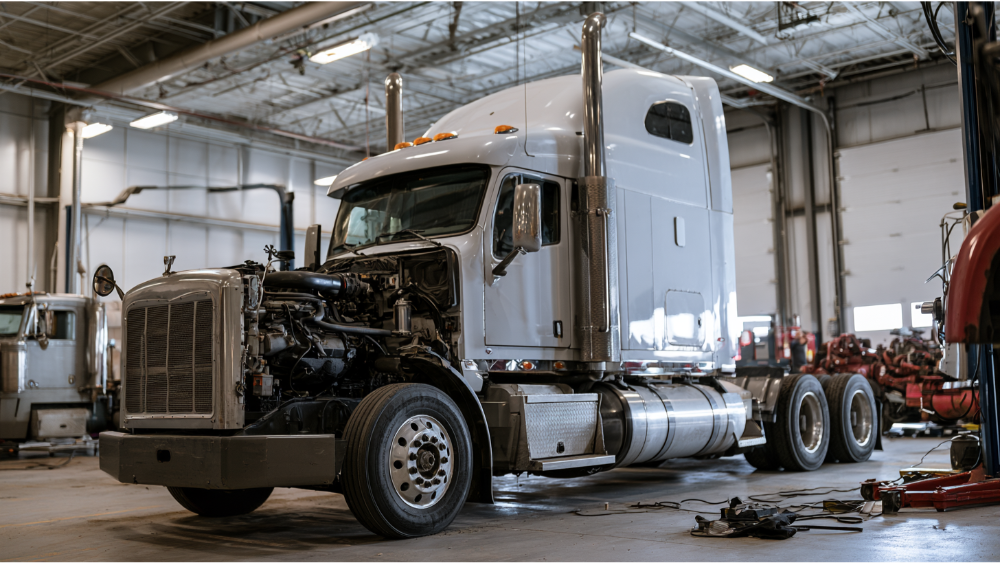
The comparison is not about which engine is better. It is about which one fits the work. Diesel wins where load is heavy, duty cycles are long, and hours accumulate fast. Higher fuel efficiency under load is part of the answer. Durability is the rest.
| Characteristic | Diesel | Gasoline |
|---|---|---|
| Ignition method | Compression ignition | Spark ignition |
| What enters on intake | Air only | Generally a prepared air-fuel charge |
| Typical compression ratio | Roughly 15:1 to 23:1 | Typically 8:1 to 12:1 |
| Primary power control | Fuel delivery | Air throttling plus fuel |
| Torque character | Strong torque low in the RPM band | Power delivered higher in the range |
| Construction | Built for higher cylinder pressure | Generally lighter |
| Typical application | Class 6 through 8 freight, equipment, marine | Passenger cars and light duty |
| Maintenance items | No spark plugs; adds aftertreatment service | Spark plugs and ignition components |
Call it a gas engine or a petrol engine depending on where you learned the trade. The operating difference is the same either way: spark ignition on one side, compression ignition on the other.
On efficiency, diesel thermal efficiency is commonly cited in the 40 to 45 percent range against roughly 30 to 35 percent for gasoline, with very large marine engines reported near 55 percent. Treat those as typical ranges, not guarantees. Actual fuel efficiency depends on engine design, load, and operating condition.
Combine that efficiency with higher energy per gallon and you get the practical result every fleet already knows: more work done per gallon under load. Diesel engines also hold up well across varied load conditions and can run approved biodiesel blends. The tradeoff is the aftertreatment system, which adds maintenance items that gasoline engines do not have.
Durability is the other half of the answer. Diesel engines in this class are built with heavier rotating assemblies, thicker castings, and replaceable cylinder liners on many platforms, because they are expected to accumulate hundreds of thousands of miles at high load. That construction is why diesel vehicles dominate freight and why the overhaul path on a Class 8 engine looks nothing like the disposal path on a gasoline powered light-duty engine.
Where Diesel Technology Came From: Rudolf Diesel’s Compression-Ignition Engine
Rudolf Diesel built the first diesel engine prototype in 1893, based on the idea that compressing air far enough would make an external ignition source unnecessary and extract more useful work from the same fuel. The combustion principle in a 2026 Class 8 engine is the same one he demonstrated. What changed is everything wrapped around it: electronic injection control measuring fuel in fractions of a millisecond, turbocharging and charge-air cooling, and a full aftertreatment system managing what leaves the tailpipe.
That distinction matters when you are troubleshooting. The mechanical half of modern diesel technology is old, well understood, and measurable with pressure and flow. The control half is newer, faster, and only visible through data. Good diagnosis uses both.
What Drivers Notice When One Stage of the Process Fails

The engine is one chain. Drivers almost never see the failed part. They see a symptom three links downstream, which is why the complaint and the cause are frequently in different systems.
Use this table as a starting map, not a diagnosis. Every entry is a possible result, and none of them confirms a cause on its own.
| System area | Possible driver-visible result |
|---|---|
| Air and boost | Low power under load, smoke, unusual turbo noise, declining fuel economy |
| Fuel supply and injection | Hard start, rough idle, low rail pressure, misfire, poor fuel economy |
| Compression and mechanical | Blow-by, extended cranking, uneven cylinder contribution |
| Cooling | High coolant temperature, fan running constantly, protection derate |
| Lubrication | Low oil pressure warning, noise, rapid component damage |
| Electrical, sensors, and wiring | Intermittent codes, implausible readings, no-start conditions |
| DPF, DEF, and SCR | Warning lamps, frequent regeneration, inducement derate |
Notice the overlap. Low power appears under air, fuel, compression, and aftertreatment. A derate appears under cooling, electrical, and emissions. That overlap is exactly why the symptom cannot pick the repair for you.
Related reading: What Causes Low Power in a Diesel Truck? and What Causes a Diesel Engine to Derate?
How Professional Diesel Engine Diagnosis Works
A verified diagnosis follows a sequence. Skipping steps is how shops guess, and guessing costs the driver time.
- Verify the complaint under the conditions the driver reported it. Loaded, cold, at highway speed, at idle. A fault that only appears under load will not show itself in the bay at idle.
- Pull active, inactive, and pending codes using OEM diagnostic software for that engine platform.
- Review operating and freeze-frame data to see what the engine was doing when the fault set.
- Inspect the related mechanical and electrical systems before condemning anything. Boots, clamps, connectors, grounds, filters, fuel lines.
- Test what can be measured: pressure, flow, temperature, voltage, resistance, actuator response, cylinder contribution.
- Confirm root cause against the test data, not against the code description.
- Deliver an itemized estimate before any work starts.
- Repair and verify under operating conditions, not just at idle with no codes present.
At Torpedo Truck Repair, that workflow is structured on purpose. Certified technicians, OEM diagnostic software, and a defined sequence so steps do not get skipped when the bay is busy. You get a full itemized estimate before a single bolt is turned. No surprises, no upsell.
The parts cannon is the most expensive tool in any shop, and the driver is the one who pays for it, in parts that did not need replacing and in downtime that did not need to happen. Testing is cheaper than guessing every time.
Frequently Asked Questions
How does a diesel engine work step by step?
Air is filtered, compressed by the turbo, cooled by the charge-air cooler, and drawn into the cylinder. The piston compresses that air until it is hot enough to ignite fuel. The injector sprays metered diesel into the chamber, the fuel ignites, and expanding gases push the piston down and turn the crankshaft. The exhaust valve opens, spent gas drives the turbo turbine and passes through the aftertreatment system, and the cycle repeats. One complete four-stroke cycle takes two crankshaft revolutions.
Do diesel engines have spark plugs?
No. Diesel engines ignite fuel with the heat of compressed air, so there are no spark plugs, coils, or plug wires anywhere in the system. Some diesel engines use glow plugs or an intake grid heater to assist cold starting, but those are startup aids and not part of normal running.
Are diesel engines more fuel efficient than gas engines?
Under load, yes. Diesel fuel carries more energy per gallon than gasoline, and diesel thermal efficiency is generally higher. That combination is why heavy freight runs on diesel technology. Actual fuel efficiency on your truck still depends on duty cycle, boost integrity, injector condition, tire condition, and how current your PM service is.
What is the most common problem in a diesel engine?
There is no single most common failure, but on modern heavy-duty trucks the highest-frequency complaints cluster around fuel delivery and injection, air and boost leaks, and emissions systems including DPF loading, DEF quality and dosing, and EGR. Most of those trace back to maintenance intervals, fuel and coolant cleanliness, and duty cycle. The symptom rarely names the cause.
How long will a diesel engine run on gasoline?
Not long, and it should not be run at all. Gasoline does not lubricate the high-pressure pump and fuel injectors the way diesel does, and it will not ignite reliably under compression. Do not crank the engine. Have the truck towed and the fuel system drained and flushed. The tow costs less than the fuel system and engine damage that follows.
Does a diesel trouble code tell you exactly which part failed?
No. A code reports a condition the ECM detected outside expected parameters. Wiring, grounds, connectors, mechanical restrictions, and upstream systems can all set a code that names a downstream component. Testing confirms the cause. The code only points at where to start.
Get a Straight Diagnosis and an Itemized Estimate
Every stage of a diesel engine depends on the one before it. That is why guessing at a repair costs more downtime than testing does, and why the code on the dash is the beginning of the engine work, not the end of it.
Torpedo Truck Repair handles Diesel Engine Repair And Maintenance, Fuel System Repair And Diagnostics, Electrical Diagnostics And Repair, and Exhaust And DPF Repair on Class 6 through 8 platforms, including Freightliner, Kenworth, Peterbilt, Volvo, Mack, International, and Western Star. Certified technicians. OEM diagnostic software. An itemized estimate before engine work begins, and a same-day service focus when possible. Licensed and insured, DOT certified, 4.9 stars across 146 Google Reviews.
Call (253) 449-0100. Shop hours are Mon through Fri, 8:00 AM to 5:30 PM, with 24/7 emergency dispatch available when you are down outside those hours. Not an emergency? Request a Service Quote. Takes under 60 seconds. No obligation.